Ad Banner Placeholder
Cambridge IGCSE Chemistry · 0620
Chapter 8: The Periodic Table — Part 2
Topic 8.3–8.4 · Halogens and transition elements
Group VII: The Halogens
- Halogens (chlorine, bromine, and iodine) are diatomic non-metals, meaning they exist as molecules consisting of two atoms (Cl2, Br2, I2).
- Appearance at r.t.p.:
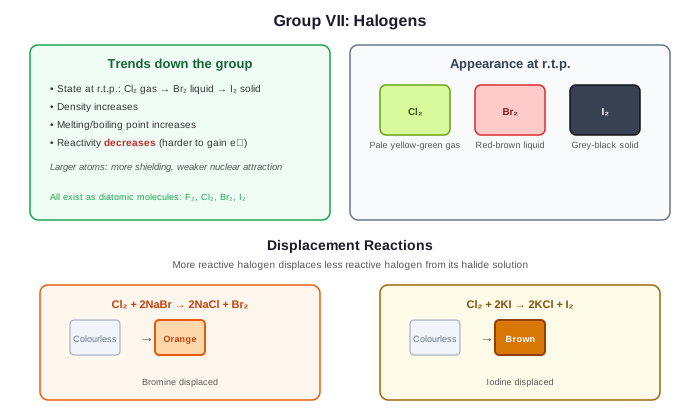
- Chlorine (Cl2): A pale yellow-green gas.
- Bromine (Br2): A red-brown liquid.
- Iodine (I2): A grey-black solid.
- Trends down the group:
- Increasing density.
- Increasing melting and boiling points: As molecules get larger, there are stronger intermolecular forces to overcome.
- Decreasing reactivity: Atomic radius and electron shielding increase down the group, decreasing the attraction between the nucleus and outer electrons, making it harder for the atom to gain an electron.
Exam Traps
- Astatine is a solid at r.t.p. and less reactive than iodine — apply the trend; do not assume it is a gas.
Displacement Reactions of Halogens
- A more reactive halogen will displace a less reactive halogen from its ionic compound in aqueous solution.
- Observations:
- Chlorine will displace bromine from sodium bromide: Cl2 + 2NaBr ? 2NaCl + Br2. The solution changes from colourless to orange.
- Chlorine will displace iodine from potassium iodide: Cl2 + 2KI ? 2KCl + I2. The solution changes from colourless to brown.
- These observations allow for the prediction of properties and reactivities of other Group VII elements like fluorine or astatine.
Exam Traps
- Orange (bromine) and brown (iodine) are distinct observations — do not swap them in displacement questions.
Transition Elements
- Located in the middle of the Periodic Table between Groups II and III.
- General Properties: Transition elements are metals with high densities, high melting points, and the ability to form coloured compounds. They often act as catalysts both as elements and in compounds.
- Variable Oxidation Numbers: Transition elements form ions with variable oxidation numbers.
- Example: Iron can form Iron(II) (Fe2+) and Iron(III) (Fe3+) ions. The specific state is indicated by a Roman numeral in the compound name (e.g., Iron(II) sulfate).
0/15
Ad Banner Placeholder