Cambridge IGCSE Chemistry · 0620 · Paper 6
Paper 6 Skills: Alternative to Practical
AO3 · Experimental skills and investigations
What Paper 6 tests
Paper 6 (Alternative to Practical) is written. You plan and analyse investigations without working in the lab:
- Identify independent, dependent, and control variables.
- Choose and justify apparatus.
- Complete results tables and draw graphs.
- Read volumes at the meniscus; calculate Rf.
- Suggest errors and improvements; write a numbered method.
Rates theory: Chapter 6. Apparatus detail: Chapter 12.
Variables & fair tests
- Independent variable (IV)
- The factor you deliberately change. Only one IV in a fair test.
- Dependent variable (DV)
- The factor you measure.
- Control variables
- All other factors kept constant.
| Type | Question | Example (Mg + HCl) |
|---|---|---|
| Independent | What am I changing? | Concentration of HCl / mol dm−3 |
| Dependent | What am I measuring? | Volume of H2 in 2 min / cm3 (or time for a fixed volume) |
| Control | What stays the same? | Mass/length of Mg, volume of acid, temperature, same syringe |
State IV and DV with units in the plan and results table. Name controls with quantities — not “keep everything the same”.
Range, repeats & control experiments
- Range
- At least five values of the IV across a clear trend.
- Repeats
- At least three trials; calculate a mean. Discard clear anomalies with a reason.
- Concordant results
- In titration, titres that agree closely are used for the mean — see Chapter 12 Part 2.
- Control experiment
- Same set-up without the key factor (e.g. Mg in water instead of acid; H2O2 without MnO2).
Common controls in rate work: temperature, mass/length of metal, surface area, volume of liquid reactant, catalyst mass.
Apparatus & reading the meniscus
- Measuring cylinder — approximate volumes; quick but less accurate.
- Volumetric pipette — one fixed volume accurately (e.g. 25.0 cm3).
- Burette — variable volumes to 0.05 cm3; titrations.
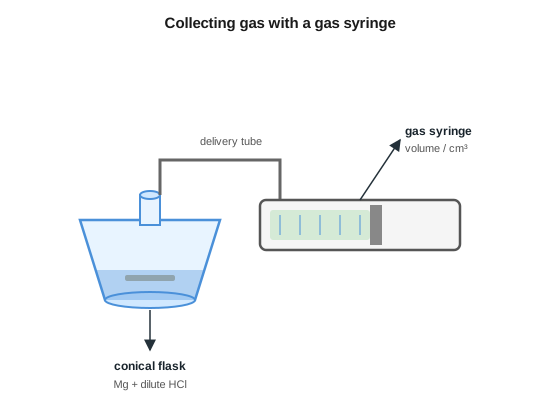
- Gas syringe — measures gas volume in cm3 (better than counting bubbles).
- Balance / stopwatch / thermometer — mass, time, temperature; avoid parallax.
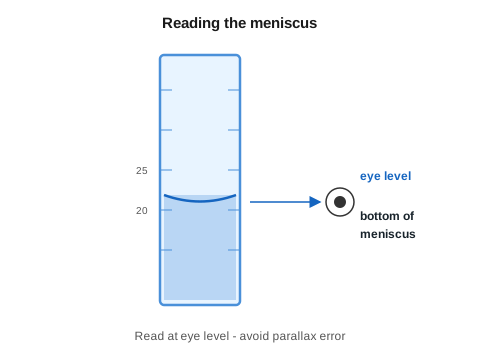
Read aqueous volumes at the bottom of the meniscus, with the eye level with the liquid surface.
Exam Traps
- Counting bubbles instead of using a gas syringe when the question asks for an accurate volume.
Results tables
Headings need quantity and unit. Put the IV first; include repeats and a mean column when you have them.
| Time / s | Volume of gas 1 / cm3 | Volume of gas 2 / cm3 | Volume of gas 3 / cm3 | Mean volume / cm3 |
|---|---|---|---|---|
| 0 | 0 | 0 | 0 | 0 |
| 30 | 18 | 17 | 19 | 18 |
| 60 | 32 | 31 | 33 | 32 |
| 90 | 40 | 39 | 41 | 40 |
| 120 | 44 | 45 | 44 | 44 |
Graphs & rate
- IV on the x-axis, DV on the y-axis; both labelled with units.
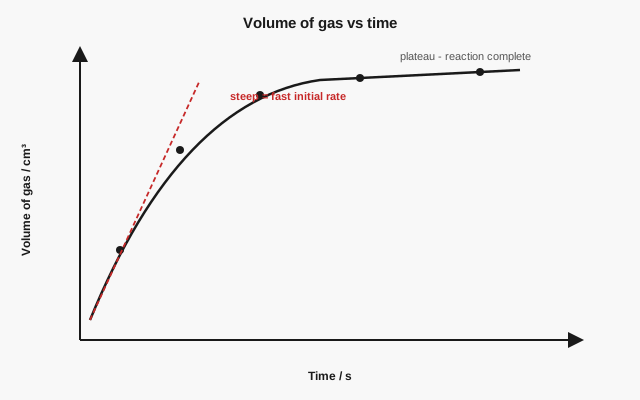
- Plot points carefully; draw a smooth best-fit curve for volume–time data.
- The steeper the initial slope, the faster the rate. A plateau means the reaction has finished (limiting reactant used up).
To compare rates at two temperatures, either compare volumes at the same time, or compare times to collect the same volume. Initial rate can be estimated from a tangent at t = 0: rate ≈ Δvolume / Δtime. Units are typically cm3/s.
Chromatography and Rf
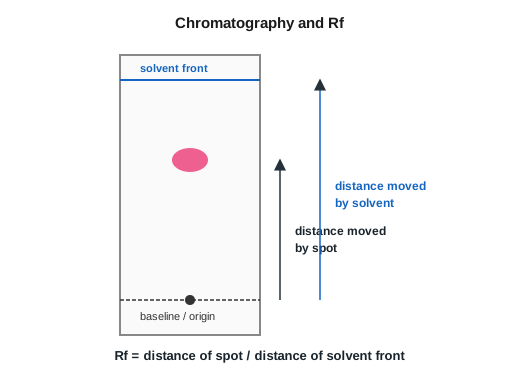
On Paper 6 you may measure distances on a chromatogram and calculate:
Rf = distance moved by the spot ÷ distance moved by the solvent front
Both distances are measured from the baseline (origin). Rf has no units and is always less than 1. Full chromatography notes: Chapter 12 Part 3.
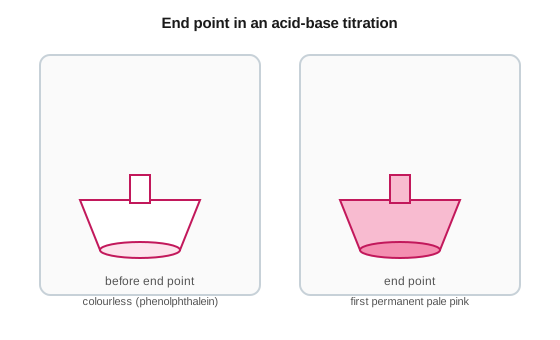
Titration results and concordant titres
Paper 6 often gives a table of titres. Ignore a rough trial. Use only concordant titres (typically within 0.10 cm3 or 0.20 cm3 of each other) for the mean. Full method: Chapter 12 Part 2.
| Rough | 1 | 2 | 3 | |
|---|---|---|---|---|
| Final burette reading / cm3 | 26.50 | 24.30 | 48.45 | 24.20 |
| Initial burette reading / cm3 | 0.00 | 0.00 | 24.30 | 0.00 |
| Titre / cm3 | 26.50 | 24.30 | 24.15 | 24.20 |
Concordant titres: 24.30, 24.15 and 24.20 cm3. Mean = (24.30 + 24.15 + 24.20) ÷ 3 = 24.22 cm3 (2 d.p., matching burette precision). Do not include the rough 26.50 cm3.
Collecting gases and observations
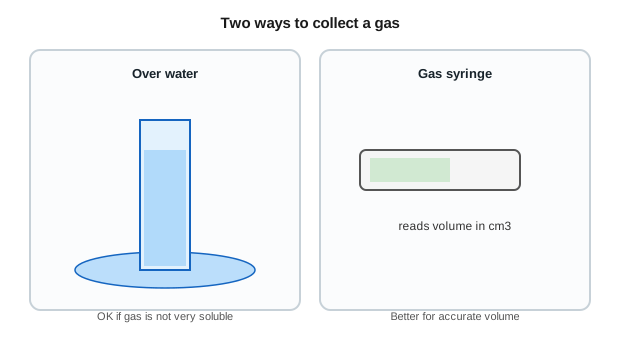
Choose a collection method that matches the gas:
- Gas syringe — best when you need an accurate volume.
- Over water — simple, but poor for gases that dissolve (e.g. ammonia, hydrogen chloride).
Paper 6 observations must name what you see. Link to identification notes rather than rewriting the full ion tests: Chapter 12 Part 5.
| Test | Positive observation |
|---|---|
| Hydrogen + lighted splint | Squeaky pop |
| Oxygen + glowing splint | Splint relights |
| Carbon dioxide + limewater | Limewater turns cloudy / milky |
| Ammonia + damp red litmus | Litmus turns blue |
| Chlorine + damp litmus | Litmus bleaches white |
Errors, improvements & writing a method
- Gas escaping before the syringe is attached → start timing only when the apparatus is sealed / use a bung with delivery tube.
- Temperature drift → thermostatic water bath.
- Inconsistent surface area of metal → same length and width of ribbon each time.
- Parallax on the burette → eye level with the meniscus.
Structure a plan: aim → variables → apparatus (with sizes) → numbered method → safety → results table. Use imperative verbs. Hazards: dilute acids (corrosive, goggles); hydrogen (flammable, no naked flames); heat (tongs, care with hot apparatus).
- Random error
- Readings scatter around the true value (e.g. reaction time, slightly different ribbon lengths). Reduce with repeats and a mean.
- Systematic error
- All readings shifted the same way (e.g. gas leak, zero error on a balance, reading the top of the meniscus). Repeats will not fix it — change the method or apparatus.
| Apparatus | When to choose it |
|---|---|
| Measuring cylinder | Approximate volumes; not for titres |
| Pipette (e.g. 25.0 cm3) | One accurate fixed volume of solution |
| Burette | Variable accurate volume to 0.05 cm3 |
| Balance (2 d.p. or better) | Mass of solid; tare before use |
Full worked example — temperature and rate
Plan an investigation to find how temperature affects the rate of reaction between magnesium ribbon and dilute hydrochloric acid.
- Independent variable
- Temperature of the acid (20°C, 30°C, 40°C, 50°C, 60°C).
- Dependent variable
- Time to collect 20 cm3 of hydrogen / s (or volume in a fixed time).
- Control variables
- Length/mass of Mg (e.g. 5 cm); volume and concentration of HCl (e.g. 25 cm3 of 2.0 mol/dm3); same flask and gas syringe.
- Outline method
-
- Warm 25 cm3 of 2.0 mol/dm3 HCl to 20°C in a water bath.
- Add a 5 cm strip of magnesium and attach a gas syringe immediately.
- Start a stopwatch; record the time to collect 20 cm3 of gas.
- Repeat at 30°C, 40°C, 50°C, and 60°C with fresh acid and Mg each time.
- Repeat the whole experiment three times at each temperature; calculate mean times.
- Safety
- Acid is corrosive — wear goggles. Hydrogen is flammable — no flames. Hot water bath — handle with care.
Second worked example — identifying a dye by Rf
A student runs paper chromatography on an unknown food dye and three known dyes, A, B and C. The solvent front travels 8.0 cm. The unknown spot travels 4.8 cm. Dye B travels 4.8 cm; A travels 2.0 cm; C travels 6.4 cm.
- Rf (unknown) = 4.8 ÷ 8.0 = 0.60
- Rf (A) = 2.0 ÷ 8.0 = 0.25; (B) = 0.60; (C) = 0.80
- The unknown matches dye B (same Rf in the same solvent).
If two spots appear from the unknown, it is a mixture. Always measure from the baseline to the centre of each spot, and keep the solvent below the baseline when you start.
0/8