Cambridge IGCSE Mathematics — 0580 Extended
Topic 1.1: Number — Types of Number
Number types
| Type | Definition / examples |
|---|---|
| Natural numbers | Counting numbers: \(1, 2, 3, \ldots\) (sometimes \(0\) is included — follow the question) |
| Integers | Whole numbers and their negatives: \(\ldots, -2, -1, 0, 1, 2, \ldots\) |
| Prime | Exactly two factors: \(1\) and itself. \(2\) is the only even prime. \(1\) is not prime. |
| Square | \(n^2\): \(1, 4, 9, 16, 25, \ldots\) |
| Cube | \(n^3\): \(1, 8, 27, 64, 125, \ldots\) |
| Factor | Divides exactly. Factors of \(12\): \(1, 2, 3, 4, 6, 12\) |
| Multiple | \(kn\) for integer \(k\). Multiples of \(6\): \(6, 12, 18, \ldots\) |
Quick checks
Is the number \(1\)?
Not prime — it has only one factor.
Is it a perfect square?
Take its square root; if the result is an integer, it is a square number.
HCF and LCM by prime factors
Method
- Write each number as a product of prime powers (factor tree or division ladder).
- HCF — multiply the lowest power of each prime that appears in both numbers.
- LCM — multiply the highest power of every prime that appears in either number.
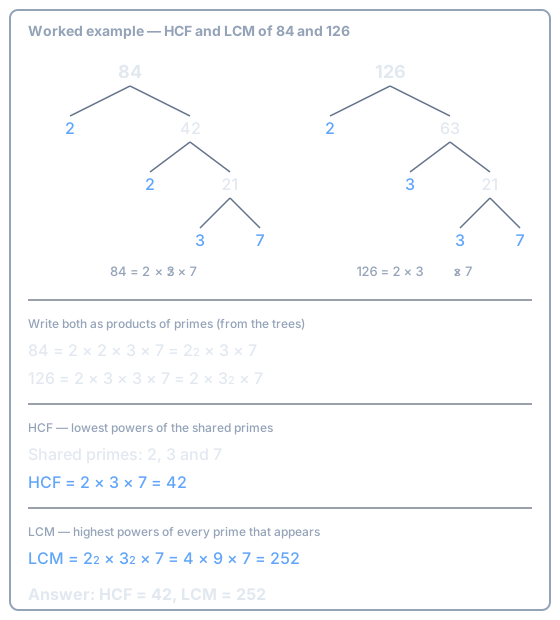
Find the HCF and LCM of \(84\) and \(126\).
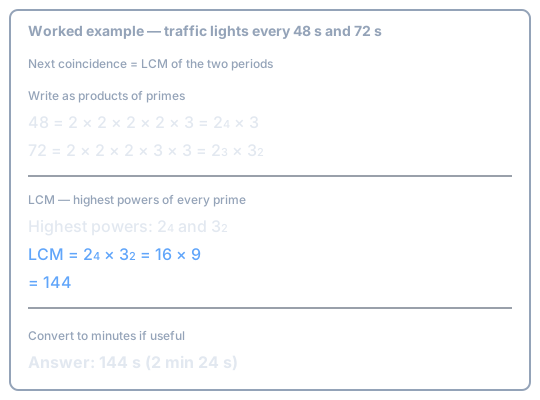
Two traffic lights turn green every \(48\) s and \(72\) s. After they flash together, how long until they next coincide?
Paper 2 (non-calculator)
Check HCF \(\times\) LCM \(=\) product of the two original numbers for a pair of integers — a fast verification on Paper 2.
Try this
Find the HCF and LCM of \(60\) and \(90\).
Show answer
-
Write as products of primes, then in index form
\[ 60 = 2 \times 2 \times 3 \times 5 = 2^{2} \times 3 \times 5 \]\[ 90 = 2 \times 3 \times 3 \times 5 = 2 \times 3^{2} \times 5 \] -
HCF — lowest powers of the shared primes
\[ \text{HCF} = 2^{1} \times 3^{1} \times 5^{1} = 2 \times 3 \times 5 = 30 \] -
LCM — highest powers of every prime
\[ \text{LCM} = 2^{2} \times 3^{2} \times 5 = 4 \times 9 \times 5 = 180 \] -
Final answer
\[ \text{HCF} = 30,\quad \text{LCM} = 180 \]
Rational, irrational, and reciprocals
Rational numbers can be written as \(\dfrac{a}{b}\) where \(a, b\) are integers and \(b \neq 0\) (includes terminating and recurring decimals). Irrational numbers cannot — e.g. \(\pi\), \(\sqrt{2}\), \(\sqrt{3}\).
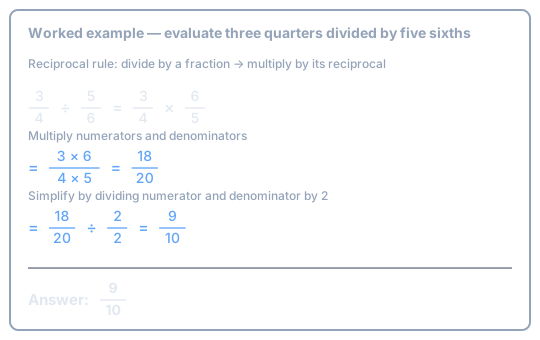
The reciprocal of a non-zero number \(a\) is \(\dfrac{1}{a}\). Dividing by \(a\) is the same as multiplying by its reciprocal.
Evaluate \(\dfrac{3}{4} \div \dfrac{5}{6}\).
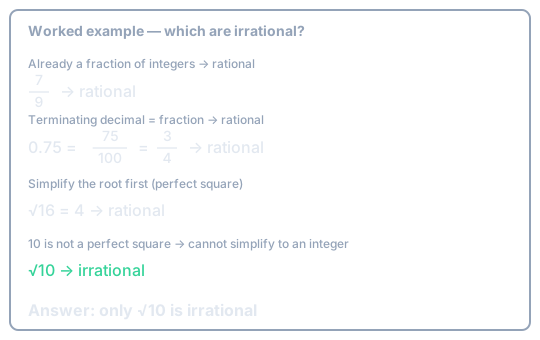
Which of these are irrational: \(\dfrac{7}{9}\), \(0.75\), \(\sqrt{16}\), \(\sqrt{10}\)?
Exam Traps
- Do not treat \(\sqrt{4}\) or \(\sqrt{9}\) as irrational — simplify the root first.
- HCF uses lowest powers; LCM uses highest powers — swapping these is a common error.
0/10