Cambridge IGCSE Mathematics — 0580 Extended
Topic 1.10: Number — Ratio & Proportion
Simplifying and dividing in ratio
A ratio compares parts of the same kind. Write it in its simplest form by dividing all parts by their HCF.
Example: \(12 : 18 = 2 : 3\).
Method — divide \(Q\) in ratio \(a : b\)
- Add the parts: total parts = \(a + b\).
- One part = \(Q \div (a + b)\).
- Multiply: first share = one part \(\times a\); second share = one part \(\times b\).
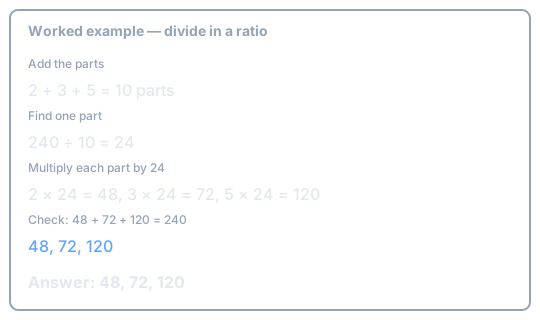
Divide \(240\) in the ratio \(2 : 3 : 5\).
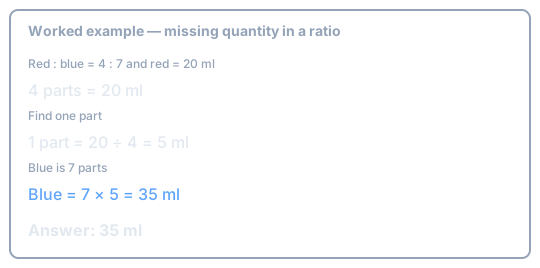
The ratio of red to blue paint is \(4 : 7\). How much blue paint is needed with \(20\) ml of red?
Proportional reasoning
If two quantities are directly proportional, they increase and decrease together. Multiply or divide both by the same factor.
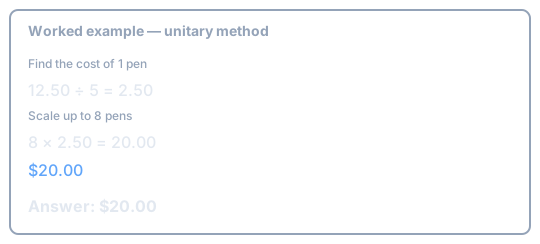
Five identical pens cost \($12.50\). Find the cost of eight pens.
Ratio or proportion?
Sharing a fixed total into parts
Divide in ratio — find one part first.
One quantity changes and the other scales with it
Use proportion — find the unit value, then scale up or down.
Map or scale drawing
Write scale as a ratio; convert using consistent units.
Map scales and best value
A map scale \(1 : 50\,000\) means \(1\) cm on the map represents \(50\,000\) cm (\(= 0.5\) km) in real life.
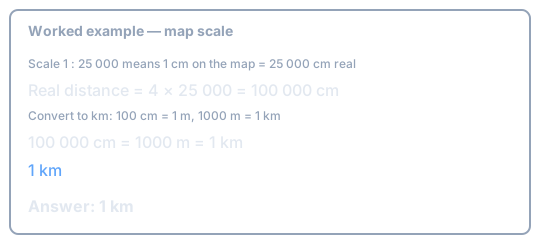
On a map with scale \(1 : 25\,000\), two towns are \(4\) cm apart. Find the real distance in km.
Best value
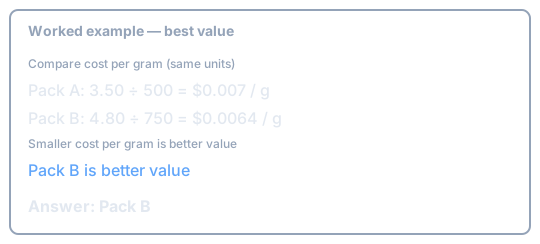
- Find the cost per unit for each option (same units).
- Compare — the lower cost per unit is better value.
- Check the question: it may ask for cheapest total or best value per kg/litre/item.
Pack A: \(500\) g for \($3.50\). Pack B: \(750\) g for \($4.80\). Which is better value?
Try this
Divide \($180\) in the ratio \(1 : 2 : 3\). A recipe uses flour and sugar in ratio \(5 : 2\). If you use \(300\) g flour, how much sugar?
Show answer
-
Total parts \(1 + 2 + 3 = 6\); one part \(= 180 \div 6 = 30\)
\[ 1 \times 30 = 30,\quad 2 \times 30 = 60,\quad 3 \times 30 = 90 \] -
Flour is 5 parts \(= 300\) g, so one part \(= 60\) g
\[ \text{sugar} = 2 \times 60 = 120 \text{ g} \] -
Final answers
\[ \$30,\; \$60,\; \$90 \quad\text{and}\quad 120\text{ g} \]
Exam Traps
- Map scales need unit conversion — \(25\,000\) cm is \(250\) m, not \(25\) km. Convert cm → m → km in steps.
- The cheaper pack is not always better value. Compare cost per gram (or per litre), not the sticker price.
0/10