Cambridge IGCSE Mathematics — 0580 Extended
Topic 1.11: Number — Rates
What is a rate?
A rate compares two quantities measured in different units. You divide one quantity by the other and write the answer with both units.
Examples: km/h (speed), people/km² (population density), litres/min (flow), g/cm³ (density).
Method
- Identify what the rate measures (e.g. speed, density).
- Write the formula or ratio: rate = first quantity \(\div\) second quantity.
- Convert units so they match what the question asks (especially time).
- Calculate and state the answer with units.
Average speed
Average speed is total distance divided by total time:
Rearrangements: \(d = s \times t\) and \(t = \dfrac{d}{s}\).
Which conversion?
Time given in hours and minutes
Convert to a single unit first — usually hours for km/h, or minutes for m/min.
Speed needed in m/s but distance in km
Convert km → m (\(\times 1000\)) and hours → seconds (\(\times 3600\)), or use km/h then convert.
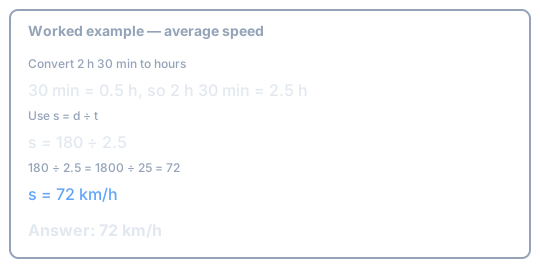
A car travels 180 km in 2 h 30 min. Find the average speed in km/h.
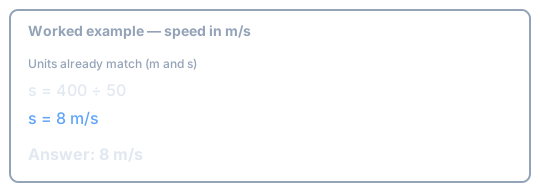
A runner covers 400 m in 50 s. Find the speed in m/s.
Paper 2 (non-calculator)
Convert mixed times mentally: 1 h 15 min = 1.25 h; 45 min = 0.75 h. For m/s, divide distance by time — e.g. 300 m in 1 min 30 s → \(300 \div 90 = 3.33\ldots\) m/s.
Pay, exchange and flow rates
Hourly pay: total pay = hourly rate \(\times\) number of hours worked.
Exchange rate: multiply by the rate to convert one currency to another; divide to convert back.
Flow rate: volume (or mass) per unit time — e.g. litres/min, m³/s.
Fuel consumption: often km/l or litres/100 km — read the units carefully.
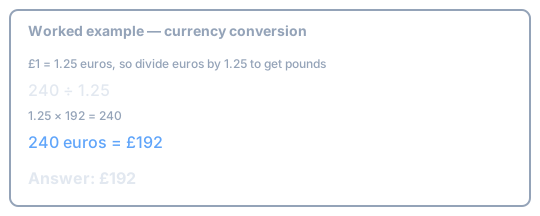
The exchange rate is £1 = 1.25 euros. Convert 240 euros to pounds.
Try this
A tap delivers 9 litres in 6 minutes. What is the flow rate in litres/min?
Show answer
-
Flow rate = volume \(\div\) time
\[ \dfrac{9}{6} \] -
Final answer
\[ = 1.5 \text{ litres/min} \]
Density, pressure and population density
In exams, the formula is usually given. You substitute and calculate — units matter.
| Rate | Formula (given) | Typical units |
|---|---|---|
| Density | \(\text{density} = \dfrac{\text{mass}}{\text{volume}}\) | g/cm³, kg/m³ |
| Pressure | \(\text{pressure} = \dfrac{\text{force}}{\text{area}}\) | N/cm², Pa |
| Population density | \(\text{density} = \dfrac{\text{population}}{\text{area}}\) | people/km² |
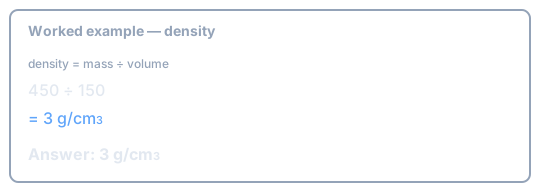
A block has mass 450 g and volume 150 cm³. Find the density in g/cm³.
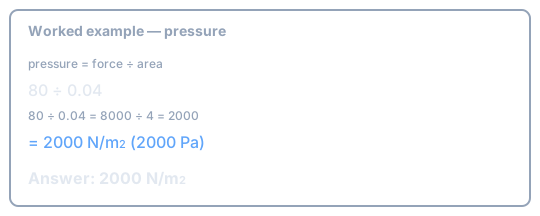
A force of 80 N acts on an area of 0.04 m². Find the pressure in N/m².
Exam Traps
- Do not treat 2 h 30 min as 2.30 hours. 30 min is half an hour, so 2 h 30 min = 2.5 h.
- If £1 = 1.25 euros, converting euros → pounds is a divide, not a multiply. Multiplying 240 by 1.25 gives euros, not pounds.
0/10