Cambridge IGCSE Mathematics — 0580 Extended
Topic 1.12: Number — Percentages
Multipliers — the core method
Instead of finding a percentage then adding, use a multiplier:
| Change | Multiplier | Example on 200 |
|---|---|---|
| Increase 15% | × 1.15 | 200 × 1.15 = 230 |
| Decrease 15% | × 0.85 | 200 × 0.85 = 170 |
| Find 15% of | × 0.15 | 200 × 0.15 = 30 |
Method
- Convert the percentage to a multiplier (100% + p% → \(1 + p/100\)).
- Multiply the original amount by the multiplier.
- For repeated changes, multiply all multipliers together.
Forward vs reverse percentages
Which method?
You know the original and the percentage change
Forward: multiply by the multiplier.
You know the final amount after a percentage change
Reverse: divide by the multiplier to find the original.
Express A as a % of B
Calculate \(\dfrac{A}{B} \times 100\). Can exceed 100% if A > B.
A price is increased by 20% to £144. Find the original price.
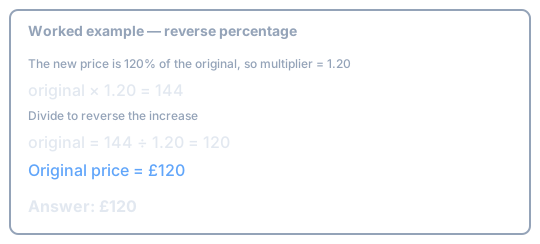
A shop buys goods for £80 and sells them for £110. Find the profit as a percentage of the cost price.
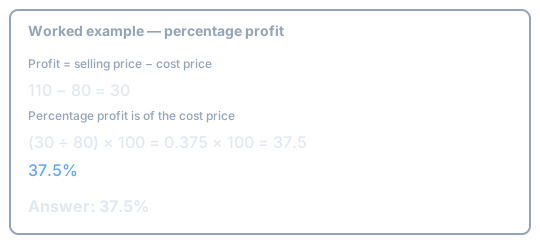
Simple and compound interest
Formulas are not given in the exam — learn them.
Simple interest: interest is calculated on the original amount only each year.
where \(P\) = principal, \(r\) = rate as a decimal, \(t\) = time in years.
Compound interest: interest is added to the balance each period; the next interest is calculated on the new total.
£2500 is invested at 4% simple interest per year for 3 years. Find the total amount.
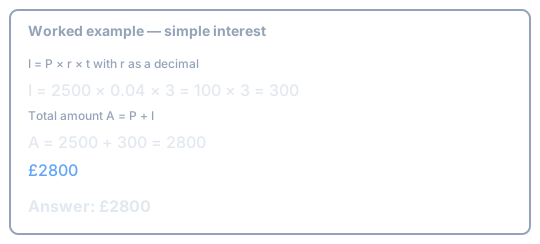
£2500 is invested at 4% compound interest per year for 3 years. Find the total amount.
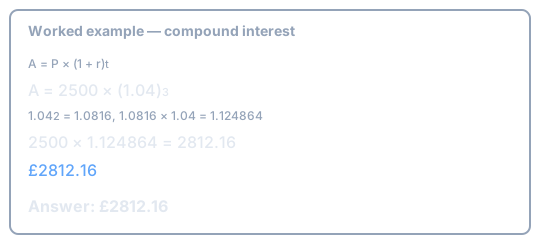
Deposits, discounts and repeated change
Deposit: pay a percentage upfront; the rest is the balance. E.g. 15% deposit on £800 → deposit = 120, balance = 680.
Discount: multiply by (1 − discount rate). A 30% discount → × 0.70.
Repeated percentage change: multiply multipliers. E.g. +10% then −10% → × 1.10 × 0.90 = × 0.99 (not back to start).
Paper 2 (non-calculator)
Know common equivalents: 10% = ÷ 10; 5% = half of 10%; 20% = ÷ 5; 25% = ÷ 4. For reverse % without a calculator: if final is 115% of original, divide by 1.15.
Try this
An item costing £400 is reduced by 15%, then a further 10% in a sale. Find the final price.
Show answer
-
15% decrease multiplier is 0.85; then 10% decrease is 0.90
\[ 400 \times 0.85 \times 0.90 \] -
Combine the multipliers first
\[ 0.85 \times 0.90 = 0.765 \] -
Final price
\[ 400 \times 0.765 = £306 \]
Exam Traps
- +10% then −10% is not back to the start: \(1.10 \times 0.90 = 0.99\), so the result is 1% lower.
- If a price has already been increased, find the original by dividing by the multiplier — do not subtract the percentage of the new price.
0/10