Cambridge IGCSE Mathematics — 0580 Extended
Topic 1.14: Number — Exponential Growth & Decay
The exponential model
When a quantity changes by the same percentage each period, you multiply repeatedly — this is exponential change.
where \(n\) = number of time periods (years, months, etc.).
- Growth: multiplier > 1 (e.g. 5% increase → × 1.05).
- Decay: multiplier < 1 (e.g. 12% decrease → × 0.88).
You do not need \(e^x\) at IGCSE — use the multiplier form above.
Method
- Identify original amount and number of periods \(n\).
- Write the multiplier (1 + rate for growth, 1 − rate for decay).
- Calculate original \(\times\) (multiplier)\(^{n}\).
- Round to the required accuracy (often 2 d.p. for money).
Exponential vs simple (linear) change
Which model?
Same fixed amount added each year
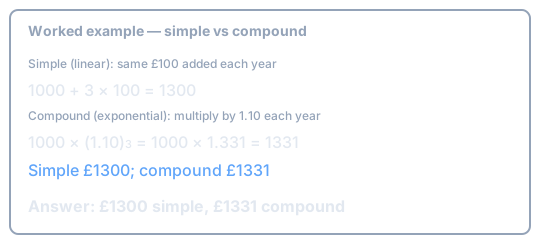
Linear (simple interest): \(A = P + kn\).
Same percentage applied each year
Exponential (compound): \(A = P \times (\text{multiplier})^n\).
Compare £1000 at 10% simple interest and 10% compound interest for 3 years.
Depreciation and growth
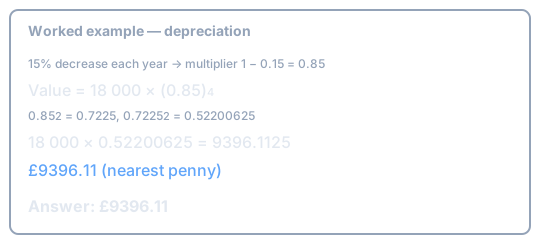
Depreciation is exponential decay — a car, machine or value loses a fixed percentage of its current value each year, not a fixed amount.
A car worth £18 000 depreciates by 15% per year. Find its value after 4 years.
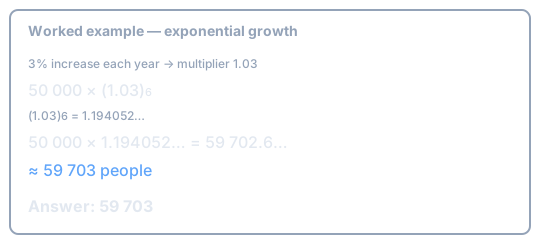
A population of 50 000 increases by 3% per year. Estimate the population after 6 years.
Exam context
Exponential decay also models radioactive decay, cooling, and any situation where the change depends on the current amount. Always check whether the question says "each year on its current value" (exponential) or "of the original value" (simple).
Paper 2 (non-calculator)
Powers of friendly multipliers can be built in steps: \(0.80^2 = 0.64\), then \(0.64 \times 0.80 = 0.512\). For 5% growth, \(1.05^2 = 1.1025\).
Try this
A laptop costs £800 and loses 20% of its value each year. Find its value after 3 years.
Show answer
-
20% of current value each year → multiplier \(0.80\)
\[ 800 \times (0.80)^{3} \] -
Build the power in steps
\[ 0.80^{2} = 0.64,\quad 0.64 \times 0.80 = 0.512 \] -
Final value
\[ 800 \times 0.512 = £409.60 \]
Exam Traps
- "Of its current value each year" is exponential. "Of the original value each year" is simple (linear) — they are not the same.
- A 15% decrease is \(\times 0.85\), not \(\times 0.15\) and not \(\times 1.15\).
0/10