Cambridge IGCSE Mathematics — 0580 Extended
Topic 1.15: Number — Surds
Simplifying surds
A surd is an irrational root left in exact form, usually \(\sqrt{n}\) where \(n\) is not a perfect square.
Factor the number under the root and take out perfect squares:
Method
- Find the largest square factor of the number under the root.
- Write \(\sqrt{ab} = \sqrt{a}\sqrt{b}\) where \(\sqrt{a}\) is an integer.
- Leave the remaining surd in simplest form.
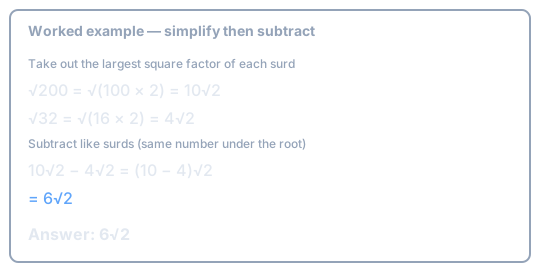
Simplify \(\sqrt{200} - \sqrt{32}\).
Operations with surds
Adding/subtracting: only like surds combine — same number under the root.
\(3\sqrt{5} + 2\sqrt{3}\) cannot be simplified (unlike surds).
Multiplying: \(\sqrt{a} \times \sqrt{b} = \sqrt{ab}\). Simplify the result.
Division: \(\dfrac{\sqrt{a}}{\sqrt{b}} = \sqrt{\dfrac{a}{b}}\) — often rationalise the denominator next.
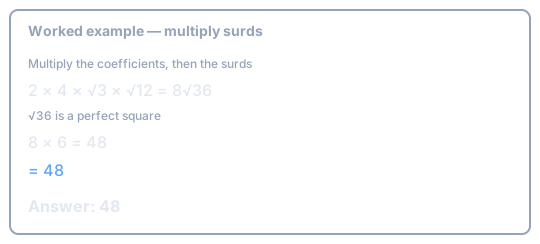
Simplify \(2\sqrt{3} \times 4\sqrt{12}\).
Rationalising the denominator
Exam answers should not have a surd in the denominator. Multiply top and bottom by a suitable surd to remove it.
Which method?
Denominator is \(\sqrt{a}\) alone
Multiply top and bottom by \(\sqrt{a}\).
Denominator is \(a \pm \sqrt{b}\)
Multiply top and bottom by the conjugate \(a \mp \sqrt{b}\).
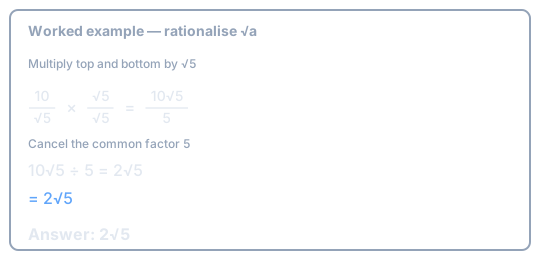
Rationalise \(\dfrac{10}{\sqrt{5}}\).
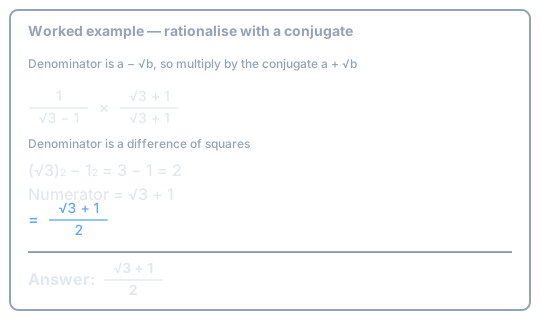
Rationalise \(\dfrac{1}{\sqrt{3} - 1}\).
Paper 2 surd skills
Paper 2 (non-calculator)
Know square numbers up to 144 to simplify quickly: \(\sqrt{72} = 6\sqrt{2}\), \(\sqrt{50} = 5\sqrt{2}\). For rationalising, spot when the denominator is a difference of squares: \((\sqrt{3}-1)(\sqrt{3}+1) = 2\).
Try this
Simplify \(\sqrt{48} + \sqrt{27}\).
Show answer
-
Take out the largest square factor of each surd
\[ \sqrt{48} = \sqrt{16 \times 3} = 4\sqrt{3} \]\[ \sqrt{27} = \sqrt{9 \times 3} = 3\sqrt{3} \] -
Add like surds
\[ 4\sqrt{3} + 3\sqrt{3} = 7\sqrt{3} \] -
Final answer
\[ 7\sqrt{3} \]
Exam Traps
- \(3\sqrt{5} + 2\sqrt{3}\) cannot be added — only like surds (same number under the root) combine.
- For a denominator \(a \pm \sqrt{b}\), multiply by the conjugate. Multiplying by \(\sqrt{b}\) alone does not clear it.
0/10