Cambridge IGCSE Mathematics — 0580 Extended
Topic 1.2: Number — Sets & Venn Diagrams
Set notation
| Symbol | Meaning | Example |
|---|---|---|
| \(\mathcal{E}\) or \(E\) | Universal set — all elements under consideration | \(\mathcal{E} = \{1,2,\ldots,10\}\) |
| \(\in\), \(\notin\) | Is / is not an element of | \(3 \in A\), \(7 \notin B\) |
| \(\emptyset\) | Empty set (no elements) | \(A \cap B = \emptyset\) |
| \(\subseteq\) | Is a subset of (every element of \(A\) is in \(B\)) | \(\{2,4\} \subseteq \{2,4,6\}\) |
| \(A'\) | Complement of \(A\) (in \(\mathcal{E}\), not in \(A\)) | If \(\mathcal{E}=\{1,2,3,4\}\), \(A=\{1,2\}\), then \(A'=\{3,4\}\) |
| \(A \cup B\) | Union — in \(A\) or \(B\) or both | \(\{1,2\}\cup\{2,3\}=\{1,2,3\}\) |
| \(A \cap B\) | Intersection — in both \(A\) and \(B\) | \(\{1,2\}\cap\{2,3\}=\{2\}\) |
| \(n(A)\) | Number of elements in \(A\) | \(n(\{5,5,7\})=2\) (no repeats) |
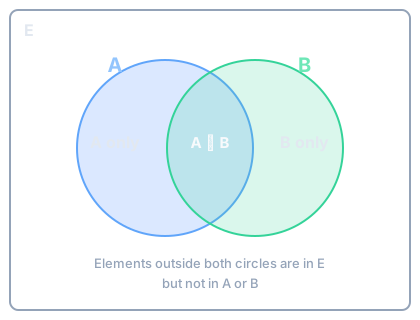
Reading Venn diagrams
Method
- Write \(\mathcal{E}\) and list every element shown (or given).
- Place elements in the correct region: \(A\) only, \(B\) only, \(A \cap B\), or outside both.
- For \(A'\): all elements in \(\mathcal{E}\) not in \(A\).
- Count carefully for \(n(A)\), \(n(A \cup B)\), or \(n(A \cap B)\).
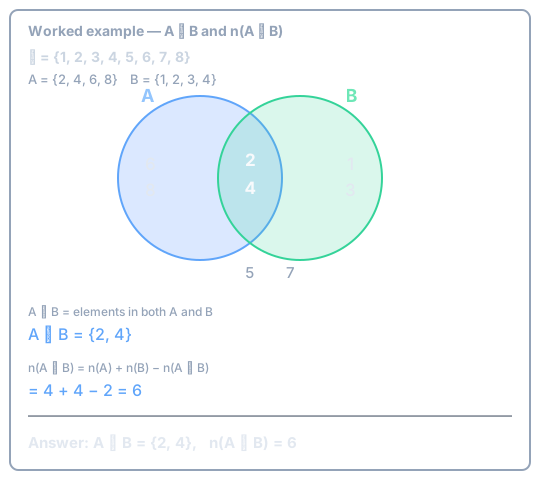
\(\mathcal{E} = \{1,2,3,4,5,6,7,8\}\). \(A = \{2,4,6,8\}\), \(B = \{1,2,3,4\}\). Find \(A \cap B\) and \(n(A \cup B)\).
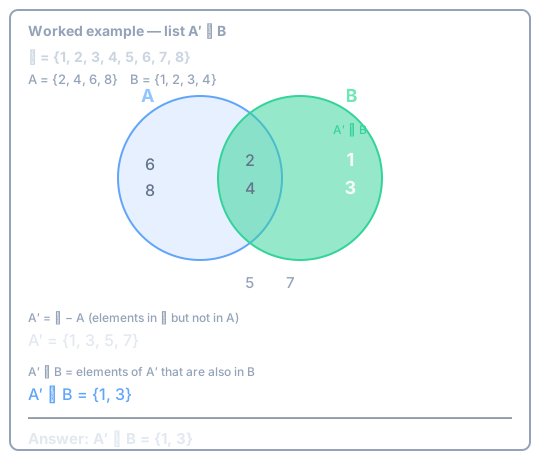
With the same sets, list the elements of \(A' \cap B\).
Try this
\(\mathcal{E}=\{p,q,r,s,t\}\), \(A=\{p,q,r\}\), \(B=\{q,r,s\}\). Find \(n(A \cap B')\).
Show answer
-
\(B' = \mathcal{E} - B\) — list \(\mathcal{E}\) and \(B\), then remove elements of \(B\)
\[ \mathcal{E}=\{p,q,r,s,t\},\quad B=\{q,r,s\} \]\[ B' = \{p,\, t\} \] -
\(A \cap B'\) — elements in both \(A\) and \(B'\)
\[ A=\{p,q,r\}, \quad A \cap B' = \{p\} \] -
Count the elements
\[ n(A \cap B') = 1 \]
Three sets
For three sets \(A\), \(B\), \(C\), each region of the Venn diagram corresponds to a combination such as \(A \cap B \cap C'\) (in \(A\) and \(B\) but not \(C\)).
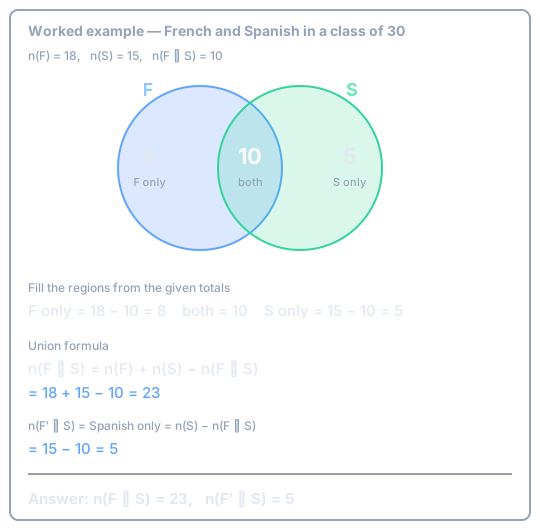
In a class of \(30\) students: \(18\) study French (\(F\)), \(15\) study Spanish (\(S\)), \(10\) study both. Find \(n(F \cup S)\) and \(n(F' \cap S)\).
Exam Traps
- \(A \cup B\) means or (include the overlap once) — do not add \(n(A)+n(B)\) without subtracting \(n(A \cap B)\).
- \(A'\) is always relative to \(\mathcal{E}\) — state \(\mathcal{E}\) before finding a complement.
0/10