Ad Banner Placeholder
Cambridge IGCSE Mathematics — 0580 Extended
Topic 1.3: Number — Powers & Roots
Squares and square roots
\(n^2\) means \(n \times n\). \(\sqrt{n}\) is the non-negative value that squares to \(n\) (for \(n \geq 0\)).
| \(n\) | \(n^2\) | \(n\) | \(n^2\) |
|---|---|---|---|
| 1 | 1 | 9 | 81 |
| 2 | 4 | 10 | 100 |
| 3 | 9 | 11 | 121 |
| 4 | 16 | 12 | 144 |
| 5 | 25 | 13 | 169 |
| 6 | 36 | 14 | 196 |
| 7 | 49 | 15 | 225 |
| 8 | 64 |
Paper 2 (non-calculator)
Knowing \(13^2 = 169\) and \(\sqrt{144} = 12\) saves time — drill the table until recall is instant.
Cubes and cube roots
| \(n\) | \(n^3\) | \(\sqrt[3]{n^3}\) |
|---|---|---|
| 1 | 1 | 1 |
| 2 | 8 | 2 |
| 3 | 27 | 3 |
| 4 | 64 | 4 |
| 5 | 125 | 5 |
| 10 | 1000 | 10 |
Calculating with powers
Method
- Evaluate roots and powers inside brackets first (respect BIDMAS).
- Combine same-base powers using index laws.
- Write the final answer as an integer or simplified power.
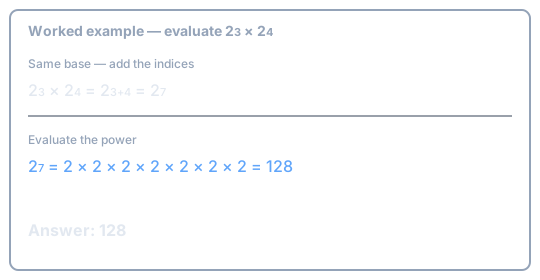
Evaluate \(2^3 \times 2^4\).
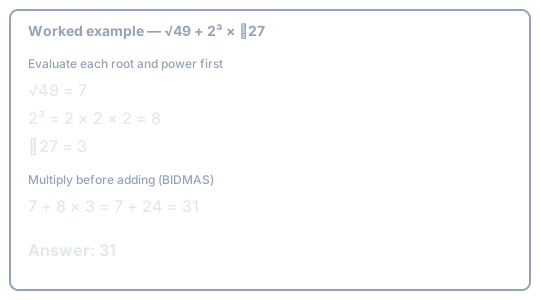
Evaluate \(\sqrt{49} + 2^3 \times \sqrt[3]{27}\).
Try this
Simplify \(\dfrac{5^6}{5^2}\).
Show answer
-
Same base — subtract the indices
\[ \dfrac{5^{6}}{5^{2}} = 5^{6-2} = 5^{4} \] -
Evaluate the power
\[ 5^{4} = 5 \times 5 \times 5 \times 5 = 625 \] -
Answer
\[ 625 \]
Exam Traps
- \(2^3 \times 3^2 \neq 6^5\) — index laws apply only when the base is the same.
0/10
Ad Banner Placeholder