Cambridge IGCSE Mathematics — 0580 Extended
Topic 1.4: Number — Fractions, Decimals & Percentages + Ordering
Fraction types and conversion
Proper: numerator \(<\) denominator (\(\dfrac{3}{5}\)). Improper: numerator \(\geq\) denominator (\(\dfrac{7}{4}\)). Mixed: whole + proper (\(1\dfrac{3}{4}\)).
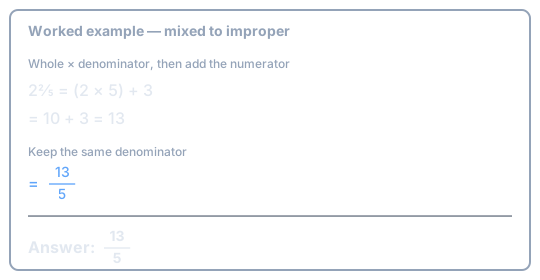
Method — mixed to improper
- Multiply the whole number by the denominator.
- Add the numerator; keep the same denominator.
Write \(2\dfrac{3}{5}\) as an improper fraction.
FDP conversions
Fraction → decimal
Divide numerator by denominator.
Fraction → percentage
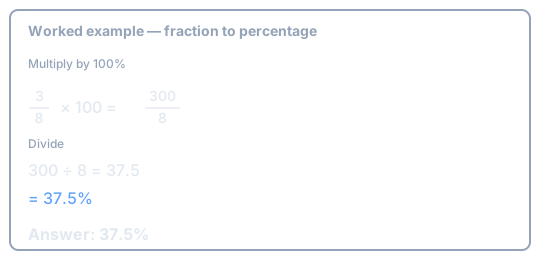
Find the decimal, then \(\times 100\%\), or multiply by \(\dfrac{100}{1}\).
Percentage → fraction
Write over \(100\) and simplify.
Express \(\dfrac{3}{8}\) as a percentage.
Recurring decimals
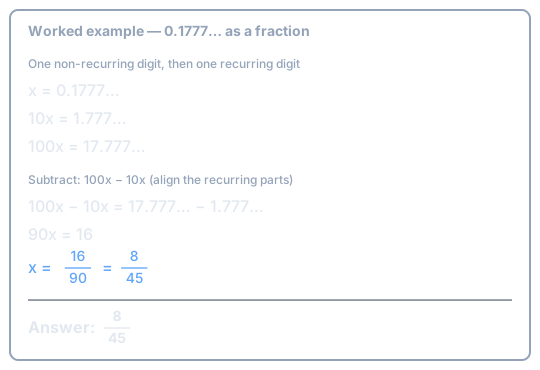
Dot notation marks the repeating block: \(0.\dot{1} = 0.111\ldots\), \(0.1\dot{7}\dot{} = 0.1777\ldots\) (1 non-recurring, 7 recurring).
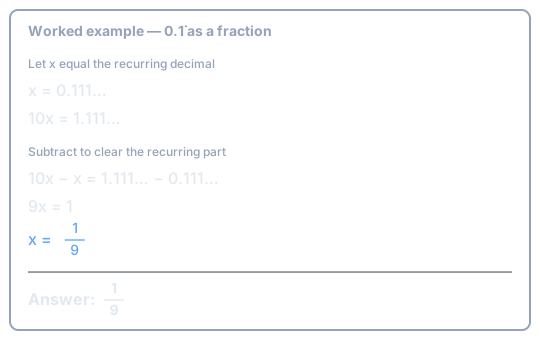
Method — pure recurring \(0.\dot{a}\)
- Let \(x = 0.\dot{a}\) (one digit repeats).
- Then \(x = \dfrac{a}{9}\). Example: \(0.\dot{1} = \dfrac{1}{9}\).
Method — general recurring (algebra)
- Let \(x\) equal the decimal; multiply by \(10^n\) to shift the recurring block.
- Subtract to eliminate the recurring part; solve for \(x\).
Write \(0.\dot{1}\) as a fraction.
Write \(0.1\dot{7}\dot{} = 0.1777\ldots\) as a fraction.
Try this
Convert \(0.\dot{3}\) to a fraction in simplest form.
Show answer
-
Let \(x\) equal the recurring decimal
\[ x = 0.333\ldots \] -
Multiply by 10 (one recurring digit)
\[ 10x = 3.333\ldots \] -
Subtract to clear the recurring part
\[ 10x - x = 3 \quad \Rightarrow \quad 9x = 3 \] -
Simplify
\[ x = \dfrac{3}{9} = \dfrac{1}{3} \] -
Answer
\[ \dfrac{1}{3} \]
Ordering numbers
Use \(=\) equal, \(\neq\) not equal, \(>\) greater, \(<\) less, \(\geq\) greater or equal, \(\leq\) less or equal.
Method
- Convert all values to the same form (usually decimals) for comparison.
- Compare place values from left to right.
- Write the order using inequality symbols or smallest-to-largest list.
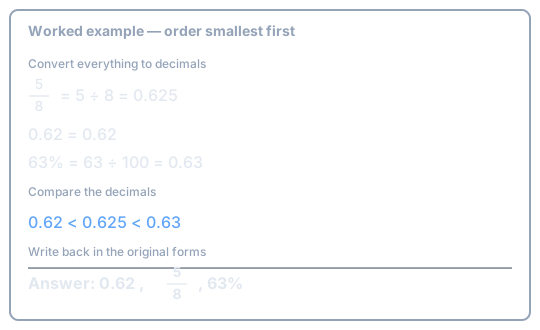
Put in order, smallest first: \(\dfrac{5}{8}\), \(0.62\), \(63\%\).
Exam Traps
- \(0.\dot{3}\) is exactly \(\dfrac{1}{3}\), not a rounded \(0.33\) — use algebra for recurring conversions.
- When ordering, check whether the question asks for smallest first or largest first.
0/10