Cambridge IGCSE Mathematics — 0580 Extended
Topic 1.5: Number — Four Operations
Negative numbers
Sign rules
Multiplying / dividing same signs
Answer is positive: \((-3) \times (-4) = +12\)
Multiplying / dividing different signs
Answer is negative: \((-3) \times 4 = -12\)
Subtracting a negative
Add the positive: \(5 - (-3) = 5 + 3 = 8\)
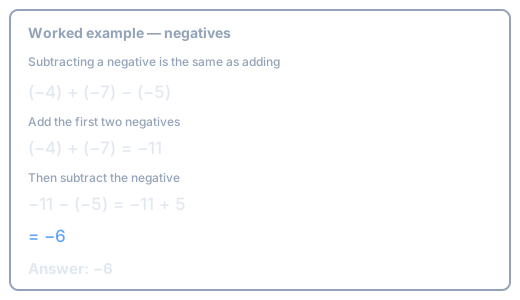
Evaluate \((-4) + (-7) - (-5)\).
Fractions and mixed numbers
Method
- +/− — common denominator, then add/subtract numerators.
- \(\times\) — multiply numerators and denominators; cancel before multiplying if possible.
- \(\div\) — multiply by the reciprocal of the second fraction.
- Convert mixed numbers to improper fractions before calculating.
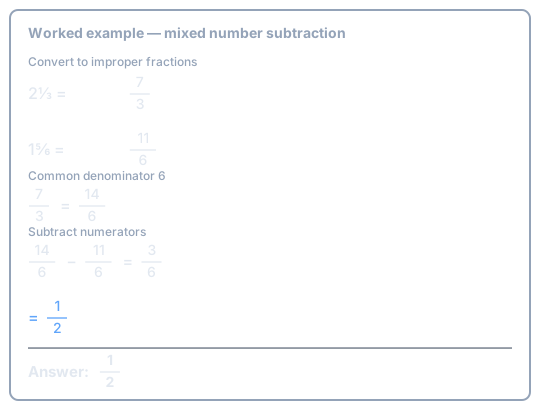
Evaluate \(2\dfrac{1}{3} - 1\dfrac{5}{6}\).
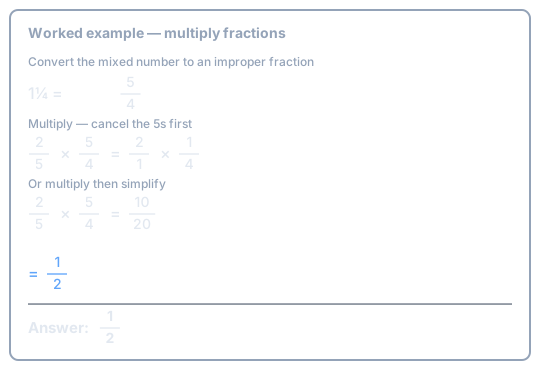
Evaluate \(\dfrac{2}{5} \times 1\dfrac{1}{4}\).
Paper 2 (non-calculator)
Cancel common factors before multiplying — it keeps numbers small and reduces arithmetic errors.
Try this
Evaluate \(\dfrac{3}{4} + \dfrac{5}{6}\).
Show answer
-
Lowest common denominator is 12
\[ \dfrac{3}{4} + \dfrac{5}{6} \] -
Rewrite each fraction over 12
\[ \dfrac{3}{4} = \dfrac{9}{12},\quad \dfrac{5}{6} = \dfrac{10}{12} \] -
Add the numerators
\[ \dfrac{9}{12} + \dfrac{10}{12} = \dfrac{19}{12} \] -
Answer
\[ \dfrac{19}{12} = 1\dfrac{7}{12} \]
BIDMAS
Order of operations: Brackets → Indices → Division & Multiplication (left to right) → Addition & Subtraction (left to right).
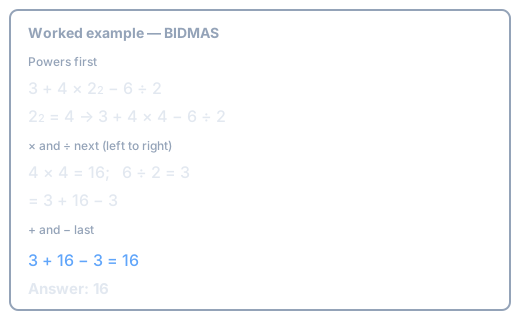
Evaluate \(3 + 4 \times 2^2 - 6 \div 2\).
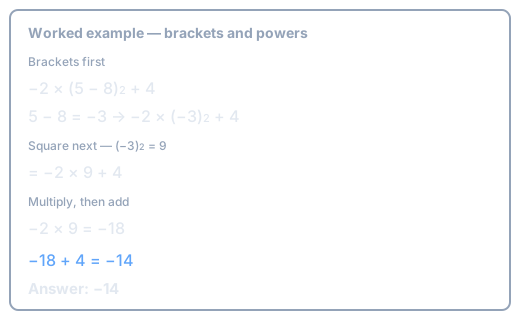
Evaluate \(-2 \times (5 - 8)^2 + 4\).
Exam Traps
- \(-3^2 = -(3^2) = -9\), but \((-3)^2 = 9\) — brackets change the sign.
- Division and multiplication have equal priority — work left to right, not division first.
0/10