Cambridge IGCSE Mathematics — 0580 Extended
Topic 1.6: Number — Indices
What an index means
An index (power) tells you how many times a base is multiplied by itself.
For example, \(2^4 = 2 \times 2 \times 2 \times 2 = 16\). The base is \(2\); the index is \(4\).
Index laws (same base)
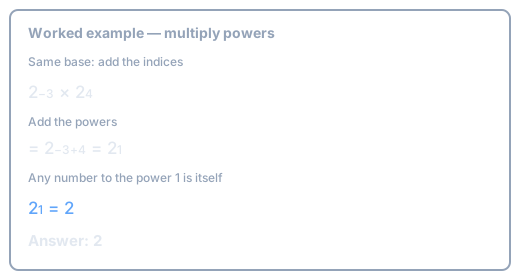
- Multiply: \(a^m \times a^n = a^{m+n}\)
- Divide: \(a^m \div a^n = a^{m-n}\)
- Power of a power: \((a^m)^n = a^{mn}\)
Zero and negative indices
Zero index: for any \(a \neq 0\):
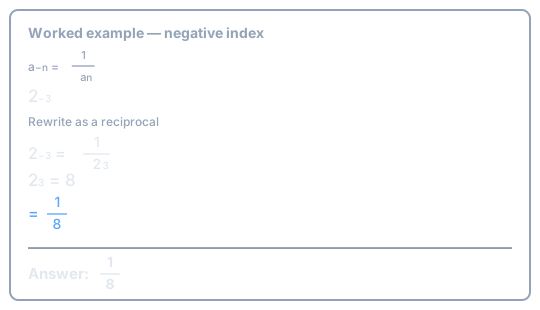
Negative index: a negative index means “take the reciprocal”:
Worked example 1
Evaluate \(2^{-3}\).
Worked example 2
Simplify \(2^{-3} \times 2^4\).
Paper 2 (non-calculator)
When indices have different bases, rewrite using prime factors first. Example: \(4^{-2} \times 2^3 = (2^2)^{-2} \times 2^3 = 2^{-4} \times 2^3 = 2^{-1} = \dfrac{1}{2}\).
Fractional indices
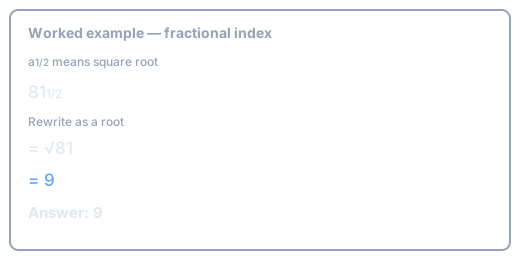
The denominator of the fraction is the root:
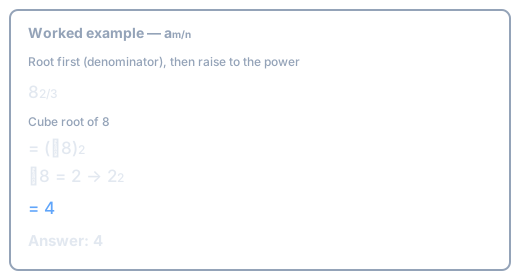
Find the root first, then raise to the power:
Worked example 3
Evaluate \(81^{\frac{1}{2}}\).
Worked example 4
Evaluate \(8^{\frac{2}{3}}\).
Which method?
Try this
Simplify \(3^{-2} \times 3^5\) and evaluate \(27^{\frac{1}{3}}\).
Show answer
-
Same base — add the indices
\[ 3^{-2} \times 3^{5} = 3^{-2+5} = 3^{3} \] -
\[ 3^{3} = 27 \]
-
Fractional index — cube root
\[ 27^{\frac{1}{3}} = \sqrt[3]{27} \] -
Answer
\[ 3^{-2} \times 3^{5} = 27,\quad 27^{\frac{1}{3}} = 3 \]
0/10