Cambridge IGCSE Mathematics — 0580 Extended
Topic 1.7: Number — Standard Form
Standard form notation
A number is in standard form when written as \(A \times 10^n\), where:
- \(A\) is a number with one non-zero digit before the decimal point: \(1 \le A < 10\)
- \(n\) is an integer (positive, zero or negative)
Examples: \(3.2 \times 10^5 = 320\,000\); \(4.7 \times 10^{-3} = 0.0047\).
Method
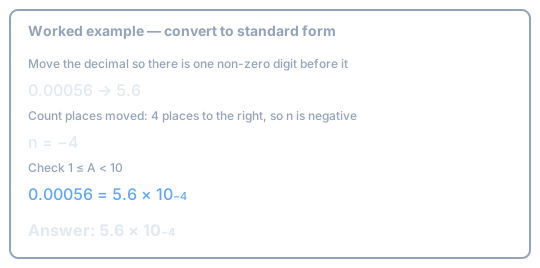
- Move the decimal point so there is exactly one non-zero digit before it — this gives \(A\).
- Count how many places you moved; that count is \(n\) (right = positive, left = negative).
- Check: \(1 \le A < 10\).
Write \(0.00056\) in standard form.
Calculations in standard form
Multiply and divide
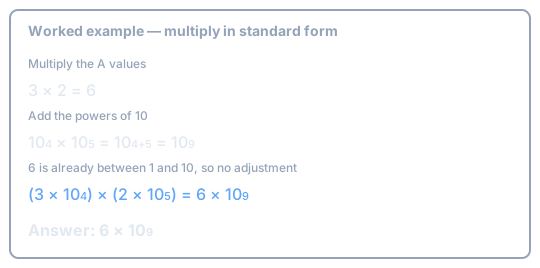
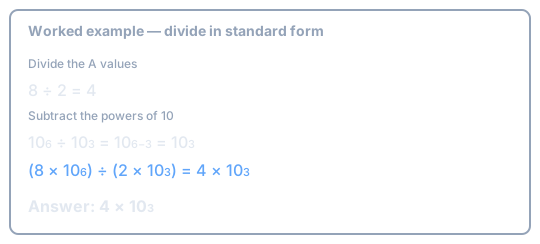
- Multiply or divide the \(A\) values.
- Add the powers when multiplying; subtract them when dividing.
- If \(A\) is not in range, adjust by moving the decimal and correcting \(n\).
Calculate \((3 \times 10^4) \times (2 \times 10^5)\).
Calculate \((8 \times 10^6) \div (2 \times 10^3)\).
Adding and subtracting
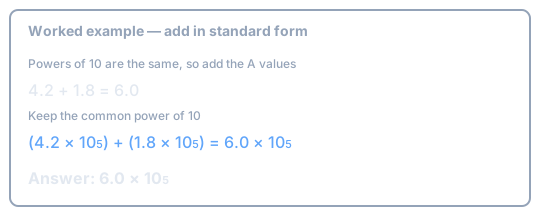
Powers of 10 are the same
Add or subtract the \(A\) values; keep the power unchanged. Adjust if needed.
Powers of 10 are different
Rewrite one number so both have the same power of 10, then add or subtract.
Calculate \((4.2 \times 10^5) + (1.8 \times 10^5)\).
Paper 2 (non-calculator)
After multiplying, \(A\) may leave the range. Example: \(5 \times 10^3 \times 4 \times 10^2 = 20 \times 10^5\). Rewrite as \(2.0 \times 10^6\).
Converting back to ordinary numbers
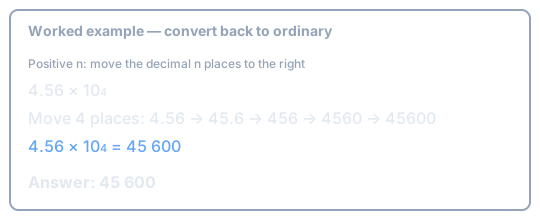
Positive \(n\): move the decimal point \(n\) places to the right, filling with zeros if needed.
Negative \(n\): move the decimal point \(|n|\) places to the left.
Write \(4.56 \times 10^4\) as an ordinary number.
Try this
Write \(7.3 \times 10^{-2}\) as an ordinary number and calculate \((5 \times 10^3) \times (4 \times 10^2)\).
Show answer
-
Negative \(n\) — move the decimal 2 places left
\[ 7.3 \times 10^{-2} = 0.073 \] -
Multiply the \(A\) values and add the powers
\[ (5 \times 10^{3}) \times (4 \times 10^{2}) = 20 \times 10^{5} \] -
\(20\) is not between \(1\) and \(10\) — rewrite
\[ 20 \times 10^{5} = 2.0 \times 10^{6} \] -
Final answers
\[ 0.073,\quad 2.0 \times 10^{6} \]
Exam Traps
- \(12 \times 10^4\) is not standard form because \(12 \not< 10\). Rewrite as \(1.2 \times 10^5\).
- Do not add the powers when adding the numbers — first make the powers of 10 the same.
0/10