Cambridge IGCSE Mathematics — 0580 Extended
Topic 1.8: Number — Estimation & Rounding
Decimal places and significant figures
Decimal places (d.p.): count digits after the decimal point. Example: \(3.146\) to 2 d.p. is \(3.15\) (look at the next digit to decide).
Significant figures (s.f.): count from the first non-zero digit. Zeros between non-zero digits count; leading zeros after a decimal point do not.
Method
- Identify the digit in the required place.
- Look at the next digit: if 5 or more, round up; if less than 5, leave it.
- Keep the place value — for example \(4567\) to 2 s.f. is \(4600\), not \(46\).
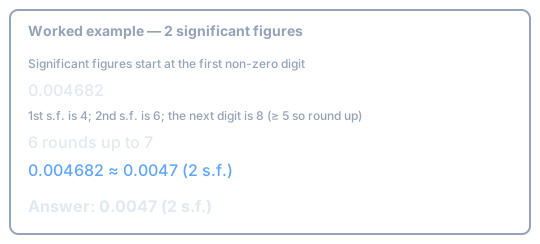
Write \(0.004682\) correct to 2 significant figures.
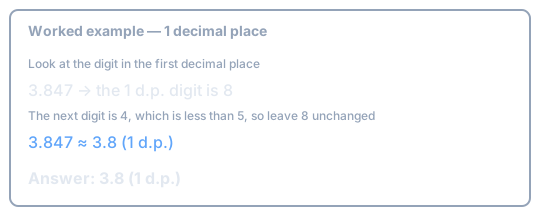
Write \(3.847\) correct to 1 decimal place.
Estimating calculations
To estimate, round each number to 1 significant figure, then calculate mentally. This gives a quick check of whether a calculator answer is sensible.
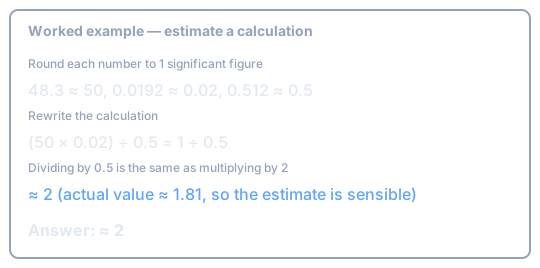
Estimate \(\dfrac{48.3 \times 0.0192}{0.512}\).
Paper 2 (non-calculator)
Estimation is essential on Paper 2. Round to friendly numbers: \(0.0192 \approx 0.02\), \(0.512 \approx 0.5\). Use fraction equivalents where helpful: \(0.5 = \dfrac{1}{2}\), so dividing by \(0.5\) is the same as multiplying by \(2\).
Which accuracy?
Question asks you to estimate
Round each value to 1 s.f., then calculate. Do not use a calculator.
Question asks for an exact answer “correct to …”
Calculate fully first, then round the final answer only.
Measurements are given to a fixed accuracy
Round the final answer to match the least accurate input (often the fewest s.f.).
Rounding in context
When a question involves units (money, length, people), round sensibly:
- Money is usually given to 2 d.p.
- Counts of people or items must be whole numbers — round down if fractional people do not make sense.
- Follow any instruction such as “correct to 3 significant figures”.
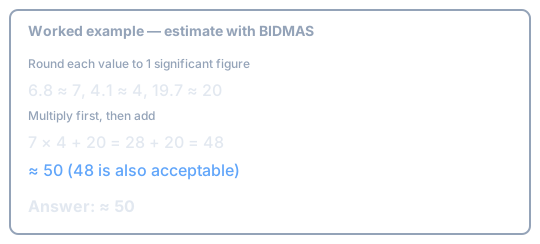
Estimate \(6.8 \times 4.1 + 19.7\).
Try this
Estimate \(\dfrac{3.9 \times 502}{0.198}\) and write \(0.06047\) to 2 s.f.
Show answer
-
Round each value to 1 s.f.
\[ 3.9 \approx 4,\quad 502 \approx 500,\quad 0.198 \approx 0.2 \] -
Calculate the estimate
\[ \dfrac{4 \times 500}{0.2} = \dfrac{2000}{0.2} = 10\,000 \] -
2 s.f. starts at the first non-zero digit (6); next digit is 0 so do not round up
\[ 0.06047 \approx 0.060 \text{ (2 s.f.)} \] -
Final answers
\[ \approx 10\,000,\quad 0.060 \]
Exam Traps
- Leading zeros after the decimal are not significant — \(0.06047\) to 2 s.f. is \(0.060\), not \(0.06\) (that shows only 1 s.f.).
- If the question says “correct to …”, calculate fully first — do not round the inputs as you would for an estimate.
0/10