Cambridge IGCSE Mathematics — 0580 Extended
Topic 1.9: Number — Limits of Accuracy / Bounds
Error interval for one measurement
When a length is measured as \(8.4\) cm correct to 1 decimal place, the true value lies in an error interval.
Half the width of one unit in the last decimal place is added and subtracted:
Write the error interval. The lower bound is included; the upper bound is not:
Method
- Identify the place value of the last digit given (e.g. 1 d.p. → \(0.1\); nearest 10 → \(10\)).
- Half that place value is the error: \(\pm 0.5 \times \text{unit}\).
- LB = stated value \(-\) half-unit; UB = stated value \(+\) half-unit.
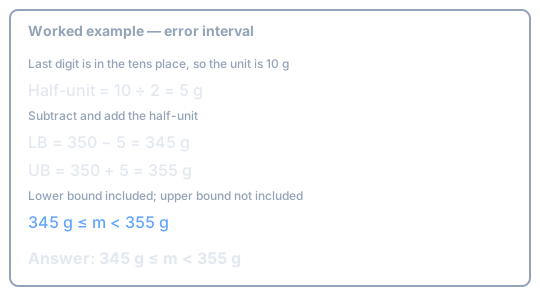
A mass is \(350\) g correct to the nearest 10 g. Find the bounds.
Bounds of calculations — decision tree
To find the maximum possible value, use bounds that make the result as large as possible. For the minimum, use bounds that make it as small as possible.
Max / min decision tree
Maximum of \(A + B\)
UB(\(A\)) + UB(\(B\))
Minimum of \(A + B\)
LB(\(A\)) + LB(\(B\))
Maximum of \(A - B\)
UB(\(A\)) − LB(\(B\))
Minimum of \(A - B\)
LB(\(A\)) − UB(\(B\))
Maximum of \(A \times B\) (both positive)
UB(\(A\)) \(\times\) UB(\(B\))
Minimum of \(A \times B\) (both positive)
LB(\(A\)) \(\times\) LB(\(B\))
Maximum of \(A \div B\) (\(B > 0\))
UB(\(A\)) \(\div\) LB(\(B\)) — largest numerator, smallest denominator
Minimum of \(A \div B\) (\(B > 0\))
LB(\(A\)) \(\div\) UB(\(B\))
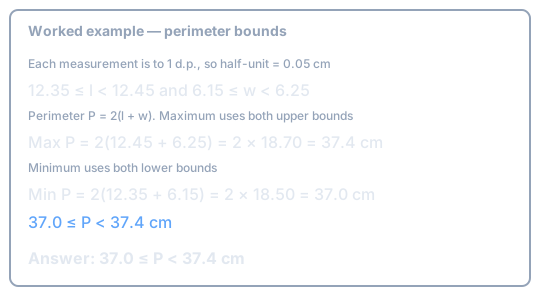
A rectangle has length \(12.4\) cm and width \(6.2\) cm, both measured to 1 d.p. Find bounds for the perimeter.
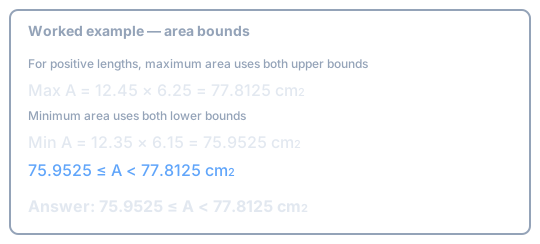
Using the same rectangle, find bounds for the area.
Speed, distance and time
Since \(\text{speed} = \dfrac{\text{distance}}{\text{time}}\):
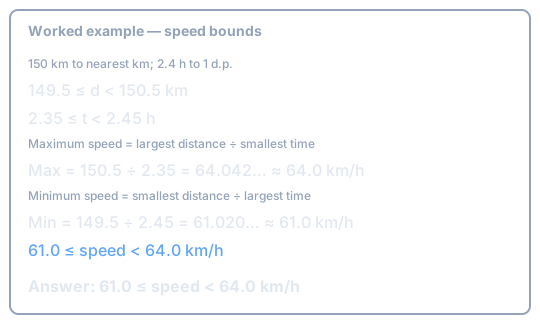
A car travels \(150\) km (nearest km) in \(2.4\) hours (1 d.p.). Find bounds for the average speed.
Paper 2 (non-calculator)
Half-units you should know instantly: 1 d.p. → \(\pm 0.05\); nearest whole → \(\pm 0.5\); nearest 10 → \(\pm 5\). Write the inequality with \(\le\) on the lower bound and \(<\) on the upper bound.
Try this
A rod has length \(5.0\) cm (1 d.p.). Write its error interval. Two such rods are placed end to end — what is the maximum possible total length?
Show answer
-
1 d.p. means half-unit \(= 0.05\) cm
\[ 5.0 - 0.05 = 4.95,\quad 5.0 + 0.05 = 5.05 \] -
Error interval for one rod
\[ 4.95 \le x < 5.05 \text{ cm} \] -
Maximum total uses both upper bounds
\[ 5.05 + 5.05 = 10.1 \text{ cm} \] -
Final answers
\[ 4.95 \le x < 5.05 \text{ cm},\quad \text{max total } = 10.1 \text{ cm} \]
Exam Traps
- For maximum speed, do not use UB \(\div\) UB. A larger time decreases speed, so the maximum uses the smallest possible time.
- The upper bound is written with \(<\), not \(\le\) — a length of \(8.45\) cm would round to \(8.5\), not \(8.4\).
0/10