Cambridge IGCSE Mathematics — 0580 Extended
Topic 2.1: Algebra and graphs — Introduction to Algebra
Letters as numbers
A letter stands for a number that can change (a variable) or a number that is fixed in a problem (a constant). Algebra lets you write a rule once and use it for any value.
| Object | What it is | Example |
|---|---|---|
| Term | A number, a letter, or a product of these | \(3x\), \(-2y^2\), \(7\) |
| Expression | Terms joined by \(+\) or \(-\) — no equals sign | \(3x^2 - 4x + 1\) |
| Equation | Two expressions set equal — you can solve it | \(3x + 4 = 10\) |
| Formula | A rule linking quantities (often named) | \(v = u + at\) |
| Identity | True for all allowed values of the letter | \((x+1)^2 = x^2 + 2x + 1\) |
Substitution
Substitution means replacing each letter with a number, then evaluating with BIDMAS.
Method
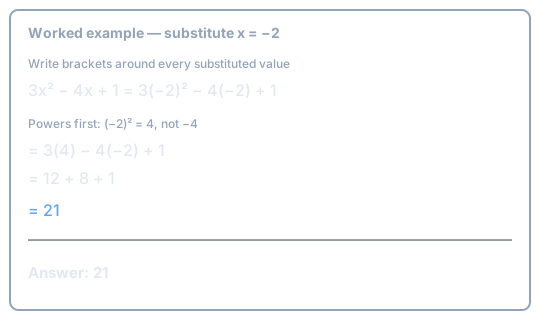
- Write the expression, then rewrite it with a bracket around every substituted value.
- Evaluate powers first — \((-2)^2 = 4\), not \(-4\).
- Then multiply/divide, then add/subtract.
If \(x = -2\), evaluate \(3x^2 - 4x + 1\).
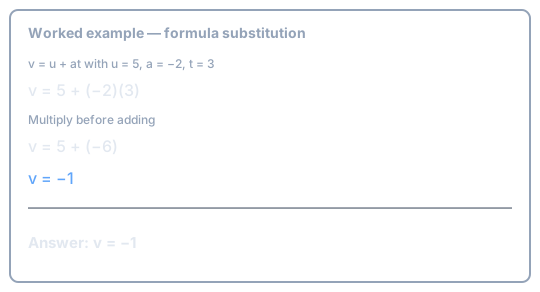
Use \(v = u + at\) with \(u = 5\), \(a = -2\), \(t = 3\). Find \(v\).
Paper 2 (non-calculator)
Always write \((-3)^2\), never \(-3^2\) when the whole value is squared. \(-3^2\) means \(-(3^2) = -9\). That single missed pair of brackets is the most common substitution mark-loss on Paper 2.
Forming expressions
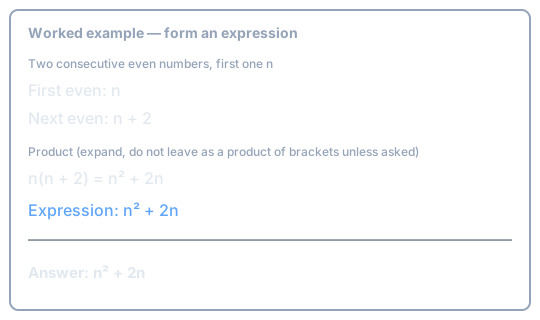
Translate the sentence into algebra, then simplify. “Consecutive even” numbers differ by \(2\); “consecutive integers” differ by \(1\).
Write an expression for the product of two consecutive even numbers, taking the first as \(n\).
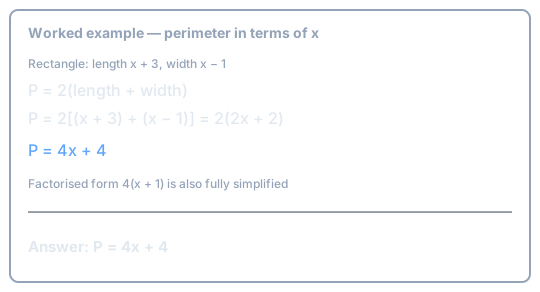
A rectangle has length \(x+3\) and width \(x-1\). Write a simplified expression for its perimeter.
Try this
If \(x = -3\), evaluate \(2x^2 + 5x - 1\).
Show answer
-
Brackets around the substituted value
\[ 2(-3)^{2} + 5(-3) - 1 \] -
Power first, then multiply
\[ 2(9) + 5(-3) - 1 = 18 - 15 - 1 \] -
Final answer
\[ 2 \]
Exam Traps
- Do not treat \(-x^2\) the same as \((-x)^2\). For \(x=3\), \(-x^2 = -9\) but \((-x)^2 = 9\).
0/10