Cambridge IGCSE Mathematics — 0580 Extended
Topic 2.10: Algebra and graphs — Graphs of Functions
Tables and plots
You must be able to construct a table of values, plot the points and join them with a smooth curve for:
- \(y = ax^n\) where \(n = -2, -1, -\tfrac{1}{2}, 0, \tfrac{1}{2}, 1, 2, 3\), and sums of at most three of these terms;
- \(y = ab^x + c\) where \(b\) is a positive integer.
A sum such as \(y = x^2 + x - 4\) is three allowed pieces: \(x^2\), \(x^1\) and the constant \((-4)x^0\).
Method
- Substitute each given \(x\) into the formula. Use brackets around negatives.
- Write the \(y\)-values in a table, then plot each pair \((x, y)\).
- Join with a smooth curve — not a rulered polyline, unless the graph is linear.
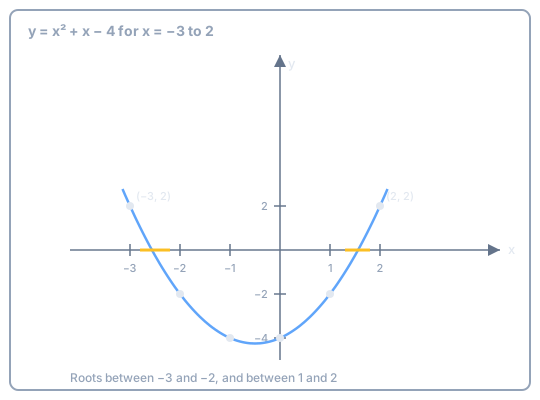
- A root is where the curve crosses the \(x\)-axis (\(y = 0\)). If it changes sign between two plotted \(x\)-values, the root lies between them.
Complete the table for \(y = x^2 + x - 4\) with \(x = -3, -2, -1, 0, 1, 2\), plot the graph, and state the intervals containing the roots.
| \(x\) | \(-3\) | \(-2\) | \(-1\) | \(0\) | \(1\) | \(2\) |
|---|---|---|---|---|---|---|
| \(y\) | \(2\) | \(-2\) | \(-4\) | \(-4\) | \(-2\) | \(2\) |
Paper 2 (non-calculator)
You may still be asked to complete a table without a calculator. Stick to simple integers: \((-3)^2 + (-3) - 4 = 9 - 3 - 4 = 2\). Write every substituted negative in a bracket.
Recognising shapes
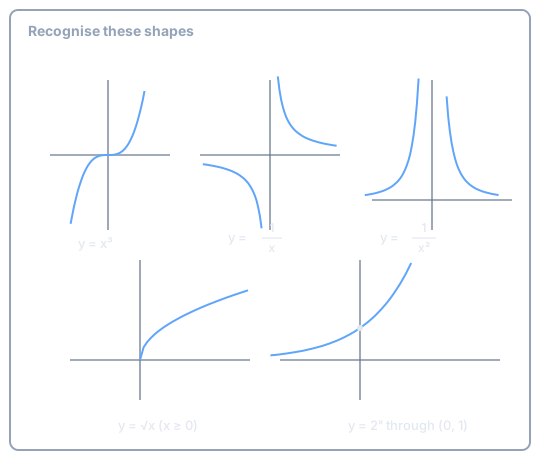
Before you plot, name the family. The sketch in the next topic (E2.11) is freehand; here you still need the shape so you join points correctly.
| Function | Shape to recognise |
|---|---|
| \(y = x^3\) | Increasing cubic through the origin; odd rotational symmetry |
| \(y = 1/x\) | Two branches; axes are asymptotes |
| \(y = 1/x^2\) | Both sides above the \(x\)-axis (if the coefficient is positive); vertical asymptote \(x = 0\) |
| \(y = \sqrt{x}\) | Starts at the origin; only for \(x \ge 0\) |
| \(y = 2^x\) | Through \((0, 1)\); approaches \(y = 0\) as \(x \to -\infty\) |
Solving graphically
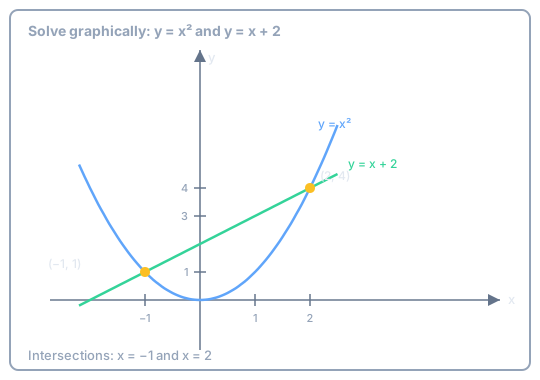
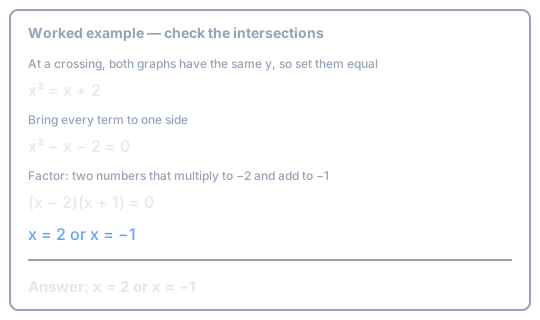
The \(x\)-coordinates of the intersection of two graphs are the solutions of the equation you get by setting the two right-hand sides equal. That pair of values satisfies both equations at once.
Method
- Draw both graphs on the same axes (or use the graphs already drawn).
- Read the \(x\)-values at the crossing points. Those are the solutions.
- If asked, check by substituting, or by rearranging into a quadratic you can factor.
The graphs of \(y = x^2\) and \(y = x + 2\) are drawn. Find the solutions of \(x^2 = x + 2\).
Exponential growth and decay
The form is \(y = ab^x + c\) with \(b\) a positive integer. If \(c = 0\):
- Growth when \(b > 1\): \(y = 4 \times 2^x\) doubles each time \(x\) increases by \(1\).
- Decay when \(0 < b < 1\), written with a positive integer base as \(y = 100 \times (0.5)^x\): halves each time \(x\) increases by \(1\).
Both pass through \((0, a)\) when \(c = 0\), and both have a horizontal asymptote \(y = c\) (here \(y = 0\)).
Plot \(y = 4 \times 2^x\) using \(x = -2, -1, 0, 1, 2\).
| \(x\) | \(-2\) | \(-1\) | \(0\) | \(1\) | \(2\) |
|---|---|---|---|---|---|
| \(y\) | \(1\) | \(2\) | \(4\) | \(8\) | \(16\) |
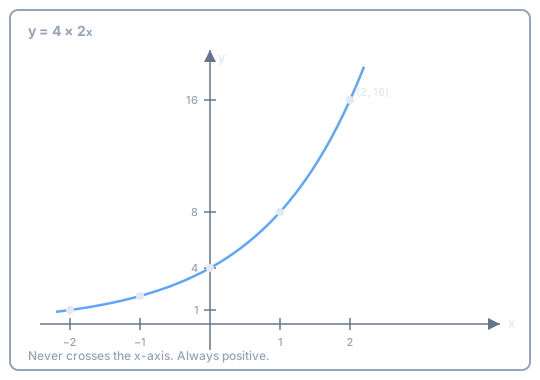
Decay uses the same method: \(y = 100 \times (0.5)^x\) gives \(100, 50, 25, 12.5\) at \(x = 0, 1, 2, 3\).
Try this
Complete the table for \(y = x^3 - x\) with \(x = -2, -1, 0, 1, 2\).
Show answer
-
Substitute with brackets around negatives
\[ (-2)^3 - (-2) = -8 + 2 = -6 \]\[ (-1)^3 - (-1) = -1 + 1 = 0 \] -
The remaining integer values
\[ 0^3 - 0 = 0,\quad 1^3 - 1 = 0,\quad 2^3 - 2 = 6 \] -
\(y\)-values in order
\[ -6,\ 0,\ 0,\ 0,\ 6 \]
Exam Traps
- \(y = x^{1/2}\) (that is \(y = \sqrt{x}\)) is only defined for \(x \ge 0\). Do not extend the curve into negative \(x\).
- The intersection of a line and a curve solves both equations simultaneously — the \(x\)-values are the solutions, not a single \(y\)-value on its own.
0/10