Cambridge IGCSE Mathematics — 0580 Extended
Topic 2.11: Algebra and graphs — Sketching Curves
This topic is recognition and sketching, not accurate plots (that is E2.10). A sketch needs the right shape, labelled intercepts, turning points and asymptotes — not a table of values.
Forms you must sketch: \(ax + by = c\) (linear); \(y = ax^2 + bx + c\) (quadratic); \(y = ax^3 + b\) and \(y = ax^3 + bx^2 + cx\) (cubic); \(y = \dfrac{a}{x} + b\) (reciprocal); \(y = ar^x + b\) with \(r > 0\) rational (exponential).
Linear graphs \(ax + by = c\)
A linear graph is a straight line. The fastest sketch uses intercepts.
Method
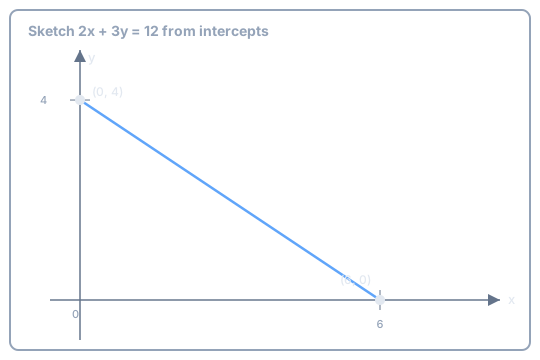
- Set \(y = 0\) to find the \(x\)-intercept.
- Set \(x = 0\) to find the \(y\)-intercept.
- Plot those two points and join them with a rulered line.
Sketch \(2x + 3y = 12\).
Quadratic sketches
For \(y = ax^2 + bx + c\) you need: the roots (if they exist), the turning point, and whether it is a minimum (\(a > 0\)) or maximum (\(a < 0\)). The line of symmetry is \(x = -\dfrac{b}{2a}\). Completing the square gives the turning point without a formula sheet.
Method
- Factor (or use the quadratic formula) to find roots, if they are required.
- Complete the square to write \(y = a(x-h)^2 + k\). The turning point is \((h, k)\).
- Sketch: roots on the \(x\)-axis, turning point marked, and the correct way up.
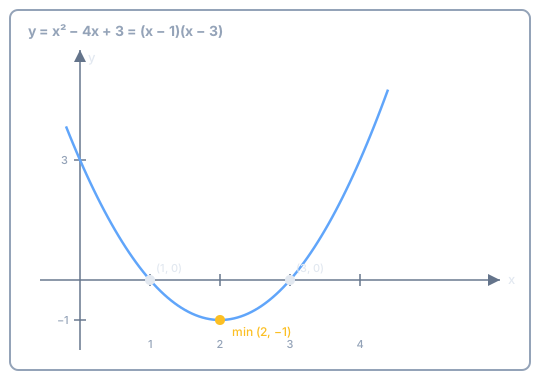
Sketch \(y = x^2 - 4x + 3\).
\(y = (x-1)(x-3) = (x-2)^2 - 4 + 3 = (x-2)^2 - 1\). Roots \(1\) and \(3\); vertex \((2, -1)\); minimum because the coefficient of \(x^2\) is positive.
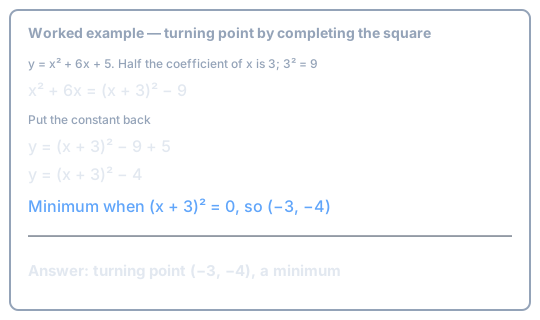
Find the turning point of \(y = x^2 + 6x + 5\) by completing the square.
Paper 2 (non-calculator)
Complete the square mentally for \(x^2 + 6x\): half of \(6\) is \(3\), and \(3^2 = 9\), so \(x^2 + 6x = (x+3)^2 - 9\). Keep the vertex as exact coordinates, not a decimal estimate.
Cubic sketches
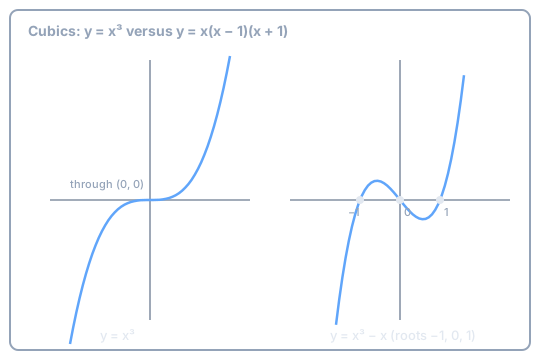
\(y = ax^3 + b\) is a cube graph translated up or down by \(b\). \(y = ax^3 + bx^2 + cx\) can have up to two turning points. Factorising shows the roots; a sketch only needs those roots and the right end-behaviour (if \(a > 0\), the graph goes down to the left and up to the right).
Compare \(y = x^3\) with \(y = x(x-1)(x+1) = x^3 - x\).
Reciprocal graphs
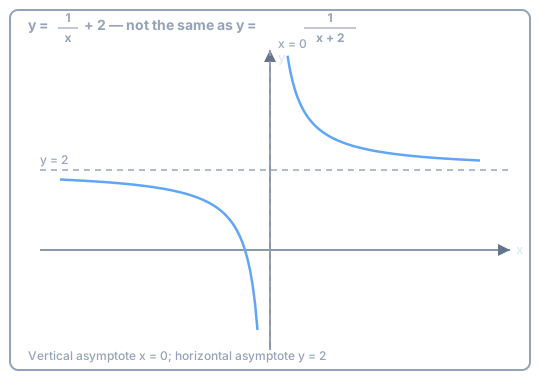
For \(y = \dfrac{a}{x} + b\): vertical asymptote \(x = 0\), horizontal asymptote \(y = b\). The two branches never cross the asymptotes.
Sketch \(y = \dfrac{1}{x} + 2\).
Exponential sketches
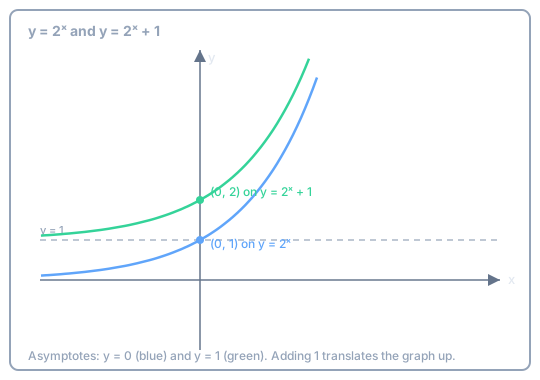
\(y = ar^x + b\) always has a horizontal asymptote \(y = b\). When \(b = 0\) and \(a = 1\), \(y = 2^x\) passes through \((0, 1)\) and approaches \(y = 0\) as \(x \to -\infty\). Adding \(1\) lifts every point by \(1\): \(y = 2^x + 1\) passes through \((0, 2)\) with asymptote \(y = 1\).
Sketch \(y = 2^x\) and \(y = 2^x + 1\) on the same axes.
Try this
By completing the square, find the vertex of \(y = x^2 - 2x - 3\).
Show answer
-
Half of \(-2\) is \(-1\); \((-1)^2 = 1\)
\[ x^2 - 2x = (x-1)^2 - 1 \] -
Replace the constant
\[ y = (x-1)^2 - 1 - 3 = (x-1)^2 - 4 \] -
Vertex (a minimum)
\[ (1,\ -4) \]
Exam Traps
- \(y = \dfrac{1}{x} + 2\) is not the same as \(y = \dfrac{1}{x+2}\). The first has asymptotes \(x = 0\) and \(y = 2\); the second has \(x = -2\) and \(y = 0\).
0/10