Cambridge IGCSE Mathematics — 0580 Extended
Topic 2.12: Algebra and graphs — Differentiation
The notation \(\dfrac{dy}{dx}\) is required. In this syllabus item, the power \(n\) is a positive integer or zero only (and simple sums of at most three such terms). You are not expected to identify points of inflection.
Gradient from a tangent
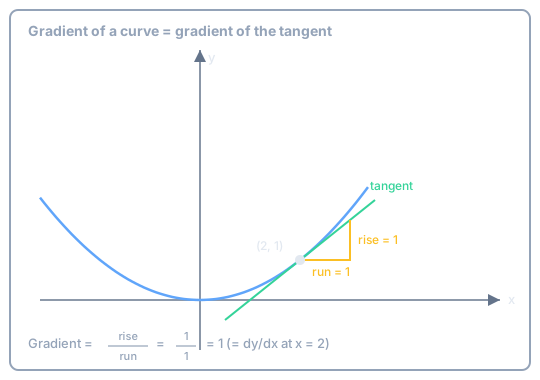
The gradient of a curve at a point is the gradient of the tangent at that point. Estimate it by drawing the tangent, then using rise/run.
Method
- Draw a straight tangent that just touches the curve at the given point.
- Pick two convenient points on the tangent and form a right-angled triangle.
- Gradient \(= \dfrac{\text{rise}}{\text{run}}\). That value is \(\dfrac{dy}{dx}\) at that \(x\).
Estimate the gradient of \(y = \tfrac{1}{4}x^2\) at \(x = 2\).
The power rule
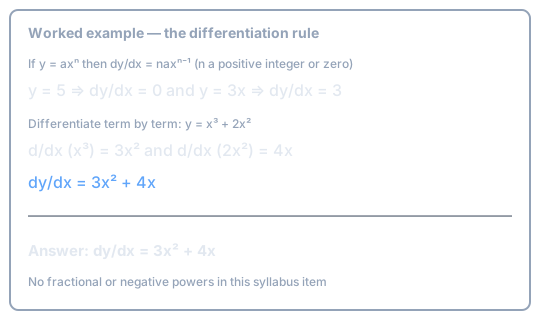
If \(y = ax^n\), then \(\dfrac{dy}{dx} = nax^{n-1}\). A constant differentiates to \(0\); \(y = 3x\) differentiates to \(3\). Differentiate sums term by term.
Differentiate \(y = x^3 + 2x^2\).
Stationary points
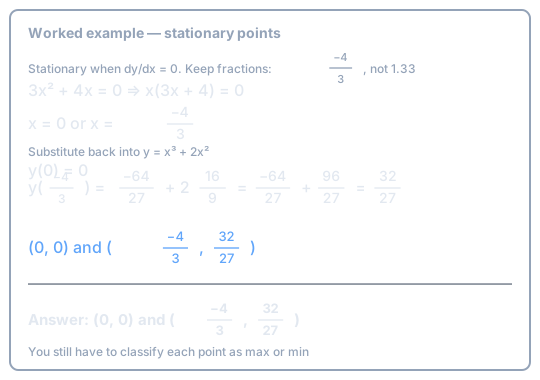
A stationary point is where \(\dfrac{dy}{dx} = 0\). Solve that equation for \(x\), then substitute into \(y\) to get the coordinates.
Method
- Find \(\dfrac{dy}{dx}\) and set it equal to \(0\).
- Factor or solve the resulting equation. Keep exact fractions.
- Substitute each \(x\) into the original \(y\) to get the point \((x, y)\).
Find the stationary points of \(y = x^3 + 2x^2\).
Paper 2 (non-calculator)
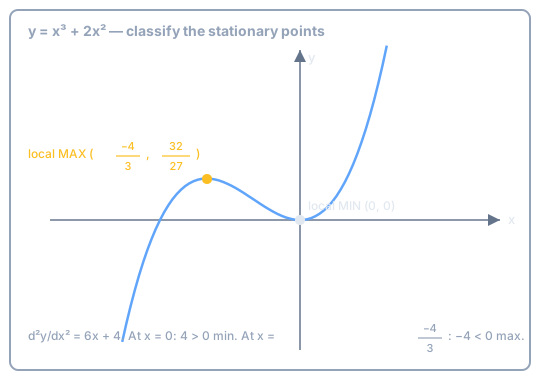
Keep fractions: \(x = -\dfrac{4}{3}\), not \(1.33\). For \(y\left(-\dfrac{4}{3}\right)\), write \(\left(-\dfrac{4}{3}\right)^3 + 2\left(-\dfrac{4}{3}\right)^2 = -\dfrac{64}{27} + \dfrac{32}{9} = -\dfrac{64}{27} + \dfrac{96}{27} = \dfrac{32}{27}\).
Maximum or minimum
After you have a stationary point you must classify it. Any one of these is accepted:
- an accurate sketch of the curve;
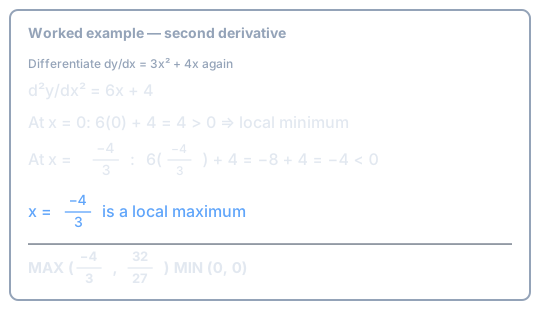
- the second derivative: \(\dfrac{d^2y}{dx^2} > 0\) is a local minimum, \(\dfrac{d^2y}{dx^2} < 0\) is a local maximum;
- the sign of \(\dfrac{dy}{dx}\) either side of the point (positive then negative is a max; negative then positive is a min).
If the second derivative is \(0\), the test is inconclusive at IGCSE — do not call the point an inflection.
Classify the stationary points of \(y = x^3 + 2x^2\).
Try this
Find \(\dfrac{dy}{dx}\) for \(y = 4x^3 - 3x + 2\), then the stationary values of \(x\).
Show answer
-
Differentiate term by term
\[ \dfrac{dy}{dx} = 12x^2 - 3 \] -
Stationary when the derivative is zero
\[ 12x^2 - 3 = 0 \Rightarrow 12x^2 = 3 \Rightarrow x^2 = \dfrac{1}{4} \] -
Two solutions
\[ x = \pm \dfrac{1}{2} \]
Exam Traps
- \(\dfrac{dy}{dx} = 0\) finds a stationary point — you must still classify it as max or min.
- If the second derivative is \(0\), the test is inconclusive. Do not call the point an inflection (not required at IGCSE).
0/10