Cambridge IGCSE Mathematics — 0580 Extended
Topic 2.13: Algebra and graphs — Functions
Function notation, domain and range
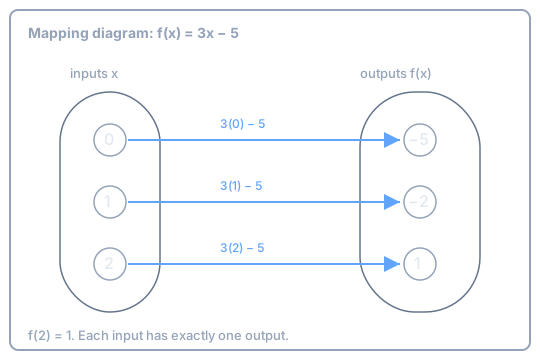
\(f(x)\) means “the output of \(f\) when the input is \(x\)”. The domain is the set of allowed inputs; the range is the set of possible outputs. Mapping diagrams are allowed.
You are not expected to find the domain or range of a composite function.
Method
- To evaluate \(f(a)\), replace every \(x\) in the rule by \(a\) (use brackets if \(a\) is negative).
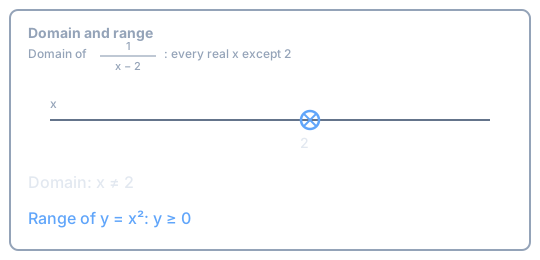
- Domain: exclude values that make a denominator zero (and, later, a square root negative).
- Range: ask what \(y\)-values the rule can actually produce. For \(y = x^2\), that is \(y \ge 0\).
If \(f(x) = 3x - 5\), find \(f(2)\). If \(h(x) = 2x^2 + 3\), find \(h(-1)\).
\(f(2) = 3(2) - 5 = 1\). \(h(-1) = 2(-1)^2 + 3 = 2(1) + 3 = 5\).
State the domain of \(\dfrac{1}{x-2}\) and the range of \(y = x^2\).
Inverse functions
The inverse \(f^{-1}\) undoes \(f\). It is not the reciprocal \(1/f(x)\) unless \(f\) itself is of the form \(k/x\).
Method
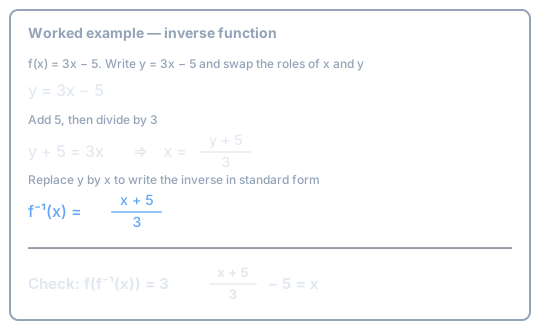
- Write \(y = f(x)\).
- Rearrange to make \(x\) the subject.
- Replace \(y\) by \(x\) to write \(f^{-1}(x)\).
- Check: \(f\big(f^{-1}(x)\big) = x\) (and \(f^{-1}\big(f(x)\big) = x\)).
Find \(f^{-1}(x)\) if \(f(x) = 3x - 5\).
Composite functions
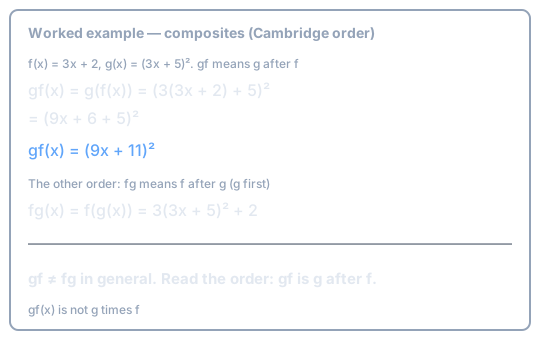
Cambridge writes \(gf(x) = g\big(f(x)\big)\): apply \(f\) first, then \(g\). In general \(fg \ne gf\).
Method
- Read the order from the right: \(gf\) means \(f\) first.
- Replace the input of the outer function by the whole inner expression, using a bracket.
- Simplify only as far as the question asks. Do not multiply \(g\) by \(f\).
Given \(f(x) = 3x + 2\) and \(g(x) = (3x + 5)^2\), find \(gf(x)\) and \(fg(x)\).
Paper 2 (non-calculator)
\(fg \ne gf\) in general. Read the order carefully: \(gf\) means \(g\) after \(f\). Substituting a number is often safer than expanding: \(f(2) = 8\), then \(g(8) = (3\cdot 8 + 5)^2 = 29^2\) if you only need a value.
Try this
If \(f(x) = 2x + 1\), find \(f^{-1}(x)\) and \(f^{-1}(7)\).
Show answer
-
Set \(y = 2x + 1\) and rearrange
\[ y - 1 = 2x \Rightarrow x = \dfrac{y-1}{2} \] -
Write the inverse in \(x\)
\[ f^{-1}(x) = \dfrac{x-1}{2} \] -
Evaluate at \(7\)
\[ f^{-1}(7) = \dfrac{7-1}{2} = 3 \]
Exam Traps
- \(gf(x) = g\big(f(x)\big)\), not \(g \times f\).
- \(f^{-1}\) undoes \(f\). Do not take the reciprocal of \(f(x)\) unless \(f\) is a \(1/x\) type. \(f^{-1}\) is not \(1/f\).
0/10