Cambridge IGCSE Mathematics — 0580 Extended
Topic 2.2: Algebra and graphs — Algebraic Manipulation
Collect like terms
Like terms have the same letters raised to the same powers. You can add or subtract their coefficients; unlike terms stay separate.
Method
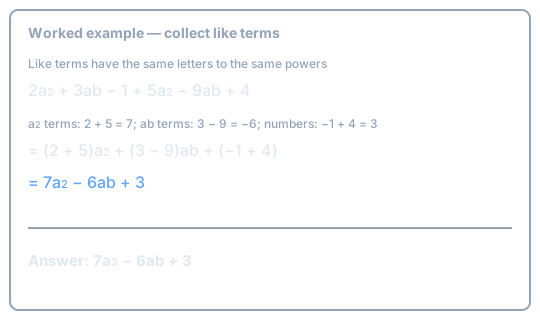
- Underline (or rewrite in groups) every \(a^2\) term, every \(ab\) term, and every number.
- Add the coefficients in each group — a minus sign belongs to the term that follows it.
- Write one simplified term per group, in a consistent order (highest power first, then mixed terms, then constants).
Simplify \(2a^2 + 3ab - 1 + 5a^2 - 9ab + 4\).
Expand
Expanding means removing brackets by multiplication. Every term in one factor multiplies every term in the other.
Method
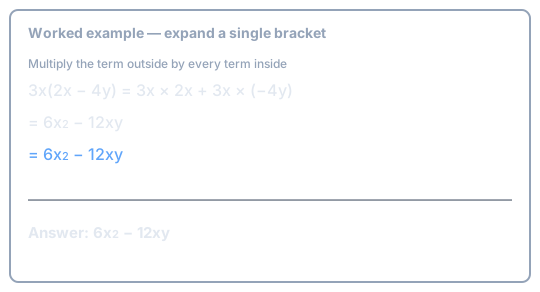
- Single bracket: multiply the outside term by each term inside.
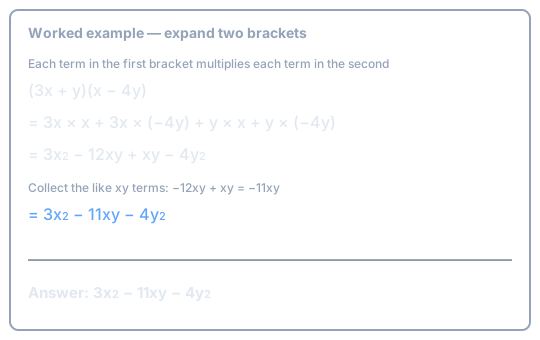
- Two brackets: four products (first \(\times\) first, first \(\times\) second, second \(\times\) first, second \(\times\) second), then collect like terms.
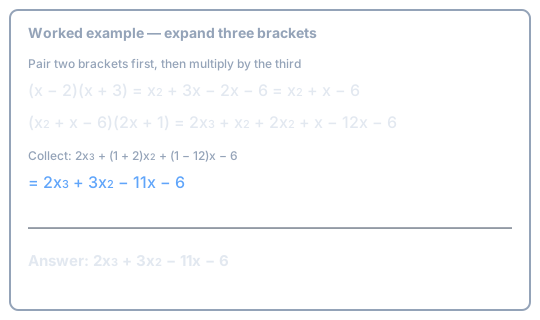
- Three brackets: expand any two first, then multiply the result by the remaining bracket.
Expand \(3x(2x - 4y)\).
Expand \((3x + y)(x - 4y)\).
Expand \((x - 2)(x + 3)(2x + 1)\).
Paper 2 (non-calculator)
For a product of three brackets, expand two of them first and simplify that quadratic before you multiply by the third. Carrying four or six uncollected terms into the last multiplication is how signs go missing.
Factorise fully
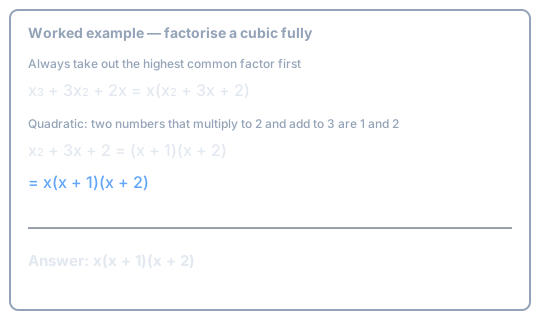
Factorising is expanding in reverse. Fully means every common factor — numbers and letters — has been taken out, and quadratics or cubics are written as products of linear factors where possible.
Method
- Take out the highest common factor of every term (number and letter).
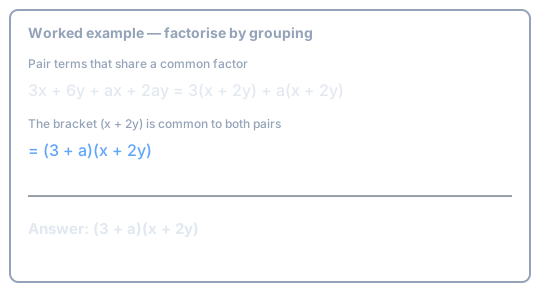
- If four terms remain, try grouping into two pairs with the same bracket.
- Spot a difference of squares: \(A^2 - B^2 = (A - B)(A + B)\).
- For a quadratic \(x^2 + bx + c\), find two numbers that multiply to \(c\) and add to \(b\).
Common factor (number and letter):
Factorise \(3x + 6y + ax + 2ay\) fully.
Difference of squares:
Quadratic trinomial:
Factorise \(x^3 + 3x^2 + 2x\) fully.
Completing the square
Completing the square rewrites a quadratic as a perfect square plus or minus a constant. Use it when the question asks for the form \((x+p)^2 + q\), or when you need the vertex of a parabola.
Method
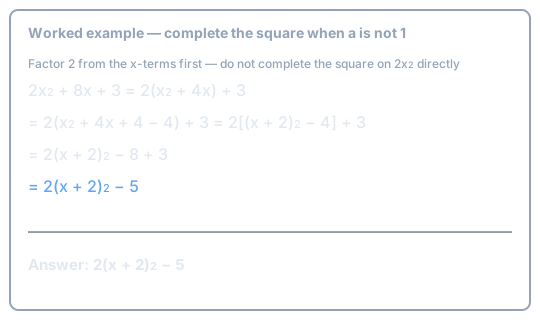
- If the coefficient of \(x^2\) is not \(1\), factor that number from the \(x\)-terms only.
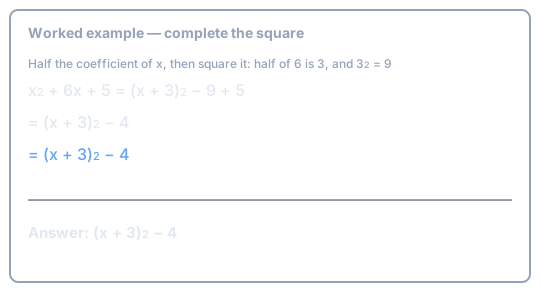
- Take half the coefficient of \(x\), then square it. Add and subtract that square inside the bracket.
- Rewrite as \(a(x+p)^2 + q\) and simplify \(q\).
Write \(x^2 + 6x + 5\) in completed-square form.
Write \(2x^2 + 8x + 3\) in completed-square form.
Which method?
The question says expand, simplify, or remove brackets
Expand, then collect like terms.
The question says factorise (fully)
Common factor, grouping, difference of squares, or quadratic factors.
You need \((x+p)^2+q\), a vertex, or a turning point
Complete the square (factor \(a\) from the \(x\)-terms first if \(a \neq 1\)).
Try this
Factorise \(x^2 - 7x + 12\).
Show answer
-
Two numbers that multiply to \(12\) and add to \(-7\)
\[ -3 \times -4 = 12,\quad -3 + -4 = -7 \] -
Final answer
\[ (x - 3)(x - 4) \]
Exam Traps
- \(9x^2 + 15xy\) factorised fully is \(3x(3x + 5y)\), not \(x(9x + 15y)\). The number \(3\) is also a common factor.
- When the quadratic starts \(2x^2 + \cdots\), factor \(2\) from the \(x\)-terms before you complete the square. Completing the square on \(2x^2 + 8x\) as if it were \(x^2 + 8x\) gives the wrong \(p\) and \(q\).
0/10