Cambridge IGCSE Mathematics — 0580 Extended
Topic 2.3: Algebra and graphs — Algebraic Fractions
Multiply and divide
Algebraic fractions follow the same rules as numerical fractions. Multiply tops with tops and bottoms with bottoms; divide by multiplying by the reciprocal. Cancel only factors that appear in both the numerator and the denominator.
Method
- To multiply: \(\dfrac{a}{b} \times \dfrac{c}{d} = \dfrac{ac}{bd}\). Cancel common factors before you multiply if you can see them.
- To divide: \(\dfrac{a}{b} \div \dfrac{c}{d} = \dfrac{a}{b} \times \dfrac{d}{c}\).
- A letter that cancels is an excluded value of the original expression (the original denominator must not be zero).
Simplify \(\dfrac{3a}{4} \times \dfrac{9a}{10}\).
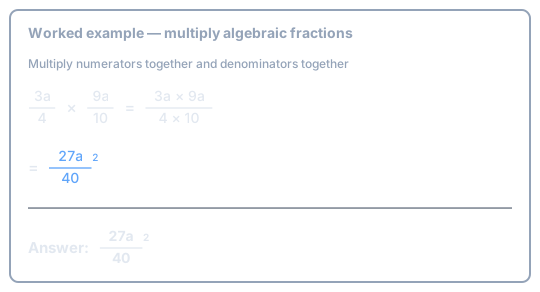
Simplify \(\dfrac{3a}{4} \div \dfrac{9a}{10}\).
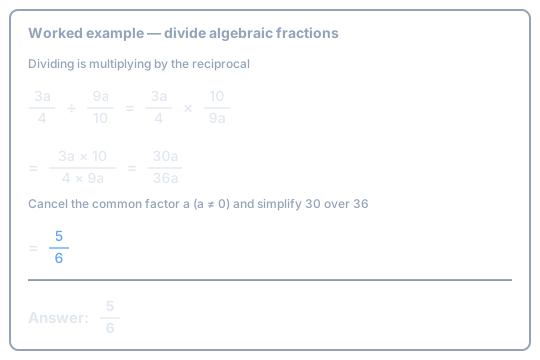
Add and subtract
You can add or subtract fractions only when the denominators match. For algebraic denominators, the common denominator is the product of the distinct factors (or the LCM of the numerical denominators).
Method
- Find a common denominator — usually the product of the two denominators if they have no common factor.
- Rewrite each fraction with that denominator, expanding numerators carefully (watch minus signs in front of a bracket).
- Add or subtract the numerators; leave the denominator factorised unless the question asks you to expand it.
Simplify \(\dfrac{1}{x - 2} + \dfrac{x + 1}{x - 3}\).
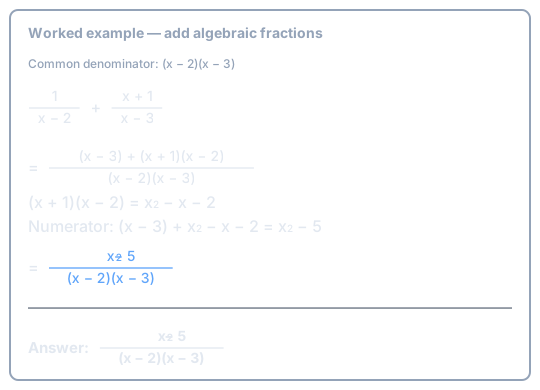
Simplify \(\dfrac{2x}{3} - \dfrac{3(x - 5)}{2}\).
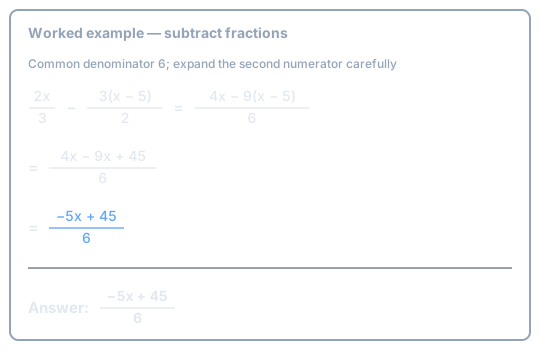
Paper 2 (non-calculator)
Leave the denominator in factorised form unless the question says expand. \((x-2)(x-3)\) is the form that scores; expanding it to \(x^2-5x+6\) is extra work and hides the excluded values \(x=2\) and \(x=3\).
Simplify rational expressions
A rational expression is a fraction whose numerator and denominator are polynomials. The only legal cancelling is a common factor of the whole numerator and the whole denominator.
Method
- Factorise the numerator completely.
- Factorise the denominator completely.
- Cancel identical factors, and state the excluded value of any cancelled factor (that value made the original denominator zero).
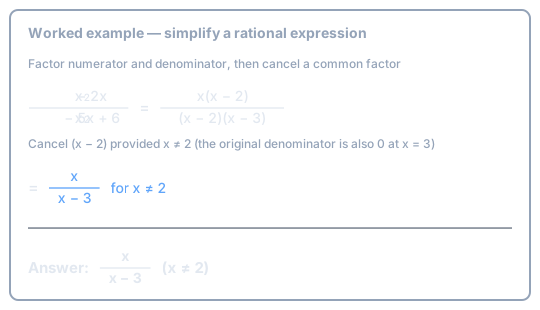
Simplify \(\dfrac{x^2 - 2x}{x^2 - 5x + 6}\).
Try this
Simplify \(\dfrac{x^2 - 9}{x^2 + 5x + 6}\).
Show answer
-
Factorise as a difference of squares over a quadratic
\[ \dfrac{(x - 3)(x + 3)}{(x + 2)(x + 3)} \] -
Cancel the common factor \(x + 3\), provided \(x \neq -3\)
\[ \dfrac{x - 3}{x + 2} \] -
Final answer
\[ \dfrac{x - 3}{x + 2} \quad (x \neq -3) \]
Exam Traps
- You cannot cancel the \(x\) in \(\dfrac{x + 2}{x}\). Addition is not a factor; \(\dfrac{x+2}{x} = 1 + \dfrac{2}{x}\), not \(2\).
- When you cancel a factor, name the excluded value. After cancelling \(x-2\) from \(\dfrac{x(x-2)}{(x-2)(x-3)}\), write \(x \neq 2\) (and the original is also undefined at \(x=3\)).
0/10