Cambridge IGCSE Mathematics — 0580 Extended
Topic 2.4: Algebra and graphs — Indices II
The Number chapter covered numerical powers. This lesson uses the same laws with letters, then solves exponential equations by rewriting both sides with the same base. Logarithms are not required for 0580.
Laws with algebraic terms
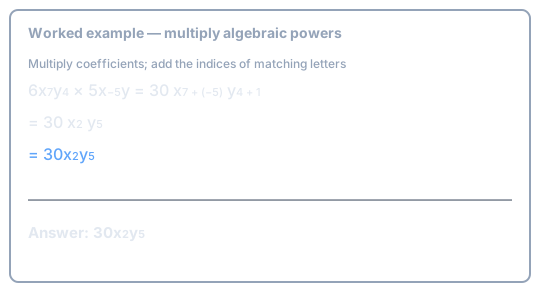
Treat the number and each letter separately. Multiply coefficients; add or subtract the indices of matching letters.
| Law | In letters |
|---|---|
| Multiply | \(a^m \times a^n = a^{m+n}\) |
| Divide | \(a^m \div a^n = a^{m-n}\) |
| Power of a power | \((a^m)^n = a^{mn}\) |
| Negative index | \(a^{-n} = \dfrac{1}{a^n}\) |
Method
- Rewrite a negative power as a reciprocal before (or after) applying the other laws — both orders work if you are consistent.
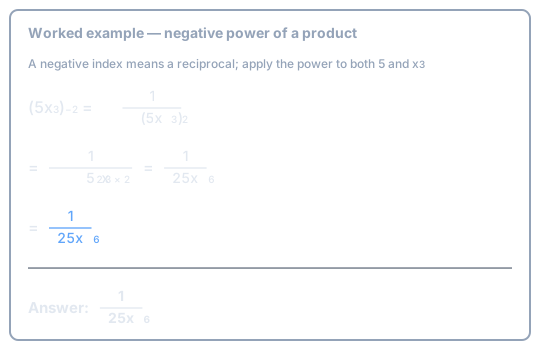
- A product raised to a power: \((5x^3)^{-2} = 5^{-2}(x^3)^{-2}\).
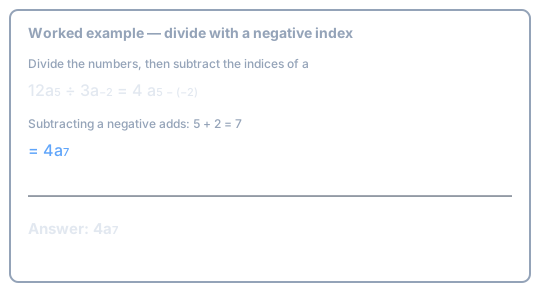
- When dividing, subtract the index of the denominator, including if that index is already negative: subtracting a negative adds.
Simplify \((5x^3)^{-2}\).
Simplify \(12a^5 \div 3a^{-2}\).
Simplify \(6x^7 y^4 \times 5x^{-5} y\).
Fractional and negative indices
\(a^{1/2} = \sqrt{a}\) and \(a^{1/n} = \sqrt[n]{a}\). A fractional index \(m/n\) means the \(n\)th root, then raise to the power \(m\): \(a^{m/n} = \left(\sqrt[n]{a}\right)^m\).
Method
- Rewrite integers such as \(8\), \(27\) and \(32\) as prime powers before you apply a fractional index.
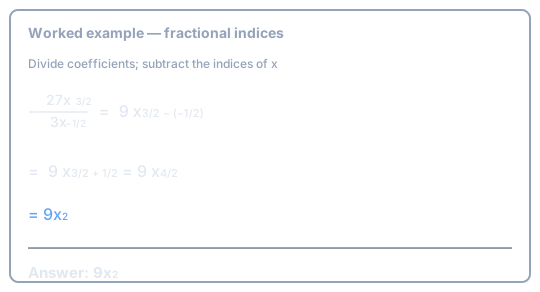
- For a quotient, divide coefficients and subtract the indices of each letter.
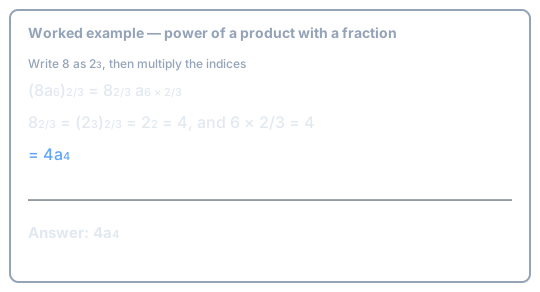
- For \((8a^6)^{2/3}\), apply \(2/3\) to \(8\) and to \(a^6\) separately.
Simplify \(\dfrac{27x^{3/2}}{3x^{-1/2}}\).
Simplify \((8a^6)^{2/3}\).
Solving by the same base
If \(a^m = a^n\) with \(a > 0\) and \(a \neq 1\), then \(m = n\). The skill is rewriting every number as a power of the same prime.
Method
- Write \(32\), \(8\), \(25\), \(27\), \(9\), \(4\) as powers of \(2\), \(3\) or \(5\).
- Use \((a^m)^n = a^{mn}\) so that both sides have the identical base.
- Equate the indices and solve the ordinary linear equation.
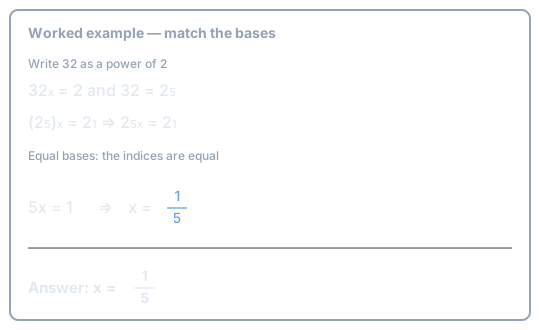
Solve \(32^x = 2\).
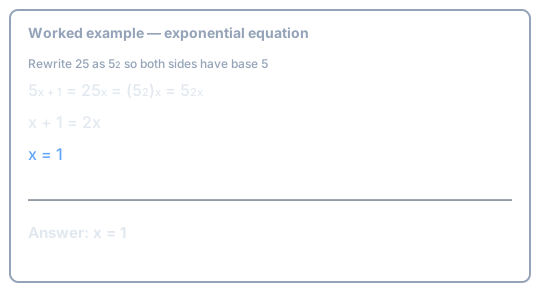
Solve \(5^{x+1} = 25^x\).
Paper 2 (non-calculator)
Rewrite \(32=2^5\), \(8=2^3\), \(25=5^2\), \(27=3^3\), \(9=3^2\) and \(4=2^2\) before you touch the unknown. Trying to “bring the power down” without a common base is a logarithm method — not on this paper.
Try this
Solve \(8^x = 2^{x+4}\).
Show answer
-
Write \(8\) as a power of \(2\)
\[ (2^3)^x = 2^{x+4} \] -
Power of a power, then equate indices
\[ 2^{3x} = 2^{x+4} \quad \Rightarrow \quad 3x = x + 4 \] -
Final answer
\[ x = 2 \]
Exam Traps
- \(a^{1/2}\) is \(\sqrt{a}\), not \(\dfrac{1}{2a}\). The index \(1/2\) is a root; a negative index is a reciprocal.
- Dividing \(12a^5 \div 3a^{-2}\) subtracts indices: \(5-(-2)=7\). Treating \(a^{-2}\) as “already a denominator” and subtracting \(2\) instead of adding it gives \(a^3\), which is wrong.
0/10