Cambridge IGCSE Mathematics — 0580 Extended
Topic 2.5: Algebra and graphs — Equations
Constructing equations
Turn a worded situation into letters and equals signs. Use a different letter for each unknown, and write one equation per independent fact. (Consecutive-even products were in Topic 2.1; here the typical exam demand is a pair of simultaneous equations.)
Method
- Name the unknowns in words, then assign letters (with units if money or measures are involved).
- Each complete sentence about a total becomes one equation.
- Do not solve yet unless the question asks for the values — sometimes you only have to form the equations.
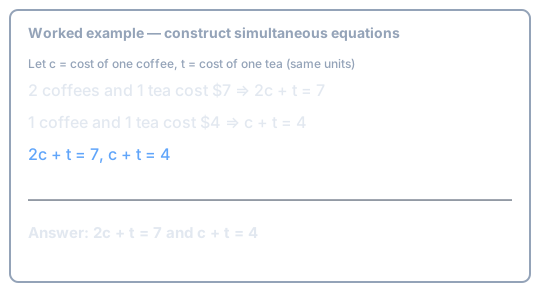
Two coffees and one tea cost $7. One coffee and one tea cost $4. Form a pair of simultaneous equations.
Linear equations
A linear equation in one unknown has the unknown to the first power only. Expand brackets, collect the letter on one side and the numbers on the other, then divide.
Method
- Expand any brackets.
- Add or subtract to collect all letter terms on one side.
- Divide by the coefficient of the letter. Leave improper fractions; do not mix a mixed number unless asked.
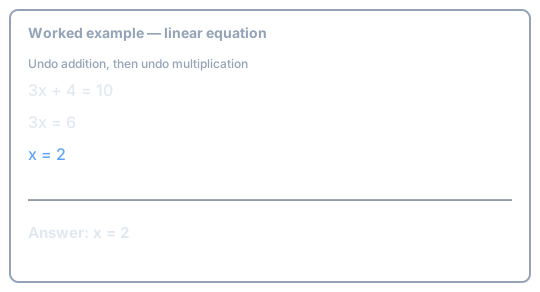
Solve \(3x + 4 = 10\).
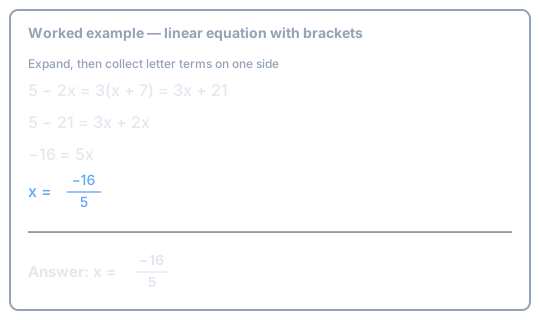
Solve \(5 - 2x = 3(x + 7)\).
Fractional equations
Clear every denominator by multiplying through by the product of the distinct denominators. Then solve the resulting linear or quadratic equation, and reject any value that makes an original denominator zero.
Method
- State the excluded values (any \(x\) that makes a denominator \(0\)).
- Multiply every term by the product of the denominators.
- Solve, then substitute each candidate back to check it is not excluded and that it satisfies the original equation.
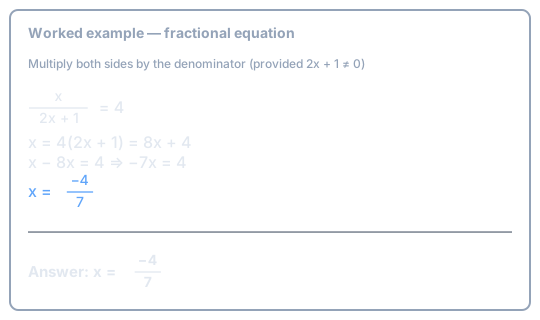
Solve \(\dfrac{x}{2x + 1} = 4\).
Solve \(\dfrac{2}{x + 2} + \dfrac{3}{2x - 1} = 1\).
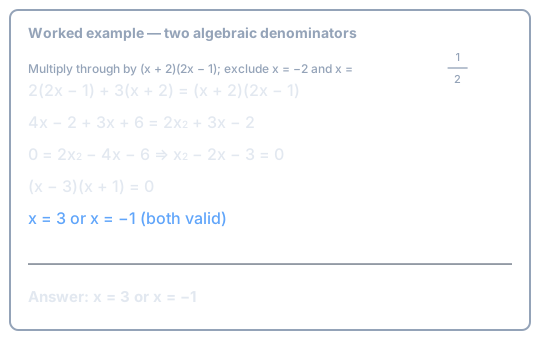
Check: \(x=3\) gives \(\dfrac{2}{5}+\dfrac{3}{5}=1\). \(x=-1\) gives \(\dfrac{2}{1}+\dfrac{3}{-3}=2-1=1\). Neither is \(x=-2\) or \(x=\dfrac{1}{2}\), so both are valid.
Paper 2 (non-calculator)
Multiply through by the product of the denominators in one line so the fractions disappear together. Then always check that neither solution makes a denominator \(0\). A root of the cleared equation that is an excluded value scores \(0\) if you leave it in.
Simultaneous equations
Two linear: elimination (add or subtract to cancel one letter) or substitution. One linear and one non-linear: rearrange the linear for one letter, substitute into the non-linear, then solve the quadratic.
Method (two linear)
- If one pair of coefficients already matches (or are opposites), add or subtract immediately.
- Otherwise multiply one or both equations so that one letter cancels.
- Substitute the first value back into the simpler original equation.
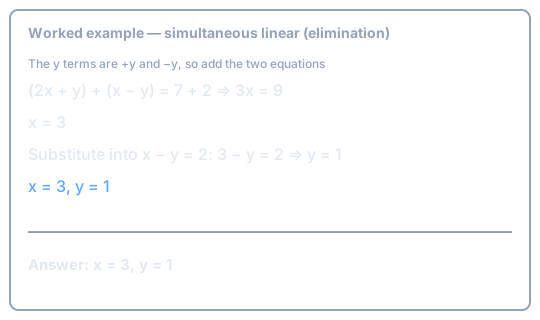
Solve \(2x + y = 7\) and \(x - y = 2\).
Method (linear and non-linear)
- Make \(y\) (or \(x\)) the subject of the linear equation.
- Substitute into the non-linear equation and expand.
- Solve the quadratic; pair each \(x\) with its \(y\). Expect two solution points unless a repeated root occurs.
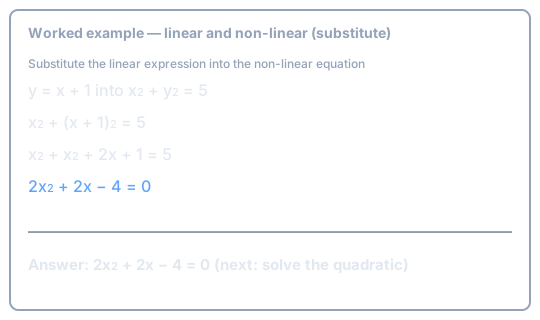
Solve \(y = x + 1\) and \(x^2 + y^2 = 5\). First substitute.
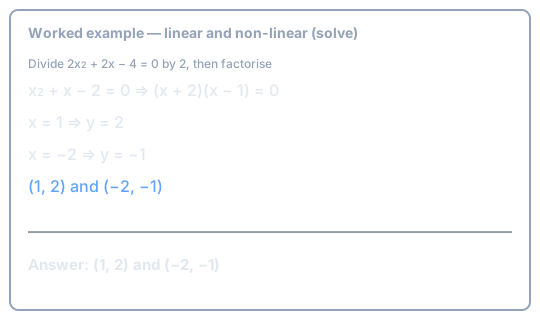
Finish the solution of \(y = x + 1\) and \(x^2 + y^2 = 5\).
Quadratic equations
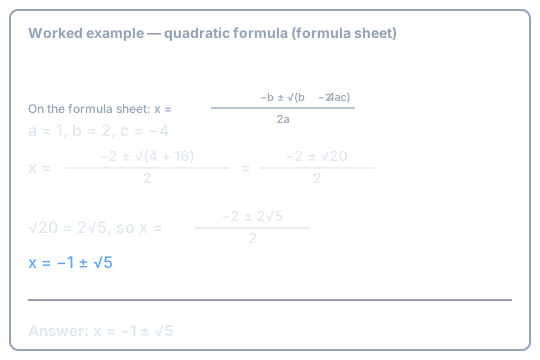
A quadratic can be solved by factorising, completing the square, or the formula. The formula is printed on the 0580 formula sheet:
Which method?
Integer roots look obvious (factors of \(c\) that add to \(b\))
Factorise.
The question says write in the form \((x+p)^2+q\), or you need the vertex
Complete the square, then solve if required.
Otherwise (messy numbers, or “leave your answer in surd form”)
Use the formula and simplify the surd.
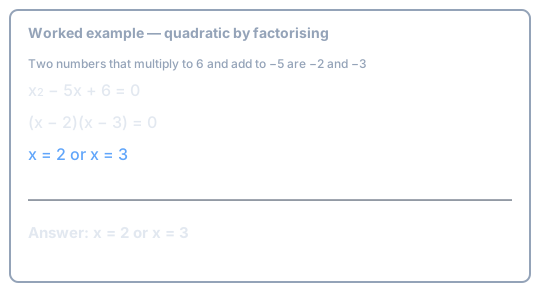
Solve \(x^2 - 5x + 6 = 0\) by factorising.
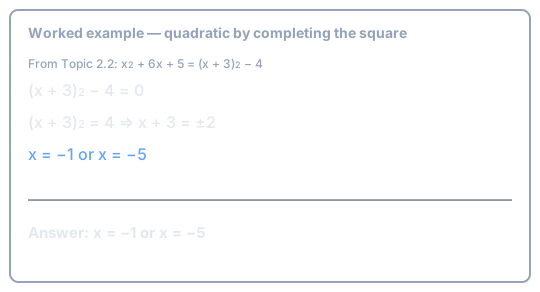
Solve \(x^2 + 6x + 5 = 0\) by completing the square.
Solve \(x^2 + 2x - 4 = 0\), leaving your answer in surd form.
Changing the subject
The same inverse operations as solving, but you stop when the named letter is isolated. If the new subject appears twice, collect those terms and factor.
Method
- Undo the last operation applied to the subject (square a root, multiply a denominator, add what was subtracted).
- If the letter appears on both sides, collect those terms on one side and factor it out.
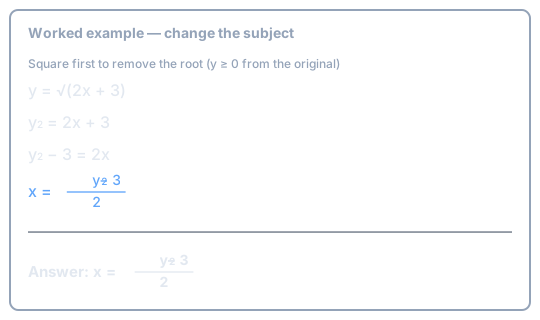
- Divide by the remaining bracket. State any restriction (for example \(r > 0\) after a square root).
Make \(x\) the subject of \(y = \sqrt{2x + 3}\).
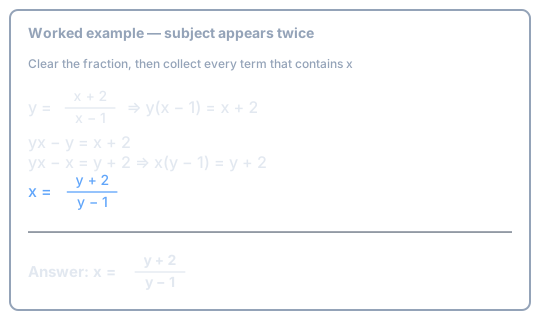
Make \(x\) the subject of \(y = \dfrac{x + 2}{x - 1}\).
Try this
Make \(r\) the subject of \(A = \pi r^2\), where \(r > 0\).
Show answer
-
Divide both sides by \(\pi\)
\[ r^2 = \dfrac{A}{\pi} \] -
Positive square root, since \(r > 0\)
\[ r = \sqrt{\dfrac{A}{\pi}} \]
Exam Traps
- From \(y=\dfrac{x+2}{x-1}\), after expanding you get \(yx-y=x+2\). Collecting \(x\) is \(yx-x=y+2\), then \(x(y-1)=y+2\). Subtracting \(yx\) from the wrong side, or dividing by \(y\) before collecting, loses the mark.
0/10