Cambridge IGCSE Mathematics — 0580 Extended
Topic 2.6: Algebra and graphs — Inequalities
Number lines
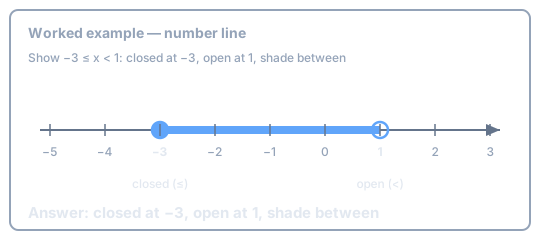
An inequality compares two expressions. On a number line, the boundary is an open circle for \(<\) or \(>\) (value not included) and a closed circle for \(\leq\) or \(\geq\) (value included). Shade the values that satisfy the inequality.
Method
- Mark each endpoint. Closed circle if the inequality includes equals; open if it does not.
- Shade every number that makes the inequality true — between the endpoints for a compound statement, or out to an arrow for a single inequality.
Show \(-3 \leq x < 1\) on a number line.
Solving linear inequalities
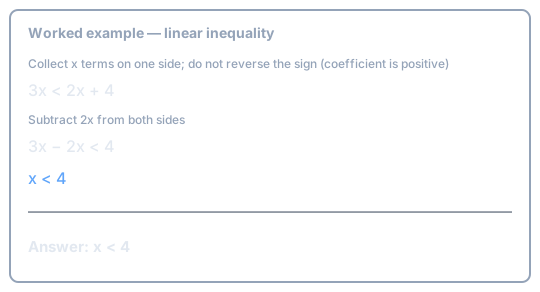
Solve an inequality with the same steps as an equation, with one extra rule: if you multiply or divide by a negative number, reverse the inequality sign.
Which method?
You multiply or divide by a positive number
Keep the inequality sign the same.
You multiply or divide by a negative number
Reverse the inequality sign (\( < \) becomes \( > \), \(\leq\) becomes \(\geq\)).
Solve \(3x < 2x + 4\).
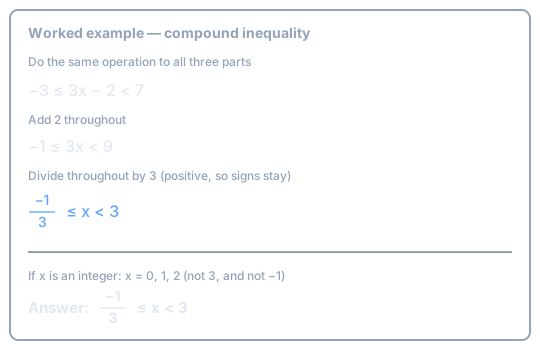
Solve \(-3 \leq 3x - 2 < 7\).
Paper 2 (non-calculator)
If the question asks for integer values of \(x\) satisfying \(-\dfrac{1}{3} \leq x < 3\), list \(x = 0, 1, 2\). Do not include \(3\) (\(x < 3\)) and do not include \(-1\) (because \(-1 < -\dfrac{1}{3}\)).
Two-variable graphs
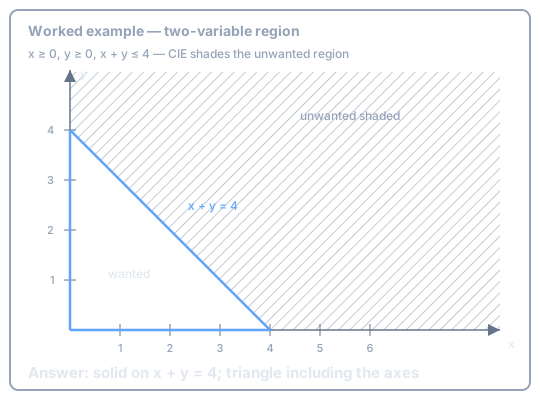
A linear inequality in \(x\) and \(y\) is a half-plane. Draw the boundary line \(ax + by = c\). Use a broken line for \(<\) or \(>\) and a solid line for \(\leq\) or \(\geq\).
Cambridge papers shade the unwanted region unless the question says otherwise. Linear programming is not in this syllabus.
Method
- Draw each boundary. Solid if equals is allowed; broken if not.
- Test a point (often the origin) in each inequality to see which side is wanted.
- Shade the unwanted side of every line. The unshaded region, including solid boundaries, is the solution.
Show the region \(x \geq 0\), \(y \geq 0\), \(x + y \leq 4\).
Listing inequalities from a region
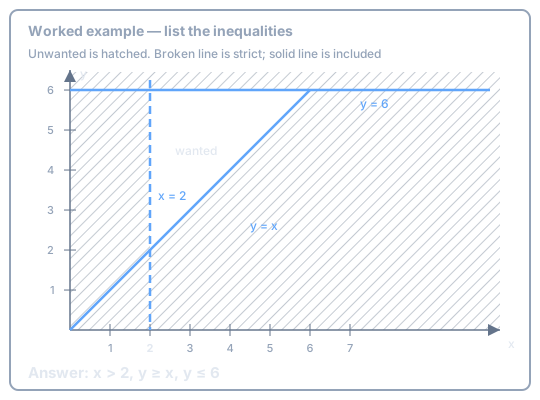
Read each boundary, then decide the direction from the unshaded (wanted) side. A broken line is strict; a solid line includes equality.
Write the three inequalities that define the unshaded region.
Try this
Solve \(5 - 2x \geq 11\).
Show answer
-
Subtract 5 from both sides
\[ -2x \geq 6 \] -
Divide by \(-2\) and reverse the sign
\[ x \leq -3 \] -
Final answer
\[ x \leq -3 \]
Exam Traps
- Reverse the inequality sign when you multiply or divide by a negative. Forgetting this is the usual mark-loss on \(5 - 2x \geq 11\).
- CIE shades unwanted regions unless the question tells you to shade the required region. Do not assume “shade the answer”.
0/10