Cambridge IGCSE Mathematics — 0580 Extended
Topic 2.7: Algebra and graphs — Sequences
Continuing a sequence
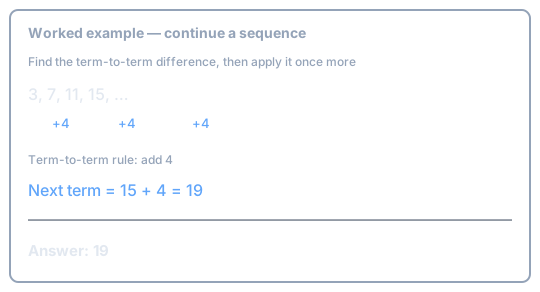
The subscript \(T_n\) means the \(n\)th term. Position \(n\) starts at \(1\) unless the question says otherwise. The term-to-term rule tells you how to get from one term to the next; the position-to-term (nth-term) rule gives any term directly.
Find the next term of \(3, 7, 11, 15, \ldots\)
Linear nth term
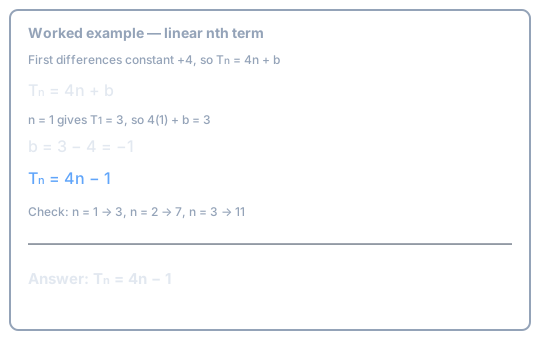
If first differences are constant, the sequence is linear: \(T_n = dn + b\), where \(d\) is that common difference.
Method
- Find the common difference \(d\).
- Write \(T_n = dn + b\). Substitute \(n = 1\) (the first term) to find \(b\).
- Check \(n = 2\) and \(n = 3\).
Find the \(n\)th term of \(3, 7, 11, 15, \ldots\)
Paper 2 (non-calculator)
If the question asks for the \(n\)th term, write \(4n - 1\). “Add 4 each time” is a term-to-term rule and does not score as an nth-term formula.
Quadratic sequences
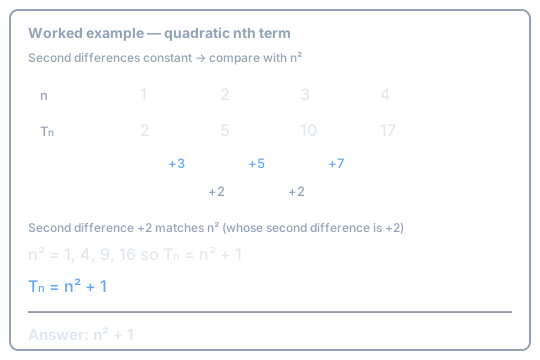
If the second differences are constant, the sequence is quadratic. For \(n^2\) the second difference is \(+2\), so a second difference of \(+2\) means the coefficient of \(n^2\) is \(1\). Compare the sequence with \(n^2\), then adjust.
Find the \(n\)th term of \(2, 5, 10, 17, \ldots\)
Cubic and exponential
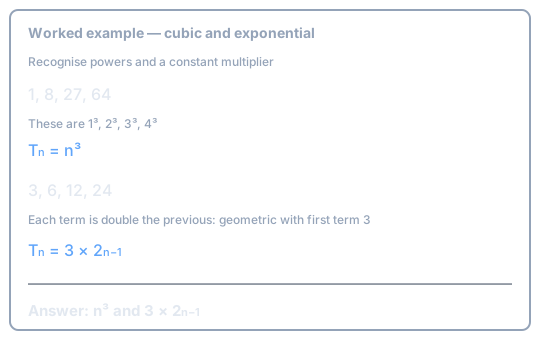
Cubes grow as \(1, 8, 27, 64, \ldots\) so \(T_n = n^3\). If each term is multiplied by the same constant, the sequence is exponential (geometric).
Find the \(n\)th term of \(1, 8, 27, 64\) and of \(3, 6, 12, 24\).
Combinations
Some sequences mix a power with a constant. Use differences to rule out linear or quadratic first, then test simple combinations such as \(n^2 + 1\) or \(2^n + 1\).
Which method?
First differences are constant
Linear: \(T_n = dn + b\).
Second differences are constant
Quadratic: compare with \(n^2\), then adjust.
Each term is multiplied by the same constant
Exponential: \(T_n = a \times r^{n-1}\).
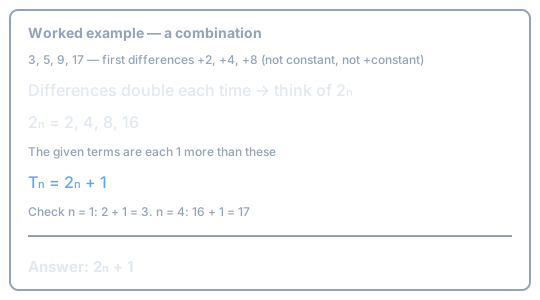
Find the \(n\)th term of \(3, 5, 9, 17, \ldots\)
Try this
Find the \(n\)th term of \(5, 8, 11, 14, \ldots\)
Show answer
-
Common difference is \(3\), so \(T_n = 3n + b\)
\[ T_1 = 3(1) + b = 5 \] -
Solve for \(b\)
\[ b = 2 \] -
Final answer
\[ T_n = 3n + 2 \]
Exam Traps
- \(n^2 + n\) and \((n+1)^2\) look similar. Substitute \(n = 1\): \(n^2 + n = 2\) but \((n+1)^2 = 4\). Always check the first term.
- Position \(n\) starts at \(1\) unless the question numbers from \(0\) or from a given \(n\).
0/10