Cambridge IGCSE Mathematics — 0580 Extended
Topic 2.8: Algebra and graphs — Algebraic Proportion
Direct proportion
If \(y\) is directly proportional to a power of \(x\), write the statement with \(\propto\), then replace \(\propto\) by \(= k\). Always introduce the constant \(k\).
| Statement | With \(\propto\) | Equation |
|---|---|---|
| \(y\) varies as \(x\) | \(y \propto x\) | \(y = kx\) |
| \(y\) varies as the square of \(x\) | \(y \propto x^2\) | \(y = kx^2\) |
| \(y\) varies as the square root of \(x\) | \(y \propto \sqrt{x}\) | \(y = k\sqrt{x}\) |
| \(y\) varies as the cube of \(x\) | \(y \propto x^3\) | \(y = kx^3\) |
| \(y\) varies as the cube root of \(x\) | \(y \propto \sqrt[3]{x}\) | \(y = k\sqrt[3]{x}\) |
Inverse proportion
Inverse means \(y\) is proportional to a reciprocal. \(y \propto \dfrac{1}{x}\) becomes \(y = \dfrac{k}{x}\). Inverse square is \(y \propto \dfrac{1}{x^2}\), so \(y = \dfrac{k}{x^2}\).
Finding \(k\), then the unknown
You are given one pair of values. Use that pair to find \(k\), write the full equation, then substitute the new value.
Method
- Write \(y \propto \ldots\), then \(y = k \times \ldots\).
- Substitute the given pair and solve for \(k\).
- Write the equation with that \(k\), then find the required unknown.
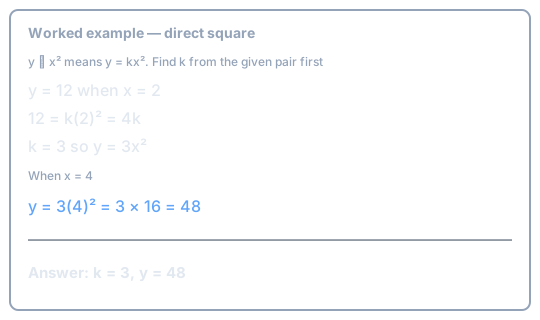
\(y \propto x^2\) and \(y = 12\) when \(x = 2\). Find \(y\) when \(x = 4\).
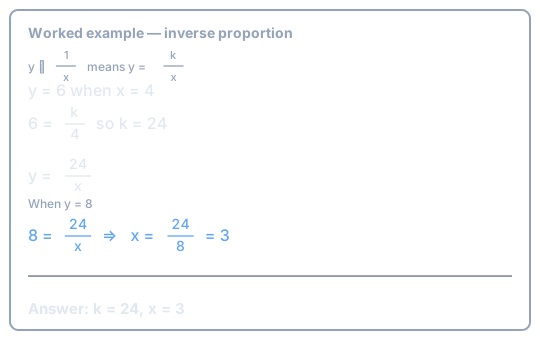
\(y \propto \dfrac{1}{x}\) and \(y = 6\) when \(x = 4\). Find \(x\) when \(y = 8\).
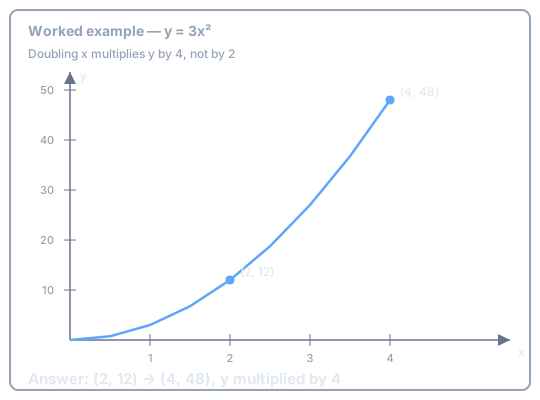
On \(y = 3x^2\), what happens to \(y\) when \(x\) doubles from \(2\) to \(4\)?
Paper 2 (non-calculator)
Find \(k\) from the given pair before finding the unknown. Jumping straight to a ratio without \(k\) is how the inverse-square questions lose a method mark.
Combined wording
Exam sentences hide the power inside words such as “the square” or “the square root”. Write \(\propto\) first so the power cannot slip.
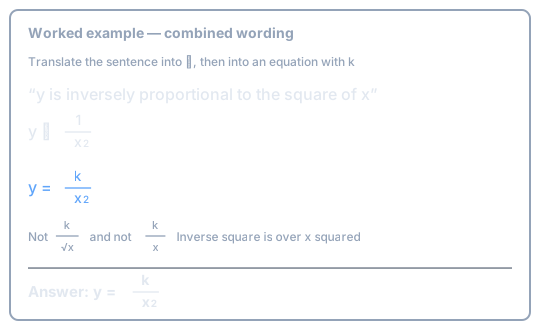
Write an equation for “\(y\) is inversely proportional to the square of \(x\)”.
Try this
\(y \propto \sqrt{x}\) and \(y = 10\) when \(x = 4\). Find \(y\) when \(x = 16\).
Show answer
-
Write the equation and substitute the given pair
\[ y = k\sqrt{x} \]\[ 10 = k\sqrt{4} = 2k \] -
Find \(k\), then substitute \(x = 16\)
\[ k = 5, \quad y = 5\sqrt{16} = 5 \times 4 \] -
Final answer
\[ y = 20 \]
Exam Traps
- Inverse square is \(k/x^2\), not \(k/\sqrt{x}\). “Square root” and “square” are different powers.
- Direct square: doubling \(x\) multiplies \(y\) by \(4\), not by \(2\).
0/10