Cambridge IGCSE Mathematics — 0580 Extended
Topic 3.1: Coordinate geometry — Coordinates
The Cartesian plane
Every point in the plane is written as an ordered pair \((x, y)\). The first number is the x-coordinate (horizontal); the second is the y-coordinate (vertical). The axes cross at the origin \((0, 0)\).
| Quadrant | Signs | Example |
|---|---|---|
| I | \((+, +)\) | \((3, 2)\) |
| II | \((-, +)\) | \((-4, 1)\) |
| III | \((-, -)\) | \((-2, -1)\) |
| IV | \((+, -)\) | \((5, -3)\) |
Method
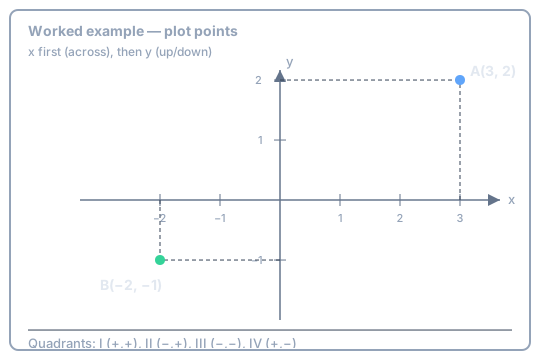
- From the origin, move \(x\) units right if positive (left if negative).
- Then move \(y\) units up if positive (down if negative).
- Mark the point and label it with its coordinates.
Plot \(A(3, 2)\) and \(B(-2, -1)\) on a coordinate grid.
Reading coordinates from a grid
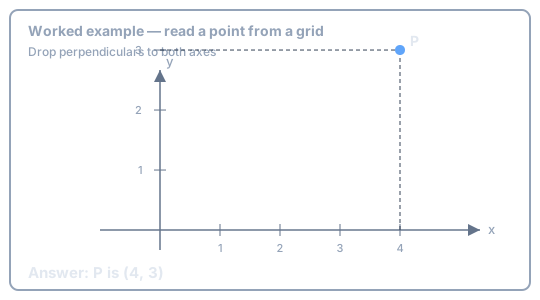
Drop (or imagine) perpendiculars from the point to each axis. Read the \(x\)-value from the horizontal axis and the \(y\)-value from the vertical axis. Write them in the order \((x, y)\).
The point \(P\) is marked on a grid. Write its coordinates.
Paper 2 (non-calculator)
Check the scale carefully. One square might be \(1\) unit, \(2\) units, or \(0.5\) units. Misreading the scale is the most common coordinate mark-loss.
Points on the axes
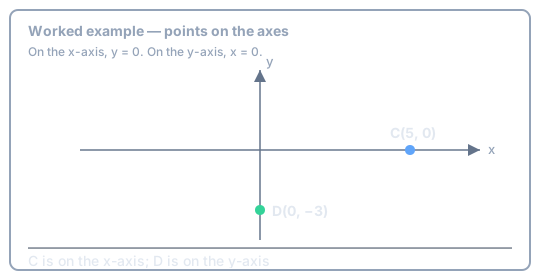
Any point on the x-axis has \(y = 0\). Any point on the y-axis has \(x = 0\). The origin is on both axes.
Identify the coordinates of \(C\) on the \(x\)-axis and \(D\) on the \(y\)-axis.
Try this
Which quadrant contains the point \((-5, 2)\)? What are the coordinates of a point \(3\) units left of the origin on the \(x\)-axis?
Show answer
-
Negative \(x\), positive \(y\)
\[ (-5, 2) \text{ is in quadrant II} \] -
On the \(x\)-axis, \(y = 0\)
\[ (-3, 0) \]
Exam Traps
- Do not swap the order: \((2, 5)\) is not the same point as \((5, 2)\).
- A point “on the \(x\)-axis” must have \(y = 0\), not \(x = 0\).
0/10