Cambridge IGCSE Mathematics — 0580 Extended
Topic 3.2: Coordinate geometry — Drawing Linear Graphs
The form \(y = mx + c\)
Every straight line that is not vertical can be written as \(y = mx + c\). The number \(m\) is the gradient; \(c\) is the y-intercept (where the line crosses the \(y\)-axis).
| Equation | Gradient \(m\) | y-intercept \(c\) |
|---|---|---|
| \(y = 3x - 1\) | \(3\) | \(-1\) |
| \(y = 7 - 4x\) | \(-4\) | \(7\) |
| \(y = \dfrac{1}{2}x\) | \(\dfrac{1}{2}\) | \(0\) |
Method
- Choose at least three \(x\)-values (including negatives if the grid allows).
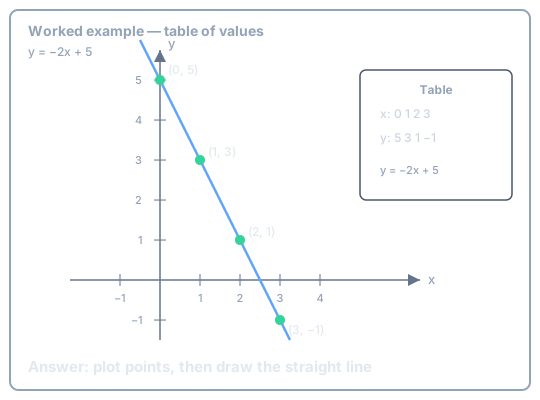
- Substitute to find the matching \(y\)-values — a table of values.
- Plot the points carefully, then join them with a straight line and extend it.
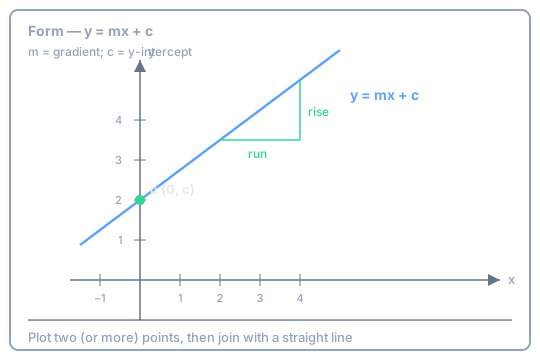
Table of values
For \(y = -2x + 5\), pick simple integers for \(x\), work out \(y\), then plot.
Draw the graph of \(y = -2x + 5\) for \(-1 \leqslant x \leqslant 3\).
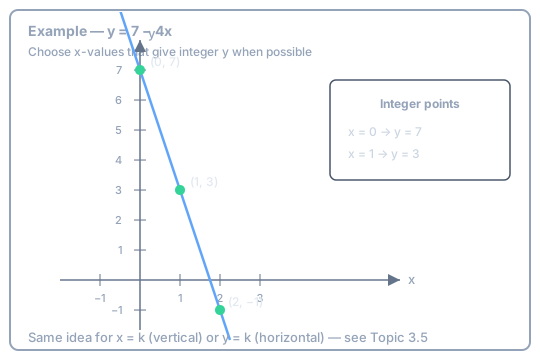
Sketch \(y = 7 - 4x\) using integer points.
Paper 2 (non-calculator)
Choose \(x\)-values that keep \(y\) as an integer when you can. Fractions on the grid are easy to mis-plot under exam pressure.
Finding intercepts
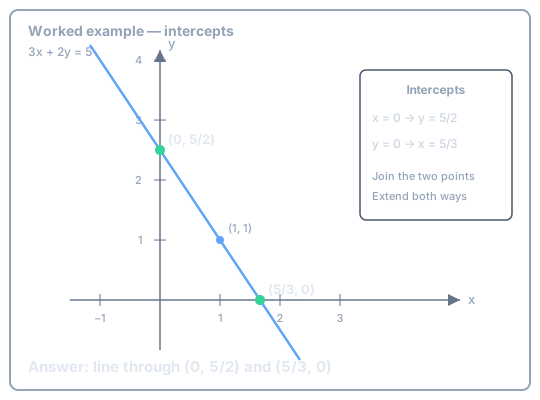
When the equation is given as \(ax + by = d\), rearrange or use intercepts: set \(x = 0\) to find the \(y\)-intercept, and set \(y = 0\) to find the \(x\)-intercept. Two points are enough to draw a straight line.
Method
- Put \(x = 0\): solve for \(y\) — mark \((0, y)\).
- Put \(y = 0\): solve for \(x\) — mark \((x, 0)\).
- Join the intercepts with a straight line and extend beyond both points.
Draw the graph of \(3x + 2y = 5\) by finding intercepts.
Try this
Find the intercepts of \(2x + 5y = 10\), then state one other integer point on the line.
Show answer
-
\(x = 0\)
\[ 5y = 10 \Rightarrow y = 2 \quad (0, 2) \] -
\(y = 0\)
\[ 2x = 10 \Rightarrow x = 5 \quad (5, 0) \] -
Another integer point (e.g. \(x = -5\))
\[ (-5, 4) \]
0/10