Cambridge IGCSE Mathematics — 0580 Extended
Topic 3.3: Coordinate geometry — Gradient
Gradient from a graph
The gradient \(m\) of a straight line measures how steep it is:
\[ m = \frac{\text{rise}}{\text{run}} = \frac{\text{change in } y}{\text{change in } x} \]
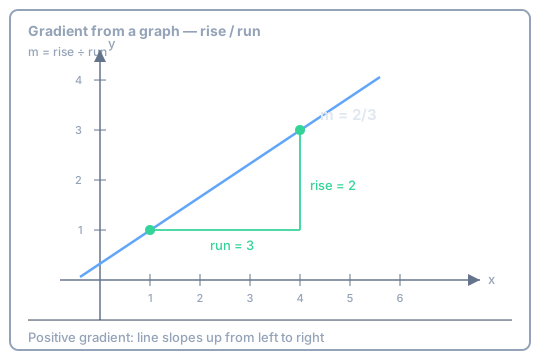
Pick two clear lattice points on the line. Draw a right-angled triangle: horizontal side = run, vertical side = rise.
Method
- Choose two points on the line with integer coordinates if possible.
- Run = difference in \(x\) (positive when moving right).
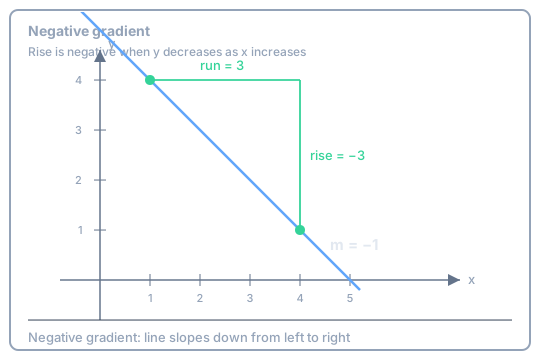
- Rise = difference in \(y\) (positive up, negative down).
- Write \(m = \dfrac{\text{rise}}{\text{run}}\) and simplify.
Find the gradient of the line shown on the grid.
Gradient from two points
For points \(A(x_1, y_1)\) and \(B(x_2, y_2)\):
\[ m = \frac{y_2 - y_1}{x_2 - x_1} \]
The order of the points does not matter, but you must subtract in the same order in the numerator and the denominator.
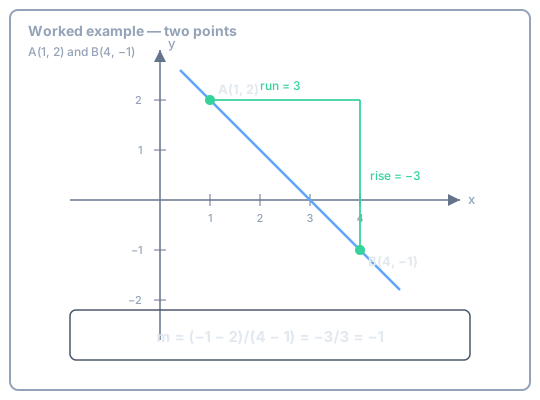
Find the gradient of the line through \(A(1, 2)\) and \(B(4, -1)\).
Try this
Find the gradient of the line through \(P(-2, 5)\) and \(Q(4, 2)\).
Show answer
-
Substitute into the formula
\[ m = \frac{2 - 5}{4 - (-2)} \] -
Simplify
\[ m = \frac{-3}{6} = -\frac{1}{2} \] -
Gradient
\[ m = -\dfrac{1}{2} \]
Types of gradient
| Type | What the line does | Value of \(m\) |
|---|---|---|
| Positive | Slopes up left \(\to\) right | \(m \gt 0\) |
| Negative | Slopes down left \(\to\) right | \(m \lt 0\) |
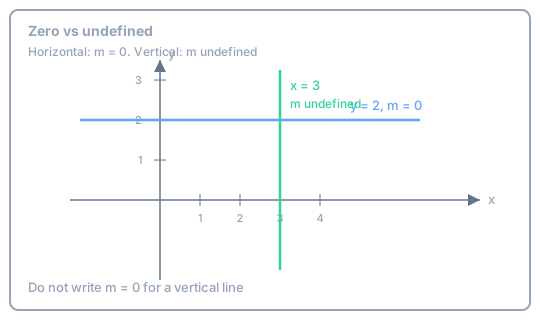
| Zero | Horizontal (\(y = k\)) | \(m = 0\) |
| Undefined | Vertical (\(x = k\)) | undefined (not \(0\)) |
Exam Traps
- Do not swap rise and run — \(\dfrac{\text{run}}{\text{rise}}\) is not the gradient.
- A vertical line has undefined gradient; do not write \(m = 0\).
0/10