Cambridge IGCSE Mathematics — 0580 Extended
Topic 3.5: Coordinate geometry — Equations of Lines
Forms of a straight-line equation
A straight line can be written in several equivalent forms. The form you use depends on what the question gives you — and what it asks for.
| Form | Meaning | Example |
|---|---|---|
| \(y = mx + c\) | Gradient \(m\), \(y\)-intercept \(c\) | \(y = 2x - 3\) |
| \(ax + by = c\) | General linear form (rearrange to find \(m\)) | \(5x + 4y = 8\) |
| \(y = k\) | Horizontal line (gradient \(0\)) | \(y = 3\) |
| \(x = k\) | Vertical line (gradient undefined) | \(x = -2\) |
Method
- If you need \(m\) or \(c\), rearrange into \(y = mx + c\).
- If you need an equation from a graph or points, find \(m\), then substitute a known point.
- Fully simplify: cancel common factors; leave fractions in lowest terms.
Gradient and intercept from an equation
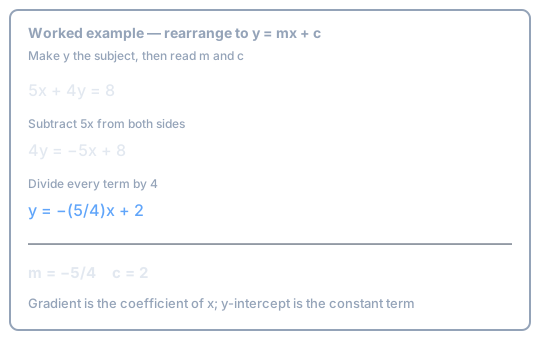
When the equation is not already \(y = mx + c\), rearrange so \(y\) is the subject. Then \(m\) is the coefficient of \(x\) and \(c\) is the constant term.
Rearrange \(5x + 4y = 8\) into the form \(y = mx + c\). State the gradient and the \(y\)-intercept.
Paper 2 (non-calculator)
Keep the fraction: \(m = -\dfrac{5}{4}\) is preferred to a decimal. If you divide every term, do not forget to divide the constant as well.
Equation from two points
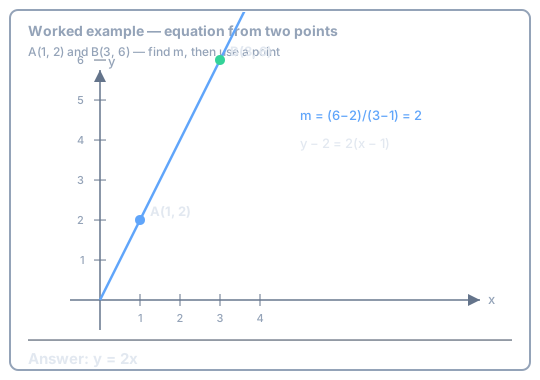
Find the gradient first, then substitute either point into \(y - y_1 = m(x - x_1)\) (or into \(y = mx + c\) to find \(c\)). Simplify fully.
Method
- \(m = \dfrac{y_2 - y_1}{x_2 - x_1}\).
- Substitute one point: \(y - y_1 = m(x - x_1)\).
- Expand and simplify to \(y = mx + c\) (or another fully simplified form if asked).
Find the equation of the line through \(A(1, 2)\) and \(B(3, 6)\).
Gradient and a point; horizontal and vertical
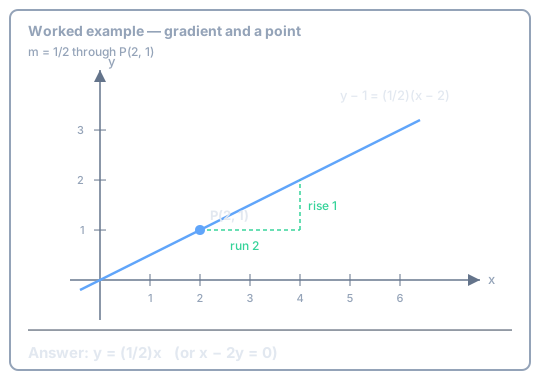
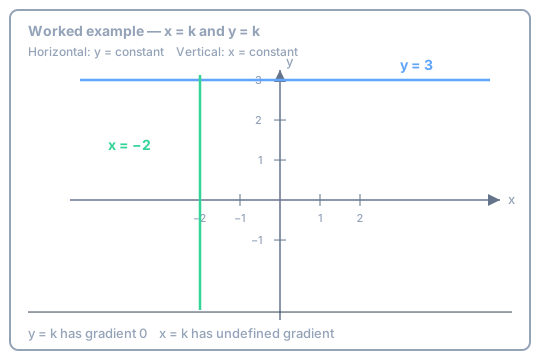
If you know \(m\) and one point, use the same point–gradient step. Horizontal lines are \(y = k\); vertical lines are \(x = k\).
A line has gradient \(\dfrac{1}{2}\) and passes through \(P(2, 1)\). Find its equation.
Identify the equations of the horizontal and vertical lines shown.
Try this
Find the gradient and \(y\)-intercept of \(3x - 6y = 12\). Then find the equation of the line through \((0, 4)\) and \((2, 0)\).
Show answer
-
Rearrange \(3x - 6y = 12\)
\[ -6y = -3x + 12 \Rightarrow y = \dfrac{1}{2}x - 2 \] -
So \(m = \dfrac{1}{2}\), \(c = -2\)
\[ m = \tfrac{1}{2},\quad c = -2 \] -
Two points: find \(m\)
\[ m = \dfrac{0 - 4}{2 - 0} = -2 \] -
Through \((0, 4)\): \(c = 4\)
\[ y = -2x + 4 \]
Exam Traps
- Do not leave \(y - 2 = 2(x - 1)\) as the final answer unless the question allows it — CIE usually wants a fully simplified equation.
- A vertical line is \(x = k\), not \(y = k\). Its gradient is undefined — do not write \(m = 0\).
0/10