Cambridge IGCSE Mathematics — 0580 Extended
Topic 3.6: Coordinate geometry — Parallel Lines
Equal gradients
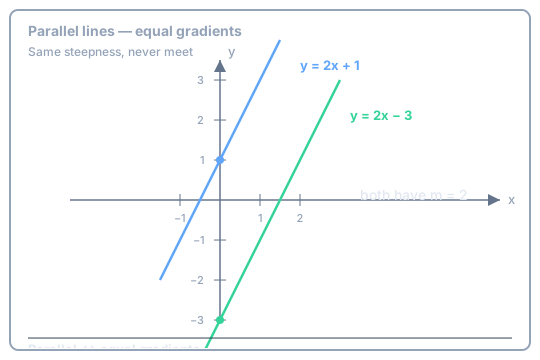
Two straight lines are parallel if and only if they have the same gradient (and are not the same line). They never meet, however far you extend them.
Show that \(y = 2x + 1\) and \(y = 2x - 3\) are parallel.
Method
- Read (or rearrange to find) the gradient of the given line.
- A parallel line has exactly the same \(m\).
- Use the given point to find \(c\) (or use \(y - y_1 = m(x - x_1)\)).
Parallel line through a point
Keep the gradient. Change the intercept so the line passes through the given point.
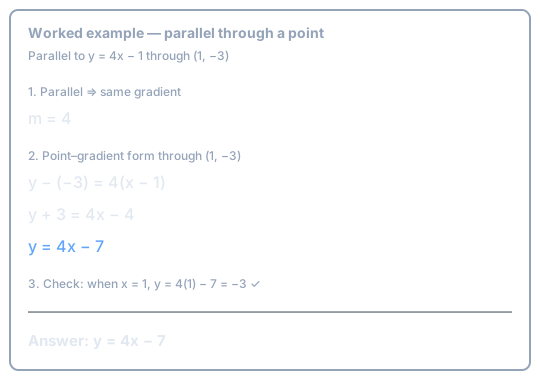
Find the equation of the line parallel to \(y = 4x - 1\) that passes through \((1, -3)\).
Paper 2 (non-calculator)
Check by substituting the point back into your answer: for \(y = 4x - 7\), when \(x = 1\), \(y = -3\). If the point does not satisfy the equation, the intercept is wrong.
Given line in \(ax + by = c\) form
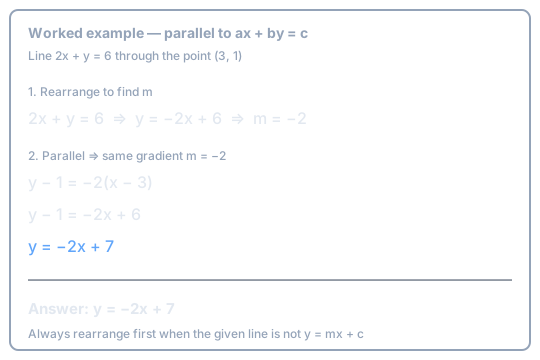
If the given line is not already \(y = mx + c\), rearrange first to find \(m\). Then proceed exactly as before.
Find the equation of the line parallel to \(2x + y = 6\) that passes through \((3, 1)\).
Try this
Find the equation of the line parallel to \(3x - y = 4\) that passes through \((-1, 2)\).
Show answer
-
Rearrange to find \(m\)
\[ -y = -3x + 4 \Rightarrow y = 3x - 4 \Rightarrow m = 3 \] -
Same \(m\), through \((-1, 2)\)
\[ y - 2 = 3\bigl(x - (-1)\bigr) = 3(x + 1) \] -
Fully simplified
\[ y = 3x + 5 \]
0/10