Cambridge IGCSE Mathematics — 0580 Extended
Topic 3.7: Coordinate geometry — Perpendicular Lines
Negative reciprocal gradients
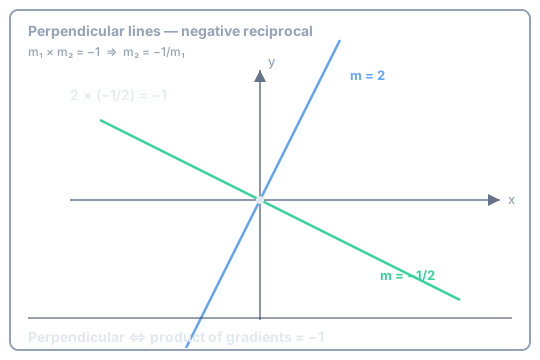
Two lines are perpendicular if they meet at a right angle. Their gradients \(m_1\) and \(m_2\) satisfy
\[ m_1 \times m_2 = -1 \quad \Rightarrow \quad m_2 = -\dfrac{1}{m_1} \]
(provided neither line is vertical). A horizontal line (\(m = 0\)) is perpendicular to a vertical line (\(x = k\)).
The lines \(y = 2x\) and \(y = -\dfrac{1}{2}x\) are perpendicular. Why?
Method
- Find \(m_1\) of the given line (rearrange if needed).
- The perpendicular gradient is \(m_2 = -\dfrac{1}{m_1}\).
- Substitute the given point into \(y - y_1 = m_2(x - x_1)\) and simplify.
Finding a perpendicular gradient
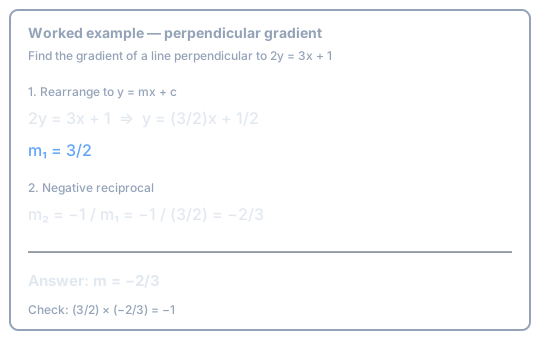
Always rearrange into \(y = mx + c\) first if the equation is given in another form.
Find the gradient of a line perpendicular to \(2y = 3x + 1\).
Paper 2 (non-calculator)
To find \(-\dfrac{1}{m}\) when \(m = \dfrac{a}{b}\), flip and change the sign: \(-\dfrac{b}{a}\). Check by multiplying: \(\dfrac{a}{b} \times \left(-\dfrac{b}{a}\right) = -1\).
Equation of a perpendicular through a point
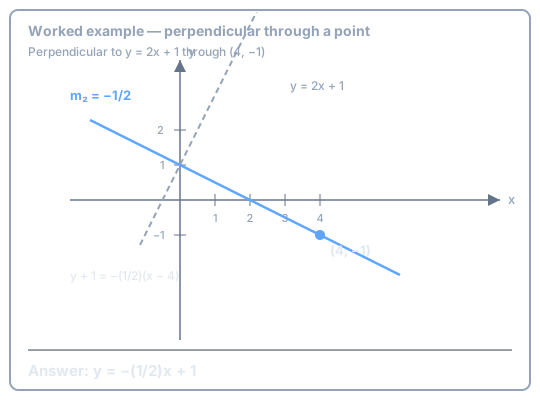
Same idea as parallel lines, but use the negative reciprocal instead of the same gradient.
Find the equation of the line perpendicular to \(y = 2x + 1\) that passes through \((4, -1)\).
Perpendicular bisector
The perpendicular bisector of the segment joining two points is the line that:
- passes through the midpoint of the segment, and
- has gradient equal to the negative reciprocal of the segment’s gradient.
Method
- Midpoint: \(M = \left(\dfrac{x_1 + x_2}{2},\, \dfrac{y_1 + y_2}{2}\right)\).
- Gradient of \(AB\): \(m_{AB} = \dfrac{y_2 - y_1}{x_2 - x_1}\).
- Perpendicular gradient: \(m = -\dfrac{1}{m_{AB}}\).
- Equation through \(M\) with that \(m\); simplify fully.
Find the equation of the perpendicular bisector of the line joining \(A(-3, 8)\) and \(B(9, -2)\).

Try this
Find the gradient of a line perpendicular to \(y = -\dfrac{3}{4}x + 2\). Then find the equation of the line perpendicular to \(y = 3x - 1\) through \((0, 5)\).
Show answer
-
Negative reciprocal of \(-\dfrac{3}{4}\)
\[ m = -\dfrac{1}{-\tfrac{3}{4}} = \dfrac{4}{3} \] -
Perpendicular to \(y = 3x - 1\): \(m = -\dfrac{1}{3}\)
\[ y - 5 = -\dfrac{1}{3}(x - 0) \] -
Fully simplified
\[ y = -\dfrac{1}{3}x + 5 \]
Exam Traps
- Do not confuse parallel (same \(m\)) with perpendicular (\(m_2 = -1/m_1\)).
- Horizontal \(\perp\) vertical: a line \(y = k\) is perpendicular to \(x = c\), not to another horizontal line.
- For a perpendicular bisector you need both the midpoint and the negative reciprocal — using only one loses marks.
0/10