Cambridge IGCSE Mathematics — 0580 Extended
Topic 4.1: Geometry — Geometrical Terms
Points, lines and angles
A point has position but no size. A line joins two points; a plane is a flat surface. Two lines are parallel if they never meet, and perpendicular if they meet at \(90^\circ\). A vertex is a corner where edges meet.
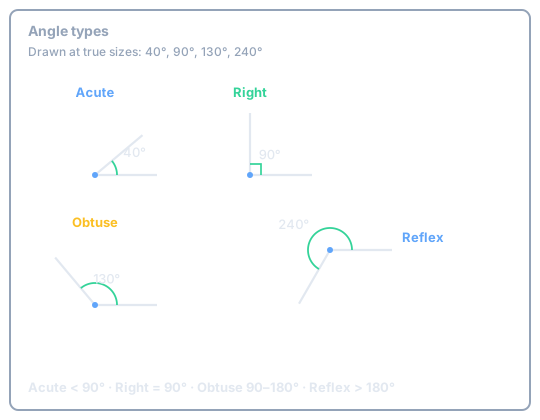
| Angle | Size |
|---|---|
| Acute | greater than \(0^\circ\), less than \(90^\circ\) |
| Right | exactly \(90^\circ\) |
| Obtuse | greater than \(90^\circ\), less than \(180^\circ\) |
| Straight | exactly \(180^\circ\) |
| Reflex | greater than \(180^\circ\), less than \(360^\circ\) |
An interior angle sits inside a polygon; an exterior angle is formed by extending one side. A bearing is an angle measured clockwise from north (three figures, \(000^\circ\) to \(360^\circ\)).
Identify each angle type. The diagrams are drawn to the labelled sizes.
Triangles and quadrilaterals
Similar shapes have the same angles and sides in the same ratio (a scale factor links corresponding lengths). Congruent shapes are identical in size and shape. You are not asked to prove two shapes are congruent, but you must use the word correctly.
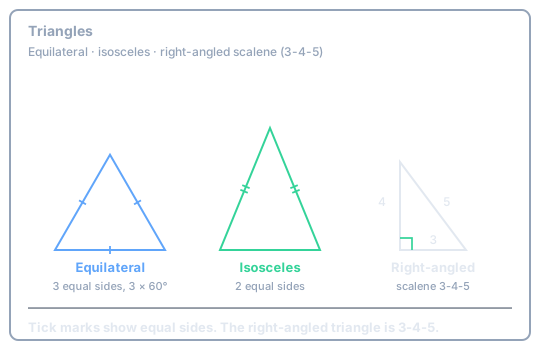
| Triangle | Property |
|---|---|
| Equilateral | 3 equal sides, 3 equal angles (\(60^\circ\)) |
| Isosceles | 2 equal sides, 2 equal base angles |
| Scalene | no equal sides |
| Right-angled | one angle of \(90^\circ\) |
Name each triangle from the diagram.
| Quadrilateral | Key facts |
|---|---|
| Square | 4 equal sides, 4 right angles |
| Rectangle | opposite sides equal, 4 right angles |
| Rhombus | 4 equal sides, opposite angles equal |
| Parallelogram | opposite sides parallel and equal |
| Kite | 2 pairs of adjacent equal sides |
| Trapezium | exactly one pair of parallel sides |
Polygons, nets and solids
A polygon is a closed 2-D shape with straight sides. Regular means all sides equal and all angles equal.
| Name | Sides |
|---|---|
| Pentagon | 5 |
| Hexagon | 6 |
| Octagon | 8 |
| Decagon | 10 |
A net is a 2-D arrangement of faces that folds to make a solid. Solids you must name: cube, cuboid, prism, cylinder, pyramid, cone, sphere, hemisphere, frustum. Count faces, edges and vertices (corners).
Circle vocabulary
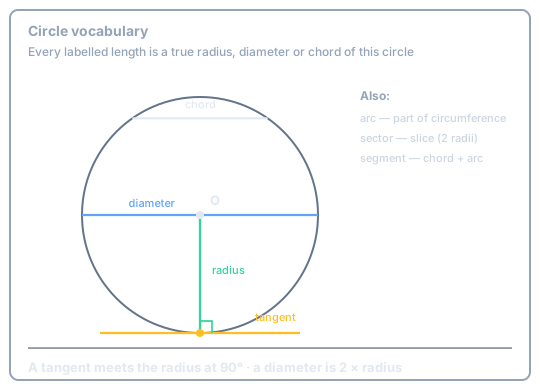
The centre is the point the same distance from every point on the circumference. That distance is the radius; the diameter is twice the radius and passes through the centre.
Method
- Radius: centre to circumference. Diameter: \(2 \times\) radius, through the centre.
- Chord: line joining two points on the circumference (a diameter is a special chord).
- Tangent: line that touches the circle at exactly one point.
Label centre, radius, diameter, chord and tangent on one circle.
What is the difference between a sector and a segment?
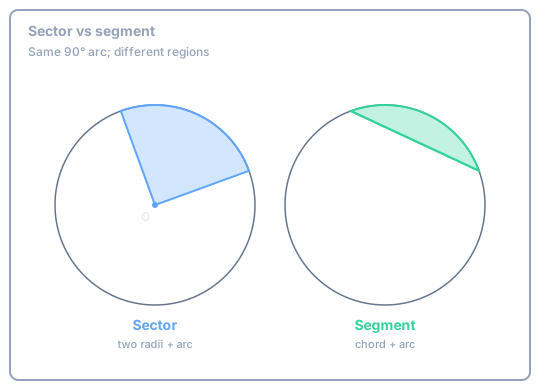
Also: semicircle (half the circle), major/minor arc (the longer/shorter path along the circumference), major/minor sector and major/minor segment.
Try this
A circle has diameter \(10\,\text{cm}\). State the radius. Name the line that touches the circle at one point only.
Show answer
-
Radius is half the diameter
\[ r = 5\,\text{cm} \] -
Touches at one point
\[ \text{a tangent} \]
Exam Traps
- Do not call a chord a diameter unless it passes through the centre.
- Do not mix sector (slice with two radii) and segment (region cut off by a chord).
0/10