Cambridge IGCSE Mathematics — 0580 Extended
Topic 4.2: Geometry — Constructions
Measuring and drawing lines and angles
Use a ruler for every straight edge — including the sides of a triangle after the compass arcs have located a vertex. Use a protractor to measure or draw an angle. A pair of compasses draws an arc of a fixed radius (every point on the arc is the same distance from the centre).
You are not required to construct a perpendicular bisector or an angle bisector. Those constructions are outside this syllabus.
Method
- Mark the two endpoints, then join them with a single rulered line. Do not freehand a “straight” side.
- To draw an angle, place the protractor’s centre on the vertex and the zero-line along the given ray; mark the size and join with a ruler.
- Read lengths to the nearest millimetre and angles to the nearest degree unless the question says otherwise.
Constructing a triangle given three sides (SSS)
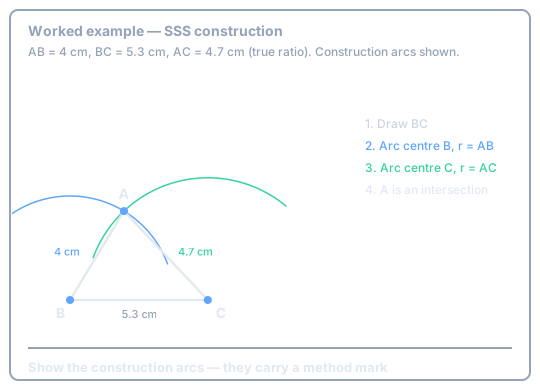
Given three side lengths that satisfy the triangle inequality, there is a unique triangle (up to reflection). Locate the third vertex with two compass arcs; then join with a ruler. The construction arcs must stay on the diagram.
Method
- Draw one side as a base with a ruler (any of the three sides; here \(BC\)).
- Open the compasses to the second length. With centre at one end of the base, draw an arc.
- Open the compasses to the third length. With centre at the other end, draw a second arc so the two arcs cross.
- The intersection is the third vertex. Join it to both ends of the base with a ruler.
Construct triangle \(ABC\) with \(AB = 4\,\text{cm}\), \(BC = 5.3\,\text{cm}\) and \(AC = 4.7\,\text{cm}\).
Paper 2 (non-calculator)
Visible construction arcs carry a method mark. An accurate-looking triangle with the arcs rubbed out scores fewer marks than a slightly imperfect triangle with the arcs still shown.
Constructing a rhombus from two triangles
A rhombus has four equal sides. It is two congruent triangles sharing a diagonal. Construct each triangle by SSS, on opposite sides of that diagonal.
Method
- Draw diagonal \(AC\) with a ruler (use the given length, or choose one if only the side is given).
- Construct \(\triangle ABC\) by SSS: arcs from \(A\) and from \(C\), each with radius equal to the side of the rhombus.
- Repeat on the other side of \(AC\) to locate \(D\). Join \(AB\), \(BC\), \(CD\) and \(DA\) with a ruler.
- Leave every construction arc visible.
If the rhombus is made of two equilateral triangles, every side and the shared diagonal are equal, and the angles are \(60^\circ\) and \(120^\circ\).
Nets of cubes, cuboids, prisms and pyramids
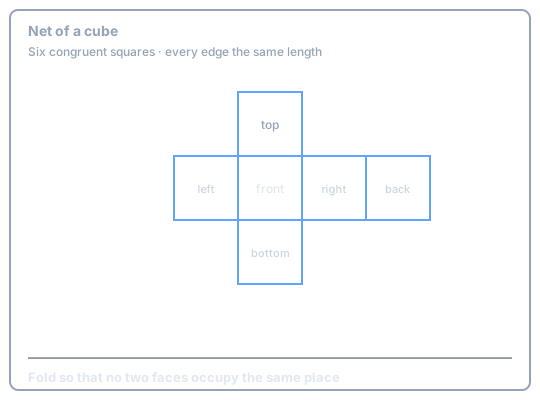
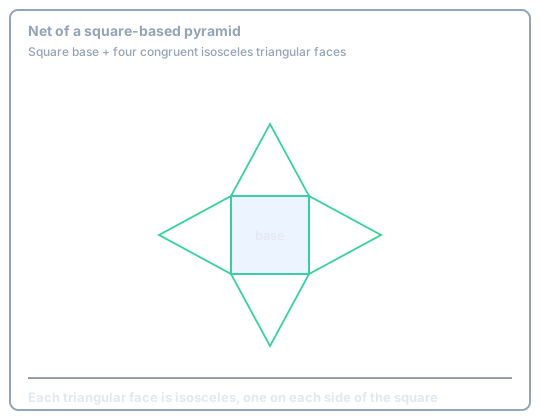
A net is a 2-D arrangement of faces that folds to make a solid, with no two faces occupying the same place. Draw every edge with a ruler. You must be able to sketch nets of a cube, cuboid, prism and pyramid.
A cube net uses six congruent squares. A cuboid net uses six rectangles (opposite faces equal). A prism net is two end-faces plus a strip of rectangles for the sides. A square-based pyramid net is a square with a triangle on each side.
Sketch a net of a cube.
Sketch a net of a square-based pyramid.
You can read lengths from a net and use them later for surface area or volume. Adding the areas of the faces on the net gives the surface area. Volume formulae belong in Chapter 5 — do not invent them here.
Try this
To construct \(\triangle PQR\) with \(PQ = 6\,\text{cm}\), \(QR = 8\,\text{cm}\) and \(PR = 7\,\text{cm}\), which side can you draw first, and which two arcs locate the third vertex? A cube net is made of squares of side \(3\,\text{cm}\). What is the surface area?
Show answer
-
Any side as base; here \(PQ\). Then arc centre \(P\) radius \(PR\) and arc centre \(Q\) radius \(QR\)
\[ R \text{ is an intersection of the two arcs} \] -
Six faces, each \(3 \times 3\)
\[ 6 \times 9 = 54 \] -
Surface area from the net
\[ 54\,\text{cm}^2 \]
0/10