Cambridge IGCSE Mathematics — 0580 Extended
Topic 4.3: Geometry — Scale Drawings & Bearings
Scale drawings
A scale drawing is an accurate diagram in which every length is multiplied by the same scale factor. A ratio scale \(1:n\) means \(1\) unit on the drawing represents \(n\) of the same units in real life.
Convert units so the drawing length and the scale use the same unit before you multiply or divide. Then convert the answer into the unit the question asks for.
Method
- Drawing \(\to\) real life: multiply by \(n\). Real life \(\to\) drawing: divide by \(n\).
- Keep both quantities in the same unit while you scale (usually centimetres).
- Convert the result (\(100\,\text{cm} = 1\,\text{m}\), \(1000\,\text{m} = 1\,\text{km}\)).
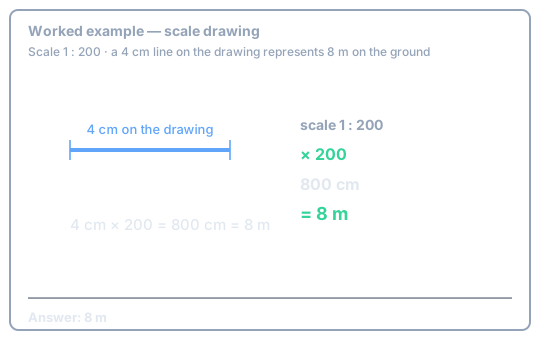
A map has scale \(1:200\). A path is \(4\,\text{cm}\) on the drawing. Find the real length.
Paper 2 (non-calculator)
Do not mix centimetres and metres in one step. Multiply \(4 \times 200 = 800\) first, then convert \(800\,\text{cm} = 8\,\text{m}\). For the reverse: \(8\,\text{m} = 800\,\text{cm}\), then \(800 \div 200 = 4\,\text{cm}\) on the drawing.
Three-figure bearings
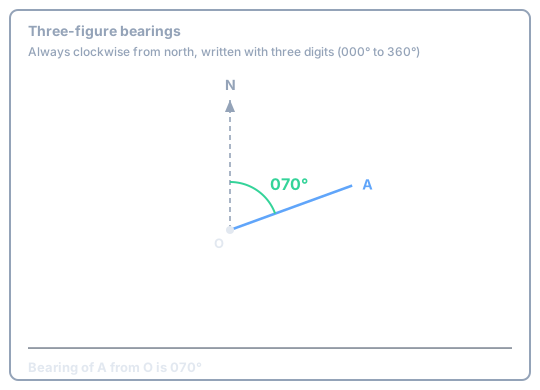
A bearing is an angle measured clockwise from north, written with three figures from \(000^\circ\) to \(360^\circ\). Draw a north line at the point you are measuring from, then measure clockwise to the direction of travel (or to the other point).
| Direction | Bearing |
|---|---|
| Due north | \(000^\circ\) (or \(360^\circ\)) |
| Due east | \(090^\circ\) |
| Due south | \(180^\circ\) |
| Due west | \(270^\circ\) |
The phrase “bearing of \(A\) from \(B\)” means: stand at \(B\), face north, then turn clockwise until you face \(A\).
Method
- Mark a north arrow at the starting point.
- Measure clockwise from that north line to the required direction.
- Write three digits: \(70^\circ\) is \(070^\circ\), not \(70^\circ\).
The bearing of \(A\) from \(O\) is \(070^\circ\). Show this on a diagram.
Reverse bearings
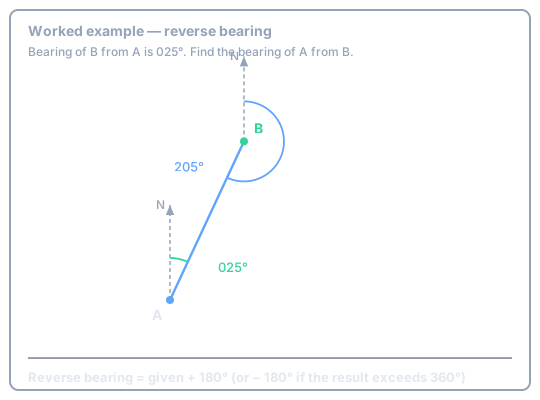
The bearing of \(A\) from \(B\) and the bearing of \(B\) from \(A\) differ by \(180^\circ\). To reverse a bearing, add or subtract \(180^\circ\) so the answer still lies between \(000^\circ\) and \(360^\circ\).
If the given bearing is less than \(180^\circ\), add \(180^\circ\). If it is \(180^\circ\) or more, subtract \(180^\circ\).
Method
- Identify the given bearing and which point it is measured from.
- Add \(180^\circ\) if the bearing is below \(180^\circ\); subtract \(180^\circ\) if it is \(180^\circ\) or above.
- Write the reverse as a three-figure bearing.
The bearing of \(B\) from \(A\) is \(025^\circ\). Find the bearing of \(A\) from \(B\).
Try this
A plan has scale \(1:50\). A wall is \(6\,\text{cm}\) on the plan. How long is the wall in metres? The bearing of \(Q\) from \(P\) is \(310^\circ\). What is the bearing of \(P\) from \(Q\)?
Show answer
-
Multiply, then convert centimetres to metres
\[ 6 \times 50 = 300\,\text{cm} = 3\,\text{m} \] -
\(310^\circ \ge 180^\circ\), so subtract \(180^\circ\)
\[ 310^\circ - 180^\circ = 130^\circ \]
Exam Traps
- The bearing of \(A\) from \(B\) is measured at \(B\), not at \(A\).
- Write three figures: \(70^\circ\) as a bearing is \(070^\circ\).
0/10