Cambridge IGCSE Mathematics — 0580 Extended
Topic 4.4: Geometry — Similarity
Similar shapes
Two shapes are similar if one is an enlargement of the other: corresponding angles are equal and corresponding sides are in the same ratio. That common ratio is the length scale factor \(k\).
Congruent shapes are the same shape and the same size (similar with \(k = 1\)). You must use the word correctly, but you are not expected to prove two triangles are congruent.
Method
- Pair equal angles. Corresponding sides sit opposite those equal angles.
- Write the length scale factor as \(k = \dfrac{\text{new length}}{\text{matching old length}}\).
- Multiply (or divide) every corresponding length by the same \(k\).
Two similar right-angled triangles have corresponding sides \(3\) and \(6\). Find the scale factor and the side matching \(4\).
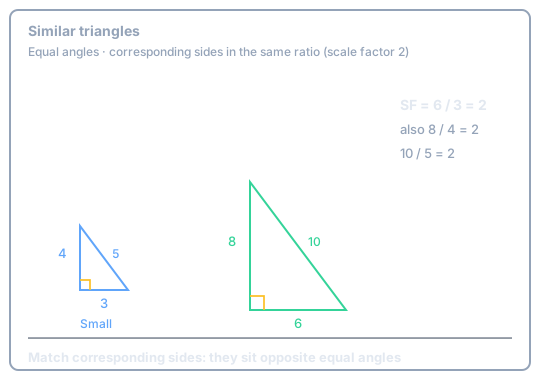
Showing two triangles are similar
For triangles, AA is enough: if two angles of one triangle equal two angles of the other, the third angles match automatically (angle sum \(180^\circ\)), so the triangles are similar.
Give a geometric reason for each equal pair (for example: corresponding angles, vertically opposite, alternate angles on parallel lines, or shared angle). Then state “triangles similar (AA)”.
Method
- Mark two pairs of equal angles and name the reason for each pair.
- Conclude the triangles are similar by AA.
- Match corresponding sides: each pair lies opposite an equal angle. Then find \(k\).
Do not jump to a length ratio until the corresponding sides are paired. A side of \(3\) does not automatically match the side of \(6\) unless those two sides sit opposite equal angles.
Length, area and volume scale factors
If corresponding lengths are multiplied by \(k\), then:
| Quantity | Scale factor |
|---|---|
| Length | \(k\) |
| Area (and surface area of similar solids) | \(k^2\) |
| Volume of similar solids | \(k^3\) |
The same rules apply to similar solids: surface area \(\times k^2\), volume \(\times k^3\). If you are given an area factor, recover \(k\) by square-rooting (take the positive root), then cube it for a volume factor.
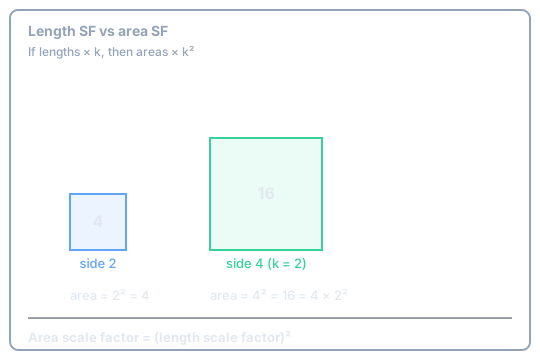
Two similar squares have sides \(2\) and \(4\). Compare their areas.
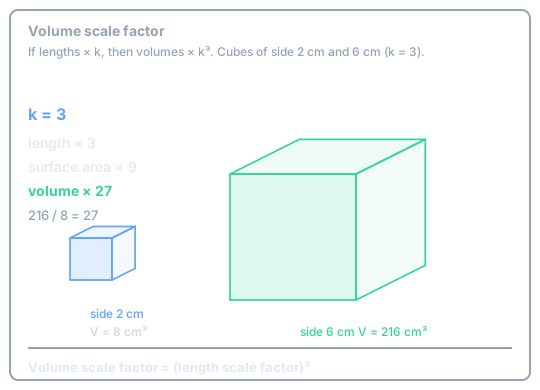
Two similar solids have length scale factor \(k = 3\). By what factor do surface area and volume change?
Paper 2 (non-calculator)
Know the small powers: \(2^2 = 4\), \(3^2 = 9\), \(4^2 = 16\), \(2^3 = 8\), \(3^3 = 27\), \(4^3 = 64\). Square roots that reverse an area factor are equally common: \(\sqrt{4} = 2\), \(\sqrt{9} = 3\).
Try this
Two similar solids have length scale factor \(2\). The smaller has volume \(10\,\text{cm}^3\) and surface area \(24\,\text{cm}^2\). Find the volume and surface area of the larger solid.
Show answer
-
Volume \(\times k^3 = \times 8\)
\[ 10 \times 8 = 80\,\text{cm}^3 \] -
Surface area \(\times k^2 = \times 4\)
\[ 24 \times 4 = 96\,\text{cm}^2 \]
Exam Traps
- If lengths scale by \(k\), areas scale by \(k^2\) and volumes by \(k^3\). Using \(k\) for an area, or \(k^2\) for a volume, loses the mark.
0/10