Cambridge IGCSE Mathematics — 0580 Extended
Topic 4.5: Geometry — Symmetry
Line symmetry
A shape has line symmetry if a mirror line folds it onto itself. That line is a line of symmetry (mirror line). Count how many such lines the shape has — do not assume a “nearly regular” sketch has the symmetries of the regular case.
Method
- Ask: can I fold the shape so one half lands exactly on the other?
- Draw every fold that works. For a polygon, a line of symmetry either joins a vertex to the midpoint of the opposite side, or joins midpoints of opposite sides, or is a diagonal of equal angles.
- Name the shape from its equal sides and angles first, then read off the matching symmetries from the table in section 03.
How many lines of symmetry does a rectangle have? How many does an isosceles triangle (not equilateral) have?
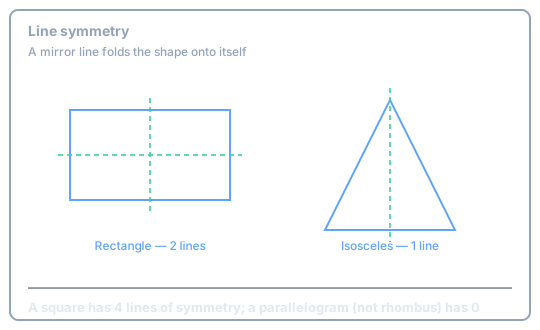
A square has \(4\) lines of symmetry. A parallelogram that is not a rhombus has \(0\) lines of symmetry — opposite sides are equal and parallel, but a fold does not map the shape onto itself.
Rotational symmetry
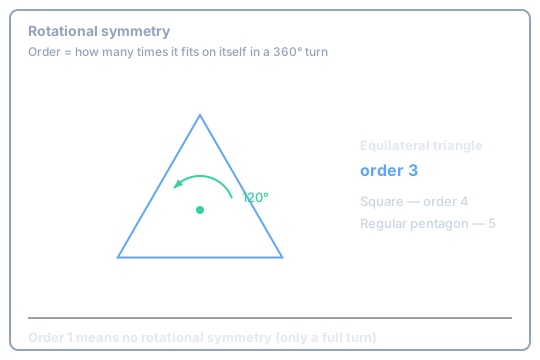
The order of rotational symmetry is how many times the shape fits onto itself in one full turn of \(360^\circ\) about its centre. The smallest angle of rotation that maps the shape to itself is \(\dfrac{360^\circ}{\text{order}}\).
Order \(1\) means the shape only matches itself after a full turn — it has no rotational symmetry. Never write “order \(0\)”.
Method
- Mark a centre (intersection of diagonals, or centroid of a regular polygon).
- Rotate until the shape first looks identical. That angle is \(\dfrac{360^\circ}{n}\) for a regular \(n\)-gon.
- The order is \(n\) if it matches \(n\) times in a full turn.
State the order of rotational symmetry of an equilateral triangle, and the smallest angle of rotation.
Triangles, quadrilaterals and polygons
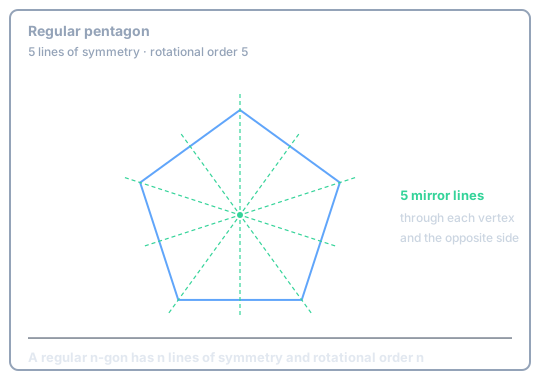
Link each named shape to its symmetries. A regular polygon (all sides equal and all angles equal) with \(n\) sides has \(n\) lines of symmetry and rotational order \(n\).
How many lines of symmetry, and what rotational order, does a regular pentagon have?
| Shape | Lines of symmetry | Rotational order |
|---|---|---|
| Equilateral triangle | \(3\) | \(3\) |
| Isosceles triangle (not equilateral) | \(1\) | \(1\) |
| Scalene triangle | \(0\) | \(1\) |
| Square | \(4\) | \(4\) |
| Rectangle (not square) | \(2\) | \(2\) |
| Rhombus (not square) | \(2\) | \(2\) |
| Parallelogram (not rhombus) | \(0\) | \(2\) |
| Kite | \(1\) | \(1\) |
| Regular \(n\)-gon | \(n\) | \(n\) |
Paper 2 (non-calculator)
A parallelogram has rotational order \(2\) even when it has no mirror lines. Do not mix the two types of symmetry.
Planes and axes in 3-D
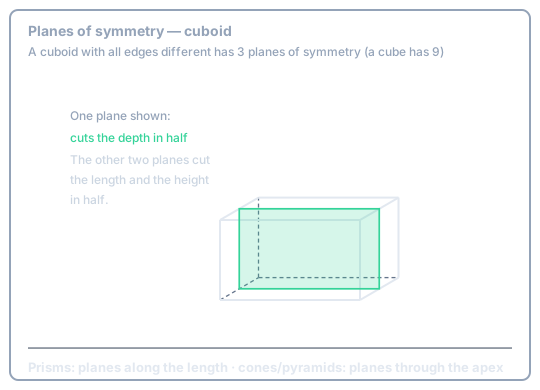
A plane of symmetry cuts a solid into two congruent halves that are mirror images. An axis of symmetry is a line about which the solid can be rotated onto itself.
A cuboid has three different edge lengths. How many planes of symmetry does it have? The diagram shows one of them.
| Solid | Planes / axes |
|---|---|
| Cube | \(9\) planes of symmetry |
| Cuboid (all edges different) | \(3\) planes of symmetry |
| Right prism | Planes along the length matching the symmetries of the cross-section; often a plane across the midpoint |
| Cylinder | Infinitely many planes through the axis; one plane perpendicular to the axis through the midpoint; the axis has infinite rotational order |
| Pyramid | Planes through the apex and a line of symmetry of the base |
| Cone | Infinitely many planes through the apex and the axis; the axis is an axis of rotational symmetry |
Try this
A regular octagon is the cross-section of a right prism. How many lines of symmetry does the octagon have? What is its rotational order? How many planes of symmetry does a cube have?
Show answer
-
Regular \(n\)-gon: \(n\) lines and order \(n\)
\[ 8 \text{ lines of symmetry, rotational order } 8 \] -
Cube (not a cuboid with unequal edges)
\[ 9 \text{ planes of symmetry} \]
Exam Traps
- A parallelogram that is not a rhombus has \(0\) lines of symmetry — but it still has rotational order \(2\).
- Order \(1\) means no rotational symmetry. Never write “order \(0\)”.
- A cube has \(9\) planes of symmetry; a cuboid with three different edge lengths has only \(3\).
0/10