Cambridge IGCSE Mathematics — 0580 Extended
Topic 4.6: Geometry — Angles
Angle facts and three-letter notation
Write every unknown with a geometric reason. Use three-letter notation: \(\angle ABC\) is the angle at \(B\), formed by points \(A\), \(B\) and \(C\) in that order. The middle letter is the vertex.
| Fact | Reason you write |
|---|---|
| Angles on a straight line sum to \(180^\circ\) | angles on a straight line |
| Angles at a point sum to \(360^\circ\) | angles at a point |
| Vertically opposite angles are equal | vertically opposite angles |
| Angles in a triangle sum to \(180^\circ\) | angles in a triangle |
| Angles in a quadrilateral sum to \(360^\circ\) | angles in a quadrilateral |
Method
- Mark every given size on the diagram. Name the angle you want (\(\angle ABC\), not “the one at the bottom”).
- Choose the fact that links a known angle to the unknown. Write the calculation and the reason on the same line.
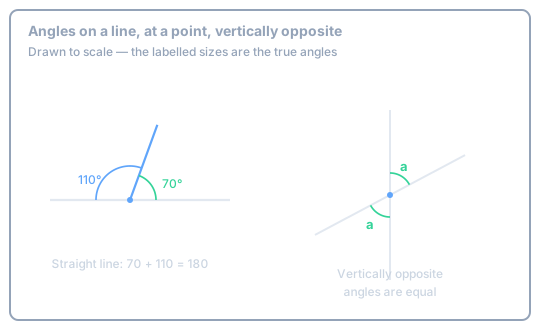
- If two lines cross, vertically opposite angles are equal — the adjacent pair on the straight line sum to \(180^\circ\).
Two angles on a straight line are \(70^\circ\) and \(110^\circ\). What fact is being used? What is true of vertically opposite angles?
Parallel lines
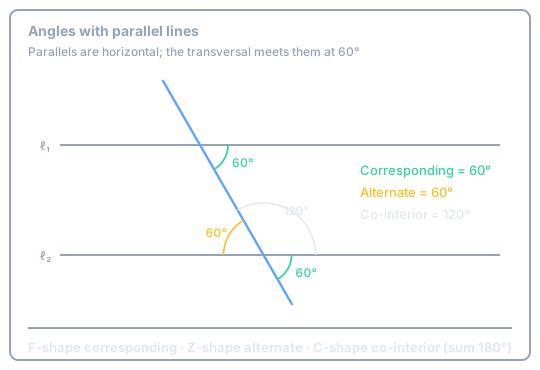
A transversal cuts two or more lines. When those lines are parallel, three named relationships hold. “Parallel lines” by itself is not a reason — name which relationship you used.
| Relationship | Memory shape | Reason you write |
|---|---|---|
| Corresponding angles are equal | F-shape | corresponding angles |
| Alternate angles are equal | Z-shape | alternate angles |
| Co-interior (allied) angles sum to \(180^\circ\) | C-shape | co-interior angles |
Two parallel horizontals are cut by a transversal at \(60^\circ\). State the corresponding, alternate and co-interior angles.
Paper 2 (non-calculator)
The arithmetic is easy; the mark is for the reason. Write “corresponding angles” or “co-interior angles”, not just “parallel”.
Interior and exterior angles of polygons
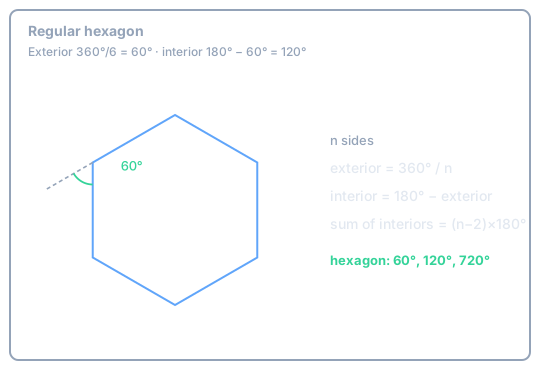
At each vertex of a convex polygon, the interior angle and the exterior angle sit on a straight line, so they sum to \(180^\circ\). Exterior angles of any convex polygon sum to \(360^\circ\). For a regular \(n\)-gon they are all equal.
Method
- Regular polygon: each exterior \(= \dfrac{360^\circ}{n}\).
- Each interior \(= 180^\circ - \) exterior.
- Sum of interiors (regular or irregular) \(= (n-2) \times 180^\circ\).
Find one exterior angle and one interior angle of a regular hexagon.
For an irregular polygon you can still use the sum of interiors and the fact that all exteriors add to \(360^\circ\), but you must not assume each exterior is \(\dfrac{360^\circ}{n}\).
Worked example — find \(x\) and \(y\)
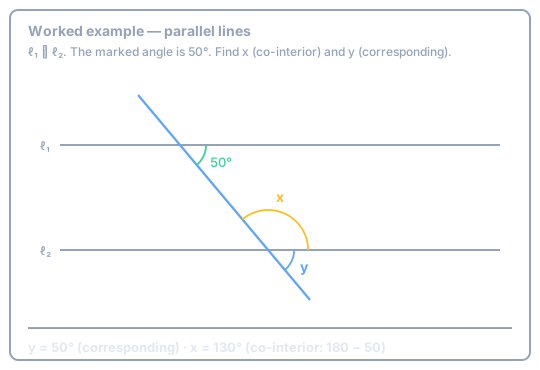
\(\ell_1 \parallel \ell_2\). A transversal makes a \(50^\circ\) angle with \(\ell_1\). \(y\) is the corresponding angle on \(\ell_2\); \(x\) is the co-interior angle on \(\ell_2\).
Find \(y\) and \(x\), giving a reason for each.
-
Corresponding angles are equal
\[ y = 50^\circ \] -
Co-interior angles sum to \(180^\circ\)
\[ x = 180^\circ - 50^\circ = 130^\circ \]
Try this
A regular octagon has \(n = 8\) sides. Find one exterior angle and one interior angle.
Show answer
-
Exterior \(= 360^\circ / n\)
\[ \frac{360^\circ}{8} = 45^\circ \] -
Interior \(= 180^\circ - \) exterior
\[ 180^\circ - 45^\circ = 135^\circ \]
Exam Traps
- Co-interior angles are supplementary, not equal — do not treat them like corresponding angles.
- Each exterior equals \(\dfrac{360^\circ}{n}\) only for a regular polygon. Irregular exteriors still sum to \(360^\circ\) but are not all equal.
- “Parallel lines” is not a reason. Name corresponding, alternate or co-interior.
0/10