Cambridge IGCSE Mathematics — 0580 Extended
Topic 4.7: Geometry — Circle Theorems I
Angle in a semicircle
Statement. The angle at the circumference standing on a diameter is a right angle. (If \(AB\) is a diameter and \(C\) lies on the circumference, then \(\angle ACB = 90^\circ\).)
\(AB\) is a diameter and \(C\) is on the circumference. Find \(\angle ACB\).
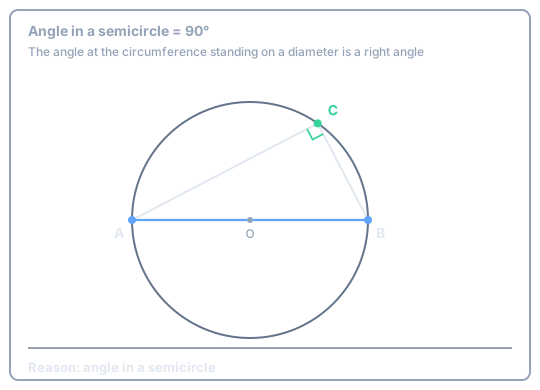
Reason you must write: angle in a semicircle.
Paper 2 (non-calculator)
Do not write “circle theorem”. Name the exact syllabus reason, as in the one-line reasons in this lesson.
Tangent perpendicular to radius
Statement. The radius to the point of contact is perpendicular to the tangent. If the tangent touches the circle at \(T\), then radius \(OT\) meets the tangent at \(90^\circ\).
A tangent touches the circle at \(T\). Radius \(OT\) meets the tangent. Find the angle at \(T\).
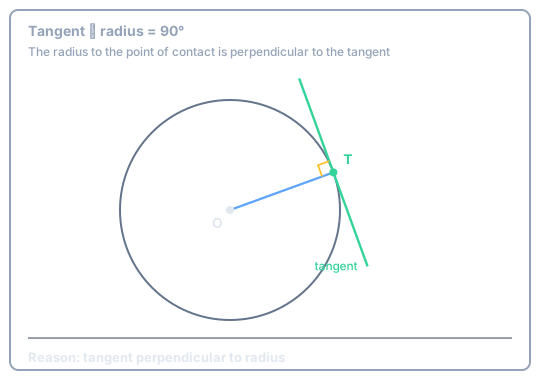
Reason you must write: tangent perpendicular to radius.
Angle at the centre
Statement. The angle at the centre is twice the angle at the circumference when both angles stand on the same arc.
Method
- Name the arc both angles stand on (here, arc \(AB\)).
- The central angle is \(\angle AOB\); the circumference angle is \(\angle ACB\).
- \(\angle AOB = 2 \times \angle ACB\).
\(\angle AOB = 120^\circ\) at the centre, standing on arc \(AB\). Point \(C\) is on the circumference, also standing on arc \(AB\). Find \(\angle ACB\).
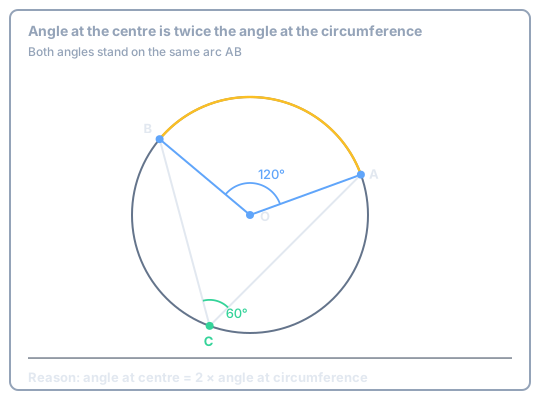
Reason you must write: angle at the centre is twice the angle at the circumference.
Angles in the same segment
Statement. Angles in the same segment of a circle are equal. They stand on the same arc.
\(\angle ACB\) and \(\angle ADB\) both stand on arc \(AB\). What is true of these angles?
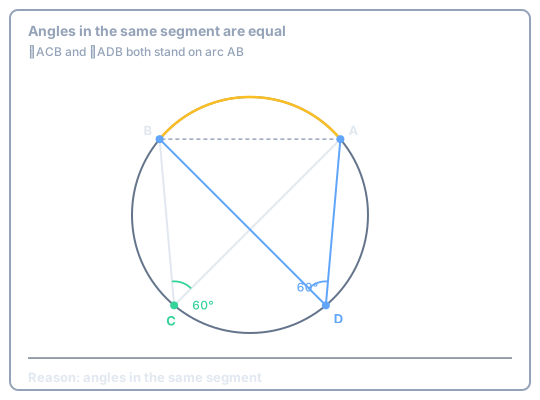
Reason you must write: angles in the same segment.
Cyclic quadrilateral
Statement. Opposite angles of a cyclic quadrilateral sum to \(180^\circ\). (A cyclic quadrilateral has all four vertices on the circumference.)
\(ABCD\) is cyclic. \(\angle DAB = 70^\circ\). Find \(\angle BCD\).
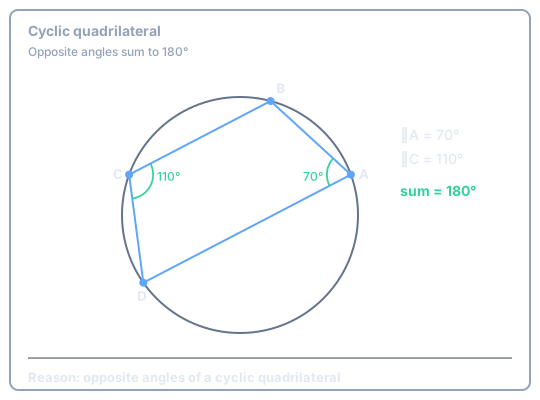
Reason you must write: opposite angles of a cyclic quadrilateral.
Alternate segment theorem
Statement. The angle between a tangent and a chord equals the angle in the alternate segment (the segment on the other side of the chord).
A tangent at \(T\) meets chord \(TA\). The marked angles are equal. Why?
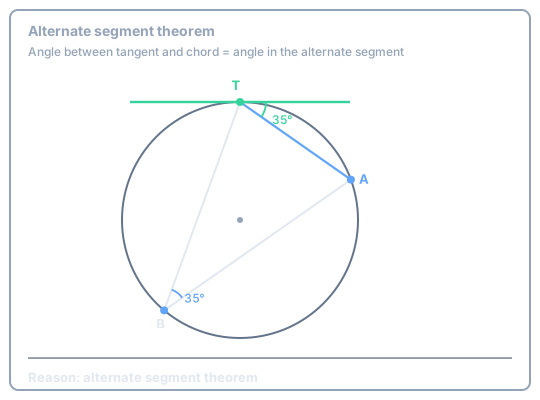
Reason you must write: alternate segment theorem.
Try this
Angle \(AOB\) at the centre is \(80^\circ\), standing on arc \(AB\). Point \(C\) is on the remaining circumference, standing on the same arc. Find \(\angle ACB\). Write the reason.
Show answer
-
Same arc \(AB\): centre is twice circumference
\[ \angle ACB = \frac{80^\circ}{2} = 40^\circ \] -
Reason: angle at the centre is twice the angle at the circumference
\[ \angle ACB = 40^\circ \]
Exam Traps
- Do not write “circle theorem”. Name which one (for example, angle in a semicircle).
- “Angle at the centre is twice the angle at the circumference” applies only when both angles stand on the same arc.
- Opposite angles of a cyclic quadrilateral sum to \(180^\circ\), not adjacent angles.
0/10