Cambridge IGCSE Mathematics — 0580 Extended
Topic 4.8: Geometry — Circle Theorems II
Equal chords
Statement. Equal chords are equidistant from the centre. The converse is also true: chords the same distance from the centre are equal.
Distance means the length of the perpendicular from the centre to the chord. This is a fact about chords — do not quote it for tangents.
Two equal chords each have a perpendicular drawn from the centre. What is true of those perpendiculars?
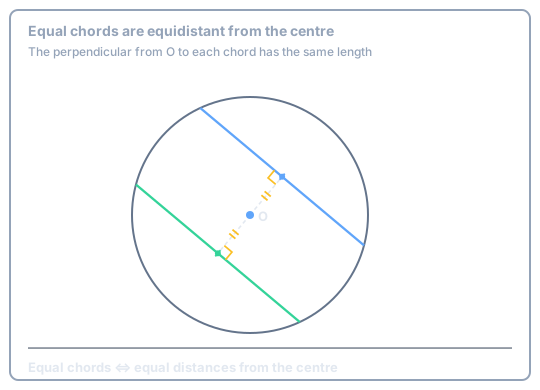
Reason you must write: equal chords are equidistant from the centre.
Perpendicular from the centre bisects a chord
Statement. The perpendicular from the centre to a chord bisects the chord. If \(OM \perp AB\) with \(M\) on \(AB\), then \(AM = MB\).
The converses are on the syllabus too: the line from the centre to the midpoint of a chord is perpendicular to the chord; and the perpendicular bisector of a chord passes through the centre.
Method
- Drop a perpendicular from \(O\) to chord \(AB\), meeting at \(M\).
- Then \(AM = MB\) and \(\angle OMA = \angle OMB = 90^\circ\).
- If you need the centre, construct the perpendicular bisector of a chord — it goes through \(O\).
Chord \(AB\) has midpoint \(M\), and \(OM\) is drawn. State the two facts shown.
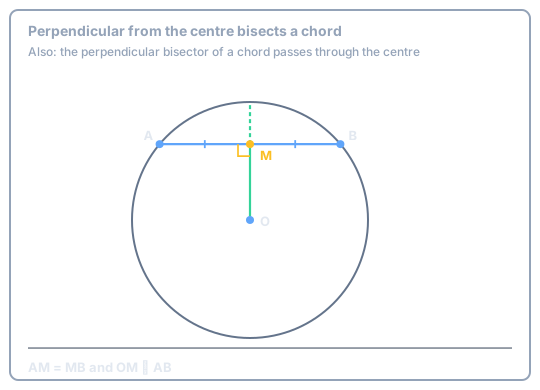
Reason you must write: perpendicular from the centre bisects the chord (or: perpendicular bisector of a chord passes through the centre).
Paper 2 (non-calculator)
If a chord has length \(10\,\text{cm}\) and the perpendicular from the centre meets it at \(M\), then each half is \(5\,\text{cm}\). You may then use Pythagoras in triangle \(OMA\) if a radius is given.
Two tangents from an external point
Statement. The two tangents from an external point to a circle are equal. If they touch at \(T_1\) and \(T_2\), then \(PT_1 = PT_2\).
Further facts that follow (and that you may use): the radii to the points of contact are perpendicular to the tangents (\(\angle OT_1P = \angle OT_2P = 90^\circ\)), and line \(OP\) bisects \(\angle T_1PT_2\).
Tangents from \(P\) touch the circle at \(T_1\) and \(T_2\). What lengths are equal, and what angles are \(90^\circ\)?
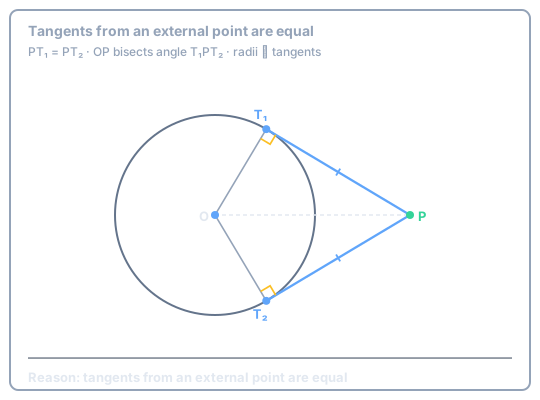
Reason you must write: tangents from an external point are equal.
Try this
Chord \(AB = 10\,\text{cm}\). The perpendicular from the centre meets \(AB\) at \(M\). Find \(AM\). From an external point \(P\), two tangents touch at \(T_1\) and \(T_2\). If \(PT_1 = 8\,\text{cm}\), find \(PT_2\). Give a reason for each.
Show answer
-
Perpendicular from the centre bisects the chord
\[ AM = 5\,\text{cm} \] -
Tangents from an external point are equal
\[ PT_2 = 8\,\text{cm} \]
Exam Traps
- Do not mix “equal chords are equidistant from the centre” with “tangents from an external point are equal” — they are different theorems.
- Do not write “circle theorem”. Name which one (equal chords, or tangents from an external point).
- \(AM = MB\) only after the line from the centre is perpendicular to the chord (or \(M\) is already the midpoint).
0/10