Cambridge IGCSE Mathematics — 0580 Extended
Topic 5.1: Mensuration — Units of Measure
Metric units of length and mass
Every metric conversion is a multiplication or division by \(10\), \(100\) or \(1000\). Learn the chain and the direction: small unit to big unit, divide; big unit to small unit, multiply.
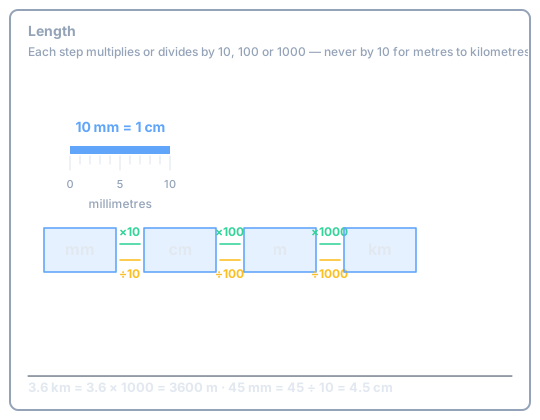
| Quantity | Conversions you must know |
|---|---|
| Length | \(10\,\text{mm} = 1\,\text{cm}\), \(100\,\text{cm} = 1\,\text{m}\), \(1000\,\text{m} = 1\,\text{km}\) |
| Length (direct) | \(1000\,\text{mm} = 1\,\text{m}\) |
| Mass | \(1000\,\text{mg} = 1\,\text{g}\), \(1000\,\text{g} = 1\,\text{kg}\), \(1000\,\text{kg} = 1\,\text{tonne}\) |
Convert \(3.6\,\text{km}\) to metres, and \(45\,\text{mm}\) to centimetres.
-
km to m is a bigger unit to a smaller unit: multiply
\[ 3.6 \times 1000 = 3600\,\text{m} \] -
mm to cm is a smaller unit to a bigger unit: divide
\[ 45 \div 10 = 4.5\,\text{cm} \]
Paper 2 (non-calculator)
All of these are digit shifts. \(\times 1000\) moves the decimal point three places right; \(\div 100\) moves it two places left. No long multiplication needed.
Area units: square the length factor
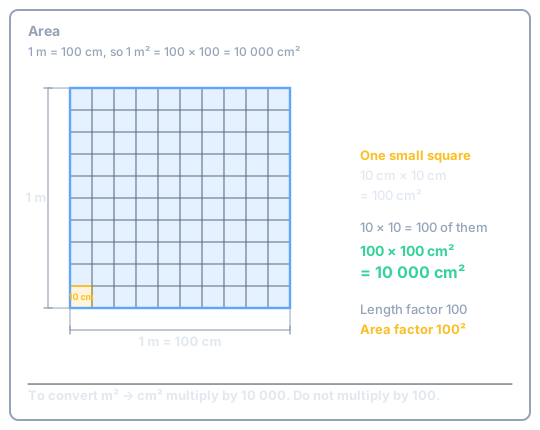
An area unit is a length unit multiplied by itself, so its conversion factor is the square of the length factor.
Method
- Write the length factor between the two units (for m to cm it is \(100\)).
- Square it: \(100^2 = 10\,000\).
- Multiply going to the smaller unit; divide going to the larger unit.
| Conversion | Length factor | Area factor |
|---|---|---|
| \(\text{cm}^2 \to \text{mm}^2\) | \(10\) | \(10^2 = 100\) |
| \(\text{m}^2 \to \text{cm}^2\) | \(100\) | \(100^2 = 10\,000\) |
| \(\text{km}^2 \to \text{m}^2\) | \(1000\) | \(1000^2 = 1\,000\,000\) |
Volume units and capacity: cube the length factor
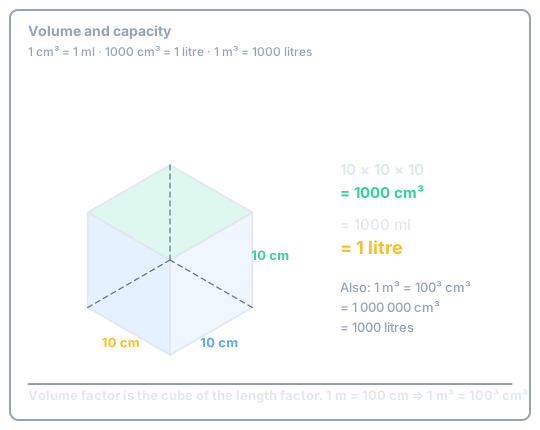
A volume unit is a length unit cubed, so its conversion factor is the cube of the length factor. Capacity (millilitres and litres) is just volume under another name.
| Conversion | Factor |
|---|---|
| \(\text{cm}^3 \to \text{mm}^3\) | \(10^3 = 1000\) |
| \(\text{m}^3 \to \text{cm}^3\) | \(100^3 = 1\,000\,000\) |
| Volume to capacity | \(1\,\text{cm}^3 = 1\,\text{ml}\) |
| Volume to capacity | \(1000\,\text{cm}^3 = 1\,\text{litre}\) |
| Volume to capacity | \(1\,\text{m}^3 = 1000\,\text{litres}\) |
A tank has volume \(0.45\,\text{m}^3\). How many litres does it hold?
-
Use \(1\,\text{m}^3 = 1000\,\text{litres}\)
\[ 0.45 \times 1000 \] -
Capacity of the tank
\[ 450\,\text{litres} \]
Worked conversion and practice
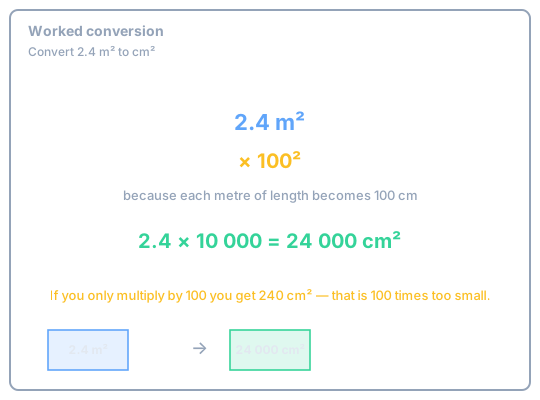
Convert \(2.4\,\text{m}^2\) to \(\text{cm}^2\).
Try this
A box has volume \(3\,500\,000\,\text{cm}^3\). Write this in \(\text{m}^3\), and state its capacity in litres.
Show answer
-
Going to the larger unit: divide by \(100^3\)
\[ 3\,500\,000 \div 1\,000\,000 = 3.5\,\text{m}^3 \] -
Then \(1\,\text{m}^3 = 1000\,\text{litres}\)
\[ 3.5 \times 1000 = 3500\,\text{litres} \]
Exam Traps
- Do not use the length factor for an area or volume. \(1\,\text{m}^2\) is \(10\,000\,\text{cm}^2\), not \(100\,\text{cm}^2\); \(1\,\text{m}^3\) is \(1\,000\,000\,\text{cm}^3\), not \(100\,\text{cm}^3\).
- Convert units before substituting into a formula. Mixing centimetres and metres inside one calculation loses the accuracy mark even if the method is right.
- \(1\,\text{litre} = 1000\,\text{cm}^3\), but \(1\,\text{litre} = 0.001\,\text{m}^3\). Check which volume unit the question uses before converting.
0/10