Cambridge IGCSE Mathematics — 0580 Extended
Topic 5.2: Mensuration — Area and Perimeter
Rectangle: perimeter and area
Perimeter is the distance once round the boundary, measured in cm. Area is the space inside, measured in \(\text{cm}^2\).
A rectangle is \(8\,\text{cm}\) long and \(5\,\text{cm}\) wide. Find its area and perimeter.
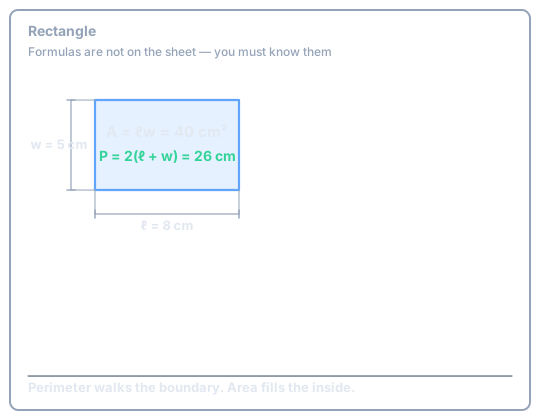
Not on the formula sheet. Except for the area of a triangle, none of the 2D area formulas in this topic are given. Learn them.
Triangle
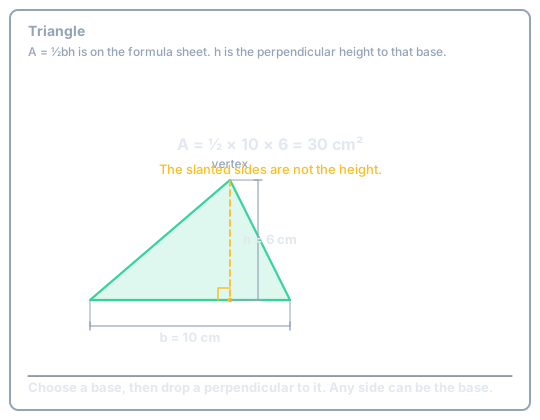
\(A = \tfrac{1}{2}bh\) is on the formula sheet. What the sheet cannot tell you is which length is \(h\): it is the perpendicular height from the chosen base to the opposite vertex.
A triangle has base \(10\,\text{cm}\) and perpendicular height \(6\,\text{cm}\). Find its area.
Method
- Pick a side to be the base — any of the three will do.
- Find the perpendicular distance from that base to the opposite vertex.
- Multiply and halve: \(A = \tfrac{1}{2}bh\).
Parallelogram
\[ A = bh \]
A parallelogram is a rectangle with a triangle slid from one end to the other, so the area is base times perpendicular height — exactly the rectangle rule.
A parallelogram has base \(10\,\text{cm}\) and perpendicular height \(6\,\text{cm}\). Find its area.
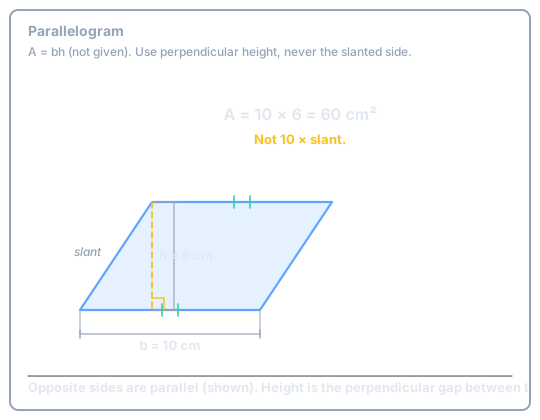
For the perimeter, you do need the slanted side: add all four sides, or \(P = 2(\text{base} + \text{slant})\).
Trapezium
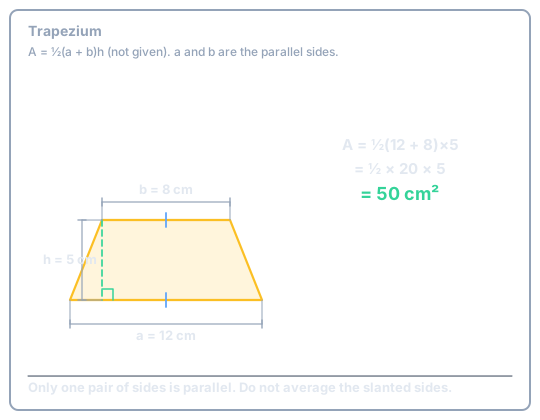
\[ A = \tfrac{1}{2}(a + b)h \]
Here \(a\) and \(b\) are the two parallel sides and \(h\) is the perpendicular gap between them. In words: average the parallel sides, then multiply by the height.
A trapezium has parallel sides \(12\,\text{cm}\) and \(8\,\text{cm}\), and height \(5\,\text{cm}\). Find its area.
Paper 2 (non-calculator)
Add the parallel sides first. \(\tfrac{1}{2}(12+8)\times 5\) becomes \(10 \times 5\) in one step; multiplying \(12 \times 5\) and \(8 \times 5\) separately takes longer and invites slips.
The four formulas at a glance
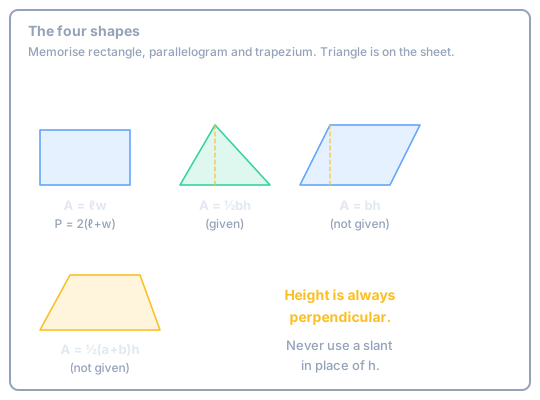
| Shape | Area | On the sheet? |
|---|---|---|
| Rectangle | \(A = \ell w\) | No |
| Triangle | \(A = \tfrac{1}{2}bh\) | Yes |
| Parallelogram | \(A = bh\) | No |
| Trapezium | \(A = \tfrac{1}{2}(a+b)h\) | No |
Try this
A trapezium has area \(84\,\text{cm}^2\). Its parallel sides are \(9\,\text{cm}\) and \(15\,\text{cm}\). Find the perpendicular height.
Show answer
-
Substitute into \(A = \tfrac{1}{2}(a+b)h\)
\[ 84 = \tfrac{1}{2}(9 + 15)h = 12h \] -
Divide by \(12\)
\[ h = 7\,\text{cm} \]
Exam Traps
- Do not use a slanted side as \(h\) in \(bh\) or \(\tfrac{1}{2}(a+b)h\). The height is always the perpendicular distance, and a diagram often gives you the slant as a distractor.
- In a trapezium, \(a\) and \(b\) must be the parallel pair. Averaging the two sloping sides scores nothing.
- Area answers take \(\text{cm}^2\) and perimeter answers take \(\text{cm}\). Marks are given for the unit in "show that" and problem-solving questions.
0/10