Cambridge IGCSE Mathematics — 0580 Extended
Topic 5.3: Mensuration — Circles, Arcs and Sectors
Circumference and area of a circle
Both of these are on the formula sheet:
\[ C = 2\pi r \qquad A = \pi r^2 \]
What the sheet does not say is that \(r\) is the radius. If a question gives the diameter \(d\), halve it first: \(r = \tfrac{d}{2}\).
A circle has radius \(7\,\text{cm}\). Find its circumference and area, leaving answers in terms of \(\pi\).
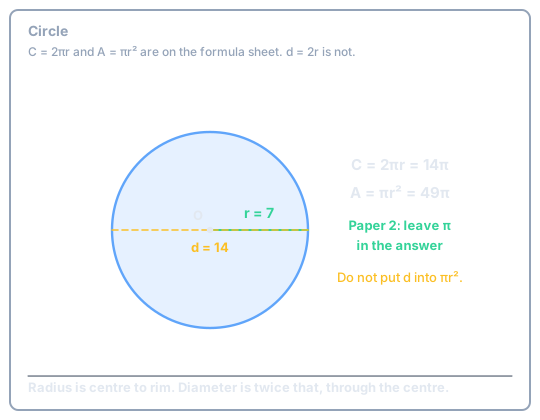
Paper 2 (non-calculator)
Leave the answer as a multiple of \(\pi\) unless the question says otherwise. \(49\pi\) is exact; \(153.9\) is a rounded value that needs a calculator.
Sectors and the fraction \(\theta/360\)
A sector is the region bounded by two radii and the arc between them. It is a fraction of the whole circle, and that fraction is the angle at the centre over \(360^\circ\).
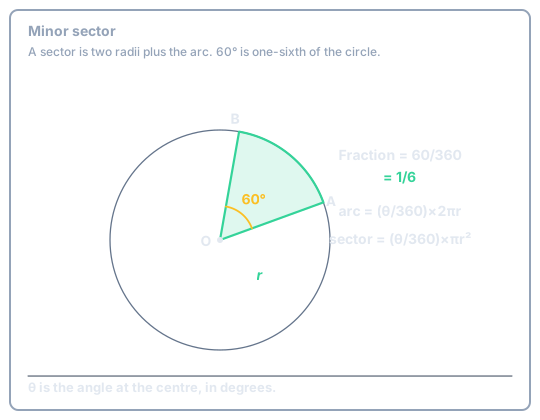
\[ \text{arc length} = \frac{\theta}{360} \times 2\pi r \qquad \text{sector area} = \frac{\theta}{360} \times \pi r^2 \]
Method
- Read the angle \(\theta\) at the centre and write the fraction \(\dfrac{\theta}{360}\); simplify it if it is neat.
- Work out the whole-circle quantity: \(2\pi r\) for arc, \(\pi r^2\) for area.
- Multiply the two.
Minor and major sectors
Two radii cut the circle into two sectors. The smaller one is the minor sector and the larger is the major sector. Extended candidates are expected to handle both.
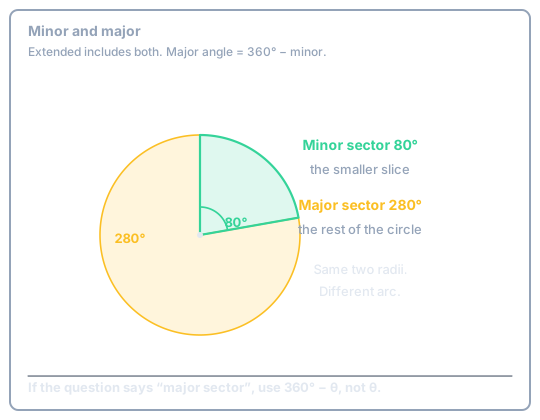
A circle has radius \(9\,\text{cm}\). Find the area of the major sector when the minor angle is \(80^\circ\), in terms of \(\pi\).
-
Major angle first
\[ \theta = 360 - 80 = 280^\circ \] -
Fraction of the circle
\[ \frac{280}{360} = \frac{7}{9} \] -
Multiply by \(\pi r^2 = 81\pi\)
\[ \frac{7}{9} \times 81\pi = 63\pi\,\text{cm}^2 \]
Arc length
An arc is part of the circumference, so it is a fraction of \(2\pi r\) — never of \(\pi r^2\).
Find the length of a \(90^\circ\) arc of a circle of radius \(14\,\text{cm}\), in terms of \(\pi\).
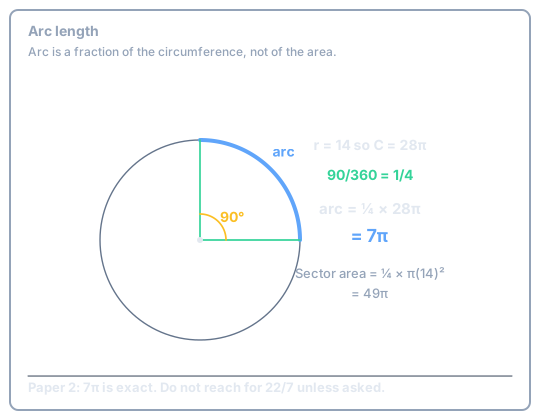
The perimeter of a sector is the arc plus the two radii — not the arc alone:
\[ P_{\text{sector}} = \frac{\theta}{360} \times 2\pi r + 2r \]
For the quarter above, \(P = 7\pi + 28\,\text{cm}\).
Sector or segment?
A sector is bounded by two radii and an arc. A segment is bounded by a chord and an arc — the cap you get when you slice straight across.
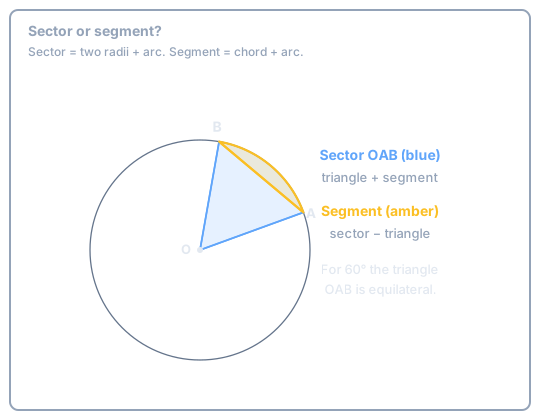
Segment area is built in Topic 5.5; for now, learn to name the two regions correctly, since the wording of the question decides which one you must find.
Try this
A sector has radius \(6\,\text{cm}\) and angle \(120^\circ\). Find its arc length and its perimeter, in terms of \(\pi\).
Show answer
-
Fraction of the circle
\[ \frac{120}{360} = \frac{1}{3} \] -
Arc is a third of \(C = 12\pi\)
\[ \text{arc} = \tfrac{1}{3} \times 12\pi = 4\pi\,\text{cm} \] -
Add the two radii for the perimeter
\[ P = 4\pi + 12\,\text{cm} \]
Exam Traps
- If the question names the major sector, use \(360^\circ - \theta\) in the fraction. Using the marked minor angle gives the wrong region.
- The perimeter of a sector includes the two straight radii. Quoting only the arc length loses the mark.
- When a diameter is given, halve it before substituting. Putting \(d\) into \(\pi r^2\) makes the area four times too large.
0/10