Cambridge IGCSE Mathematics — 0580 Extended
Topic 5.4: Mensuration — Surface Area and Volume
Cuboid
A cuboid has six rectangular faces in three equal pairs. Neither formula below is on the sheet, but both come straight from that fact.
\[ V = \ell w h \qquad SA = 2(\ell w + \ell h + wh) \]
A cuboid measures \(5 \times 4 \times 3\). Find its volume and surface area.
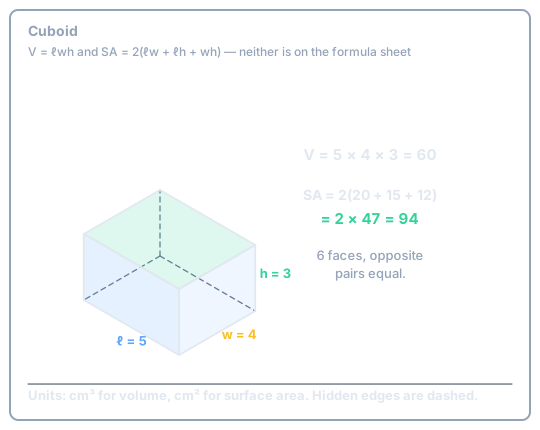
For surface area, find the three distinct face areas, add them, then double. Listing all six faces works too but takes longer.
Prisms: \(V = A\ell\)
A prism is any solid with the same cross-section all the way along its length. Its volume formula is given:
\[ V = A\ell \]
where \(A\) is the area of that uniform cross-section and \(\ell\) is the length. Everything in Topic 5.2 can therefore become a volume.
A prism has a right-angled \(3\)–\(4\)–\(5\) triangular cross-section and length \(6\). Find its volume.
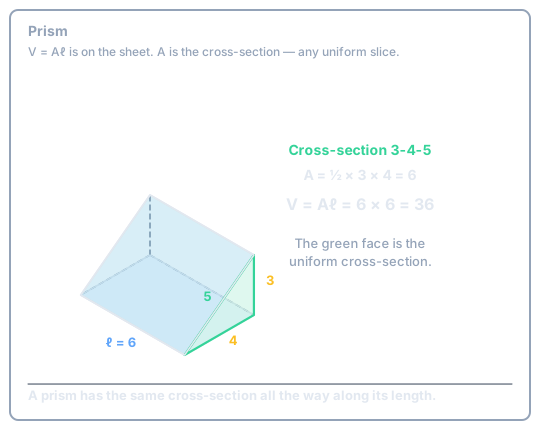
Surface area of a prism is not given: add the two end faces to the rectangles that wrap around the sides. For the prism above, the wrap is a rectangle of length \(6\) and width equal to the triangle's perimeter \(3 + 4 + 5 = 12\), giving \(72\), plus the two triangles \(2 \times 6 = 12\), so \(SA = 84\).
Cylinder
A cylinder is a prism with a circular cross-section. Both of these are on the formula sheet:
\[ V = \pi r^2 h \qquad \text{curved surface area} = 2\pi r h \]
A cylinder has radius \(3\) and height \(8\). Find its volume, curved surface area and total surface area, in terms of \(\pi\).
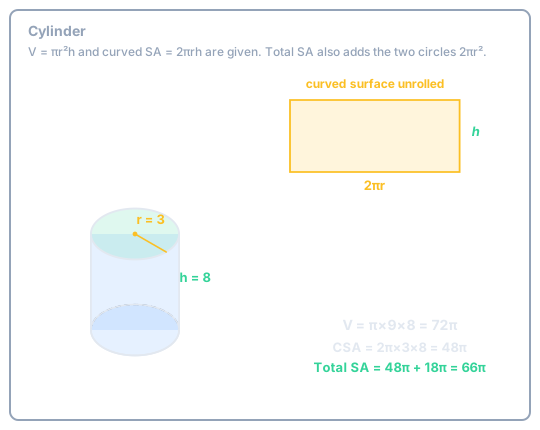
Total surface area of a closed cylinder is therefore \(2\pi r h + 2\pi r^2\). An open pipe or an open-topped can has fewer circles — count what the question actually describes.
Cone
Given on the sheet:
\[ V = \tfrac{1}{3}\pi r^2 h \qquad \text{curved surface area} = \pi r l \]
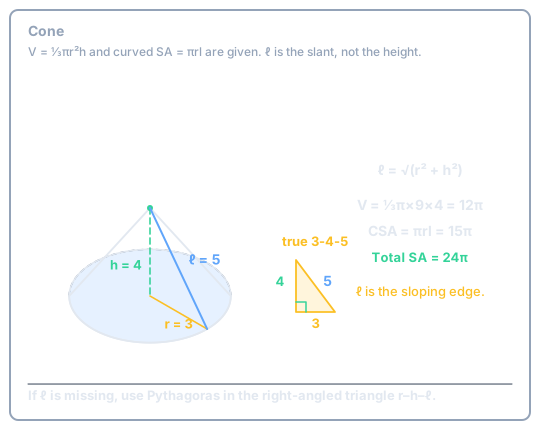
Two different lengths appear: \(h\) is the perpendicular height from apex to base centre, and \(l\) is the slant height along the sloping surface. They are linked by Pythagoras: \(l^2 = r^2 + h^2\).
A cone has radius \(3\) and perpendicular height \(4\). Find its volume and total surface area, in terms of \(\pi\).
Method
- Decide which length the question gave you, \(h\) or \(l\).
- Use \(l^2 = r^2 + h^2\) to get the other one.
- Volume needs \(h\); curved surface area needs \(l\).
Pyramid
Given on the sheet:
\[ V = \tfrac{1}{3}Ah \]
\(A\) is the area of the base — square, rectangular, triangular, whatever the question shows — and \(h\) is the perpendicular height from the apex down to the base plane.
A pyramid has a square base of side \(4\) and perpendicular height \(6\). Find its volume.
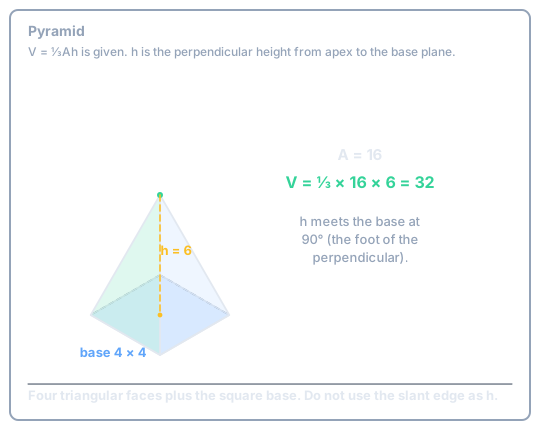
Surface area of a pyramid is not given: add the base to the triangular faces, each of which uses the slant height of that face, not the pyramid's perpendicular height.
Sphere
Both given on the sheet:
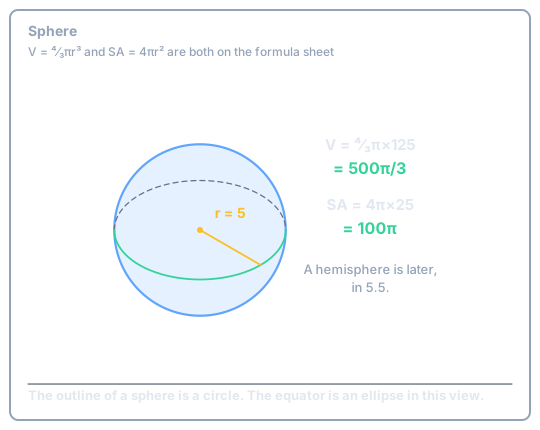
\[ V = \tfrac{4}{3}\pi r^3 \qquad SA = 4\pi r^2 \]
A sphere has radius \(5\). Find its volume and surface area, in terms of \(\pi\).
Paper 2 (non-calculator)
Cube the radius before touching the fraction: \(5^3 = 125\), then \(\tfrac{4}{3} \times 125 = \tfrac{500}{3}\). Leaving \(\dfrac{500\pi}{3}\) is a complete exact answer.
What counts as a prism
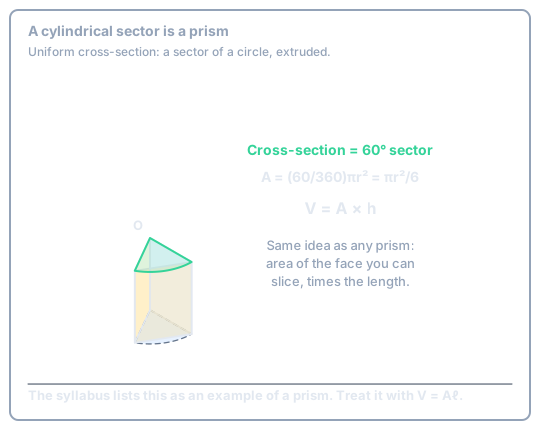
The syllabus lists a cylindrical sector as an example of a prism, because it still has one cross-section repeated along its length.
| Solid | Volume | Surface area |
|---|---|---|
| Cuboid | \(\ell w h\) (not given) | \(2(\ell w + \ell h + wh)\) (not given) |
| Prism | \(A\ell\) (given) | ends \(+\) wrap (not given) |
| Cylinder | \(\pi r^2 h\) (given) | curved \(2\pi r h\) (given) |
| Cone | \(\tfrac{1}{3}\pi r^2 h\) (given) | curved \(\pi r l\) (given) |
| Pyramid | \(\tfrac{1}{3}Ah\) (given) | base \(+\) triangles (not given) |
| Sphere | \(\tfrac{4}{3}\pi r^3\) (given) | \(4\pi r^2\) (given) |
Try this
A cone has radius \(6\,\text{cm}\) and slant height \(10\,\text{cm}\). Find its volume in terms of \(\pi\).
Show answer
-
Volume needs \(h\), so use \(l^2 = r^2 + h^2\)
\[ h = \sqrt{10^2 - 6^2} = \sqrt{64} = 8 \] -
Substitute into \(V = \tfrac{1}{3}\pi r^2 h\)
\[ V = \tfrac{1}{3}\pi(36)(8) = 96\pi\,\text{cm}^3 \]
Exam Traps
- In a cone, \(\pi r l\) uses the slant and \(\tfrac{1}{3}\pi r^2 h\) uses the perpendicular height. Swapping them is the single most common loss of marks in this topic.
- The sheet gives only the curved surface area of a cylinder and cone. If the solid is closed, you must add \(2\pi r^2\) or \(\pi r^2\) yourself.
- \(V = A\ell\) needs the area of the cross-section, not of the face you happen to be looking at. In a lying-down prism the cross-section is the end, not the long rectangle.
0/10