Cambridge IGCSE Mathematics — 0580 Extended
Topic 5.5: Mensuration — Compound Shapes and Parts of Shapes
Compound areas: split, then add
Cut the shape into pieces whose formulas you know, work out each piece, then add. (Sometimes it is quicker to take the bounding rectangle and subtract the missing piece — both earn full marks.)
Find the area and perimeter of the L-shape below.
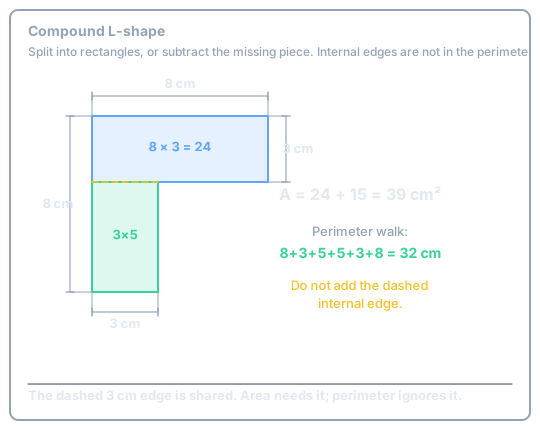
The dashed \(3\,\text{cm}\) edge is internal. It is needed to split the area, but it is not part of the boundary, so it never enters the perimeter.
Method
- Draw the split line and mark every missing length using the given ones.
- Area: find each piece and add (or subtract the cut-out).
- Perimeter: put your pen on one corner and walk right round the outside, listing each side once.
Shapes with a circular part
A semicircle contributes \(\tfrac{1}{2}\pi r^2\) to the area and \(\tfrac{1}{2}(2\pi r) = \pi r\) to the perimeter. Its radius is half the straight edge it sits on.
A shape is a \(10\,\text{cm}\) by \(6\,\text{cm}\) rectangle with a semicircle on top. Find its area and perimeter in terms of \(\pi\).
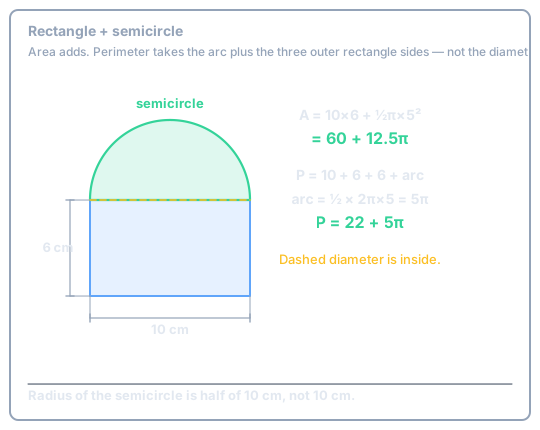
Notice which rectangle sides survive: the top edge is swallowed by the semicircle, so the perimeter uses three sides plus the arc.
Segment: sector minus triangle
A segment is the region between a chord and its arc. Remove the triangle from the sector and the segment is what remains:
\[ \text{segment} = \frac{\theta}{360}\pi r^2 - \tfrac{1}{2}ab\sin C \]
A circle has radius \(6\). Find the area of the segment cut off by a chord subtending \(60^\circ\) at the centre.
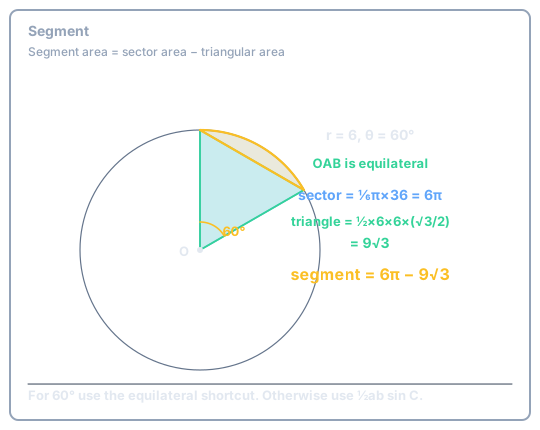
When \(\theta = 60^\circ\) the triangle is equilateral, since both radii and the chord are equal. For any other angle use \(\tfrac{1}{2}r^2\sin\theta\).
Hemisphere: curved only, or total?
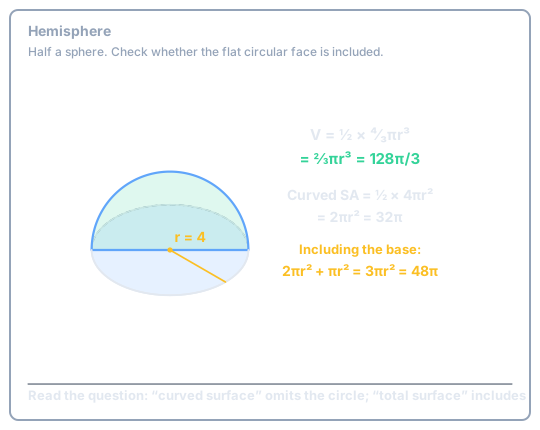
Halve the sphere formulas for volume and for the curved part, but read the question before deciding whether the flat circle counts.
| Quantity | Formula |
|---|---|
| Volume | \(\tfrac{1}{2} \times \tfrac{4}{3}\pi r^3 = \tfrac{2}{3}\pi r^3\) |
| Curved surface only | \(\tfrac{1}{2} \times 4\pi r^2 = 2\pi r^2\) |
| Total surface (solid dome) | \(2\pi r^2 + \pi r^2 = 3\pi r^2\) |
Frustum: big cone minus small cone
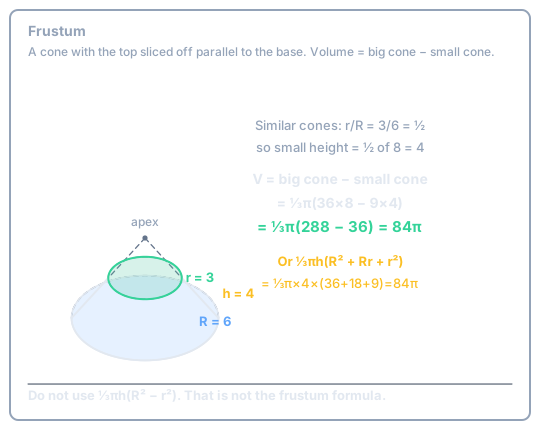
A frustum is a cone with the top sliced off parallel to the base. The removed tip is a smaller cone similar to the original, so its dimensions scale together.
A frustum has base radius \(6\), top radius \(3\) and height \(4\). Find its volume in terms of \(\pi\).
Method
- Use similarity, \(\dfrac{r}{R} = \dfrac{h_{\text{small}}}{H}\), to find the missing heights.
- Find the volume of the whole cone.
- Subtract the volume of the small cone you sliced off.
Compound solids
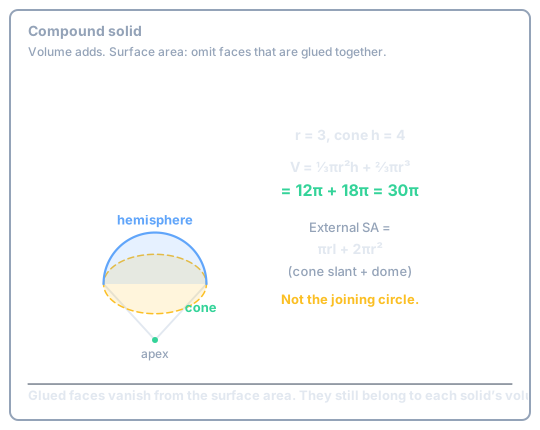
Volumes always add. Surface areas do not: any face where two solids are glued together is inside the compound and disappears from the outside.
A hemisphere of radius \(3\) sits on a cone of radius \(3\) and height \(4\). Find the volume and external surface area, in terms of \(\pi\).
Try this
A solid is a cylinder of radius \(5\,\text{cm}\) and height \(12\,\text{cm}\) with a hemisphere of radius \(5\,\text{cm}\) on the top. Find its volume and its total external surface area, in terms of \(\pi\).
Show answer
-
Volumes add
\[ V = \pi(25)(12) + \tfrac{2}{3}\pi(125) = 300\pi + \tfrac{250\pi}{3} \] -
Outside faces: base circle, cylinder wall, dome. The top circle of the cylinder is covered.
\[ SA = \pi(25) + 2\pi(5)(12) + 2\pi(25) \] -
Collect the terms
\[ V = \frac{1150\pi}{3}\,\text{cm}^3, \qquad SA = 195\pi\,\text{cm}^2 \]
Exam Traps
- Internal edges and glued faces count for area and volume but never for perimeter or external surface area. Add the dashed line back in and the answer is wrong.
- "Curved surface area" of a hemisphere is \(2\pi r^2\); "total surface area" of a solid dome is \(3\pi r^2\). The wording decides, not the picture.
- For a frustum, subtract the small cone's volume — do not use \(\tfrac{1}{3}\pi h(R^2 - r^2)\), which is not a valid formula.
0/10