Cambridge IGCSE Mathematics — 0580 Extended
Topic 6.1: Trigonometry — Pythagoras’ Theorem
The theorem
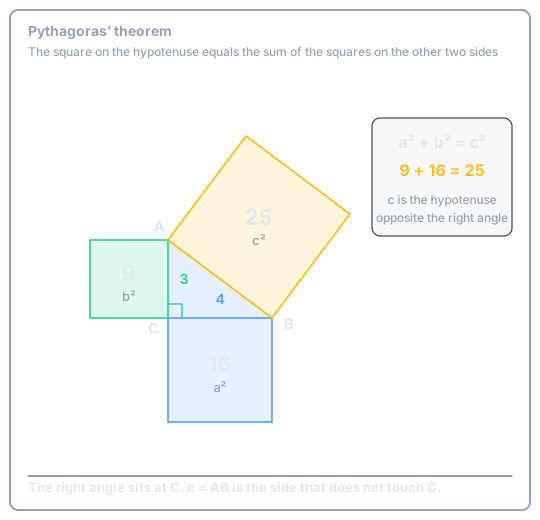
In a right-angled triangle the square on the hypotenuse equals the sum of the squares on the other two sides.
\[ a^2 + b^2 = c^2 \]
The hypotenuse \(c\) is the side opposite the right angle — the longest side, and the only side that does not touch the right angle.
Method
- Mark the right angle. The hypotenuse is the side that does not touch it.
- Call that side \(c\). The other two sides are \(a\) and \(b\) (either way round).
- Write \(a^2 + b^2 = c^2\), substitute, then rearrange for the unknown.
Finding the hypotenuse
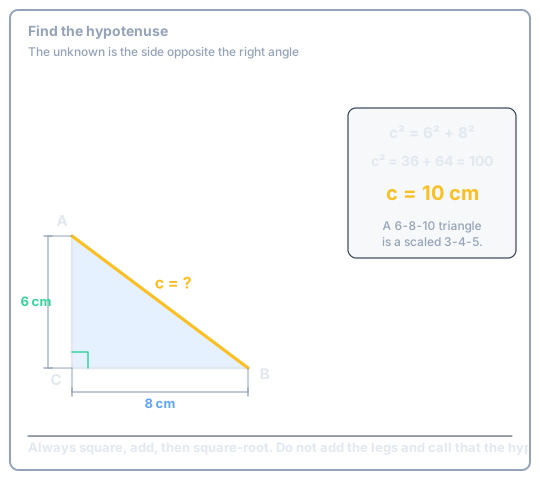
When the unknown is the hypotenuse you add the squares of the two legs, then square-root.
A right-angled triangle has legs \(6\,\text{cm}\) and \(8\,\text{cm}\). Find the hypotenuse.
Finding a shorter side
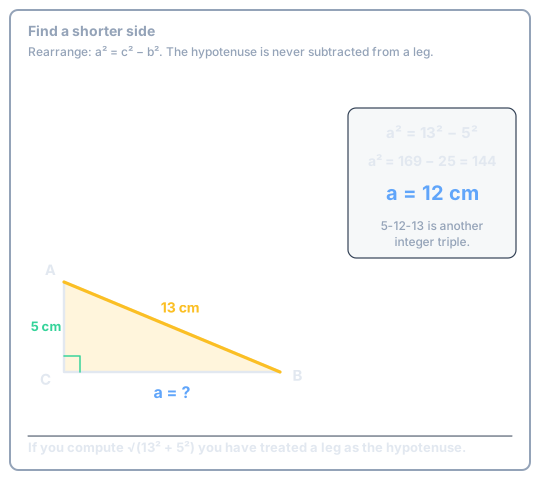
When the unknown is a leg, rearrange first: \(a^2 = c^2 - b^2\). You subtract the known leg from the hypotenuse — you never add a leg to the hypotenuse.
A right-angled triangle has hypotenuse \(13\,\text{cm}\) and one leg \(5\,\text{cm}\). Find the other leg.
Integer triples and isosceles
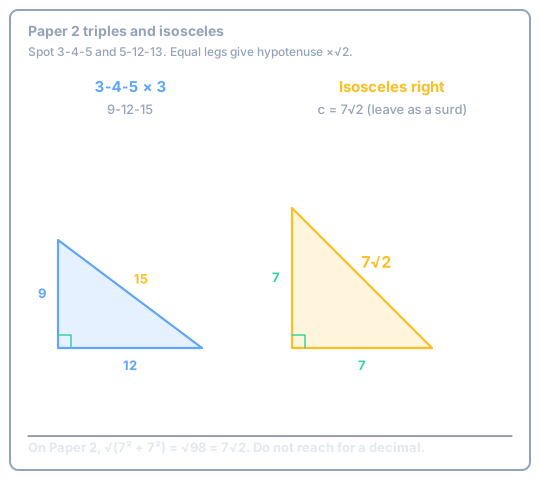
Learn the two triples that appear on Paper 2: \(3\)-\(4\)-\(5\) and \(5\)-\(12\)-\(13\), and their scalings (\(6\)-\(8\)-\(10\), \(9\)-\(12\)-\(15\), \(10\)-\(24\)-\(26\)).
If the two legs are equal, the hypotenuse is the leg times \(\sqrt{2}\). Leave the surd — do not decimalise it on Paper 2.
Paper 2 (non-calculator)
\(\sqrt{7^2 + 7^2} = \sqrt{98} = \sqrt{49 \times 2} = 7\sqrt{2}\). Writing \(9.9\) (or similar) from memory of \(\sqrt{2}\) is not exact and will lose the mark if exact form is required.
Try this
A rectangle is \(9\,\text{cm}\) by \(12\,\text{cm}\). Find the length of a diagonal.
Show answer
-
The diagonal is the hypotenuse of a \(9\)-\(12\) right triangle
\[ d^2 = 9^2 + 12^2 = 81 + 144 = 225 \] -
A scaled \(3\)-\(4\)-\(5\)
\[ d = 15\,\text{cm} \]
Exam Traps
- The hypotenuse is opposite the right angle. Squaring and adding all three given sides, or treating a labelled leg as \(c\), is the standard Pythagoras error.
- To find a leg, subtract: \(a^2 = c^2 - b^2\). Computing \(\sqrt{c^2 + b^2}\) makes the unknown longer than the hypotenuse, which is impossible.
0/10