Cambridge IGCSE Mathematics — 0580 Extended
Topic 6.2: Trigonometry — Right-angled Triangles
Label opposite, adjacent, hypotenuse
Sine, cosine and tangent compare two sides of a right-angled triangle. The labels Opposite, Adjacent and Hypotenuse are always taken from the acute angle you are using — not from the right angle.
\[ \sin\theta = \frac{\text{O}}{\text{H}} \qquad \cos\theta = \frac{\text{A}}{\text{H}} \qquad \tan\theta = \frac{\text{O}}{\text{A}} \]
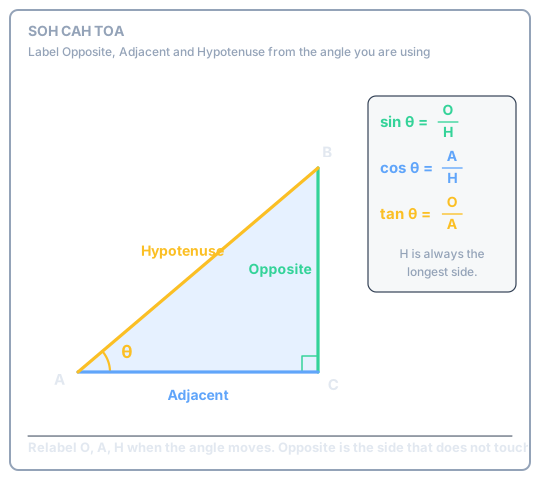
Method
- Circle the angle you are using and mark the right angle.
- Label O, A and H from that angle. Relabel if the question switches angle.
- Choose the ratio that uses the two sides you care about, then rearrange.
- Calculator in degree mode. Decimal answers to \(1\) d.p. unless the paper says otherwise.
Finding a side
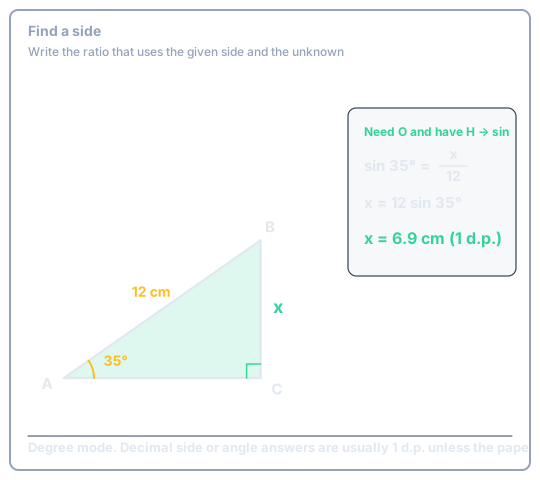
Write the ratio that contains the known side and the unknown. Rearrange so the unknown is the subject, then evaluate.
In a right-angled triangle the hypotenuse is \(12\,\text{cm}\) and one acute angle is \(35^\circ\). Find the side opposite \(35^\circ\).
Finding an angle
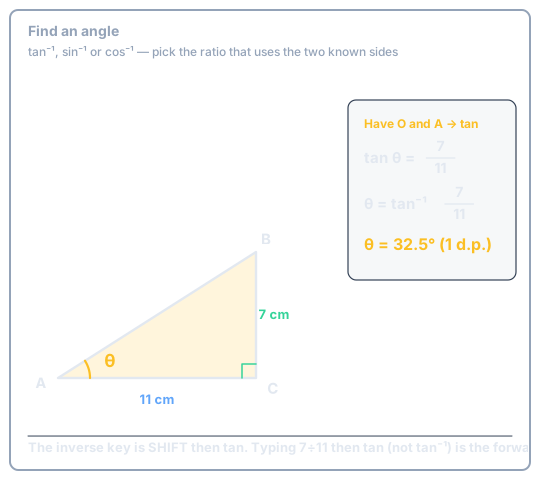
When two sides are known, form the matching ratio and take the inverse: \(\sin^{-1}\), \(\cos^{-1}\) or \(\tan^{-1}\).
The side opposite \(\theta\) is \(7\,\text{cm}\) and the side adjacent to \(\theta\) is \(11\,\text{cm}\). Find \(\theta\).
Angles of elevation and depression
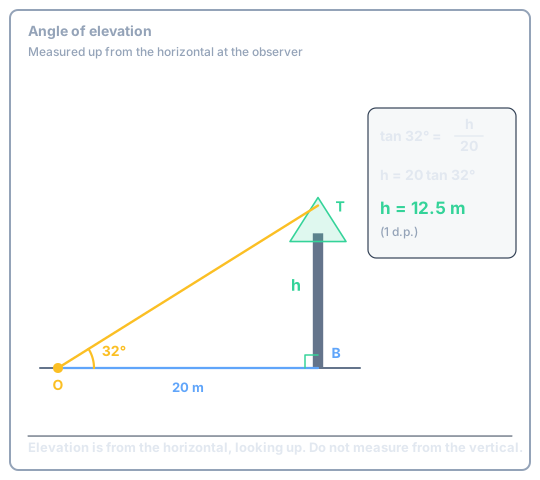
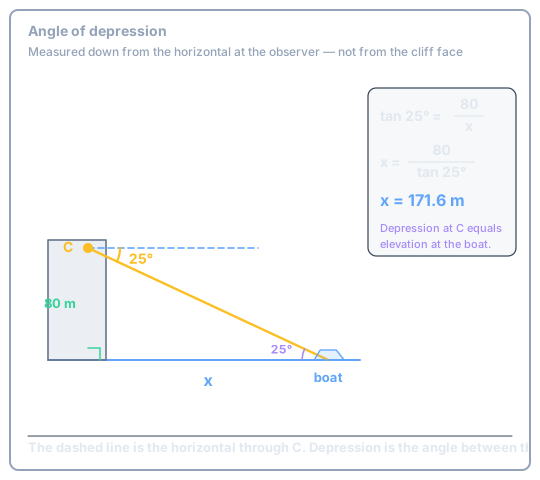
An angle of elevation is measured up from the horizontal at the observer. An angle of depression is measured down from the horizontal at the observer. Depression at one end of a sight-line equals elevation at the other (alternate angles with the two horizontals).
From a point \(20\,\text{m}\) from the base of a tree, the angle of elevation of the top is \(32^\circ\). Find the height of the tree.
From the top of an \(80\,\text{m}\) cliff the angle of depression of a boat is \(25^\circ\). Find the distance of the boat from the base of the cliff.
Bearings
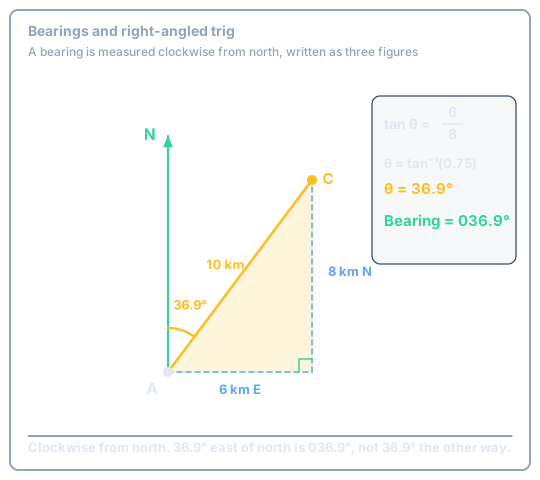
A bearing is an angle measured clockwise from north and written with three figures (\(036.9^\circ\), not \(36.9^\circ\)). Drop perpendiculars to make a right-angled triangle, then use \(\tan\) (or Pythagoras) as usual.
Point \(C\) is \(8\,\text{km}\) due north and \(6\,\text{km}\) due east of \(A\). Find the bearing of \(C\) from \(A\).
Shortest distance to a line
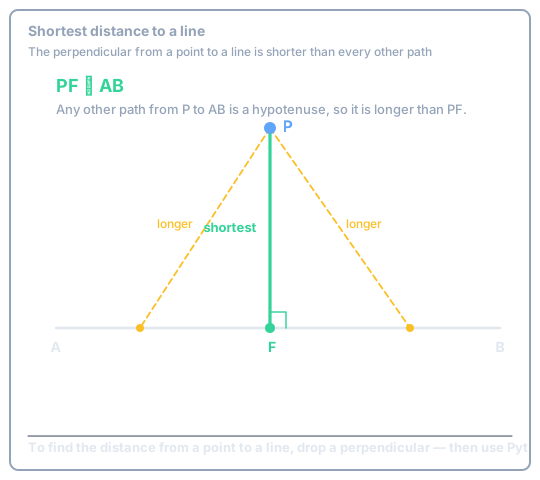
The perpendicular from a point to a line is the shortest distance. Any other path from the point to the line is the hypotenuse of a right-angled triangle, so it is longer. To find that distance, drop a perpendicular and then use Pythagoras or trigonometry.
Try this
A ladder of length \(10\,\text{m}\) leans against a vertical wall. The angle between the ladder and the ground is \(55^\circ\). How far is the foot of the ladder from the wall?
Show answer
-
The ground is adjacent to \(55^\circ\); the ladder is the hypotenuse
\[ \cos 55^\circ = \frac{x}{10} \] -
Degree mode, \(1\) d.p.
\[ x = 10\cos 55^\circ = 5.7\,\text{m} \]
Exam Traps
- Elevation and depression are measured from the horizontal, never from the vertical wall or cliff face. A dashed horizontal through the observer is worth drawing.
- If \(\sin 32^\circ\) comes out near \(0.53\) you are in degree mode; a result near \(0.55\) (or a huge number) usually means the calculator is in radians.
0/10