Cambridge IGCSE Mathematics — 0580 Extended
Topic 6.3: Trigonometry — Exact Trigonometric Values
The \(45^\circ\)-\(45^\circ\)-\(90^\circ\) triangle
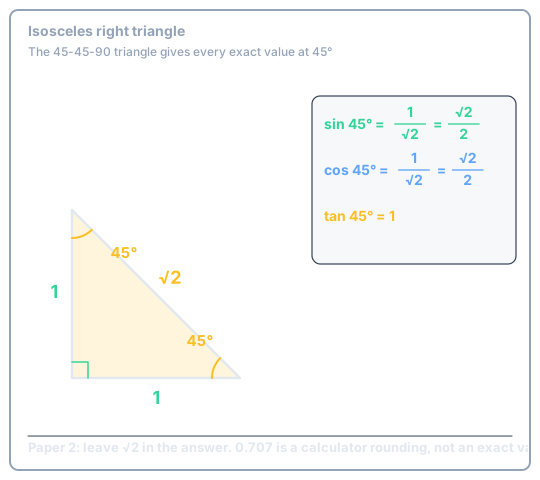
An isosceles right-angled triangle with equal legs \(1\) has hypotenuse \(\sqrt{2}\) by Pythagoras. Every exact value at \(45^\circ\) comes from this one diagram.
\[ \sin 45^\circ = \frac{1}{\sqrt{2}} = \frac{\sqrt{2}}{2} \qquad \cos 45^\circ = \frac{\sqrt{2}}{2} \qquad \tan 45^\circ = 1 \]
The \(30^\circ\)-\(60^\circ\)-\(90^\circ\) triangle
Cut an equilateral triangle of side \(2\) in half. The altitude is \(\sqrt{3}\) and half the base is \(1\). That is the \(30^\circ\)-\(60^\circ\)-\(90^\circ\) triangle with sides \(1\), \(\sqrt{3}\), \(2\).
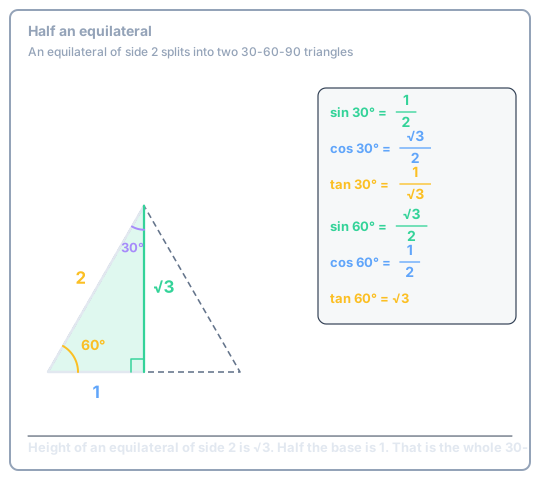
\[ \sin 30^\circ = \tfrac{1}{2} \qquad \cos 30^\circ = \tfrac{\sqrt{3}}{2} \qquad \tan 30^\circ = \tfrac{1}{\sqrt{3}} = \tfrac{\sqrt{3}}{3} \]
\[ \sin 60^\circ = \tfrac{\sqrt{3}}{2} \qquad \cos 60^\circ = \tfrac{1}{2} \qquad \tan 60^\circ = \sqrt{3} \]
Sine and cosine swap when you swap \(30^\circ\) and \(60^\circ\); tangent becomes its reciprocal.
The table to learn
You must know \(\sin x\) and \(\cos x\) at \(0^\circ\), \(30^\circ\), \(45^\circ\), \(60^\circ\) and \(90^\circ\), and \(\tan x\) at \(0^\circ\), \(30^\circ\), \(45^\circ\) and \(60^\circ\). \(\tan 90^\circ\) is undefined — it is not on the list.
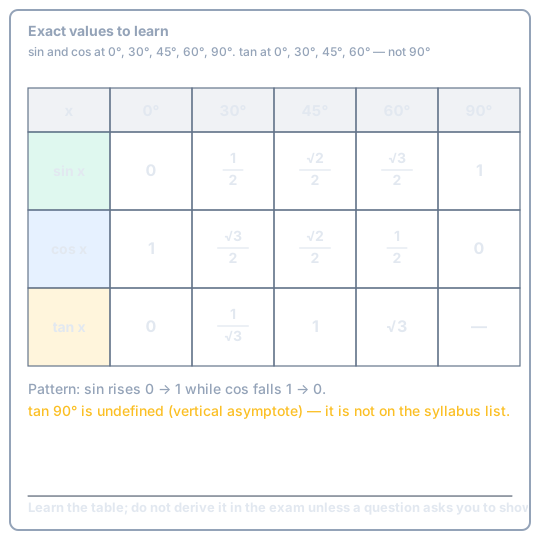
| \(x\) | \(0^\circ\) | \(30^\circ\) | \(45^\circ\) | \(60^\circ\) | \(90^\circ\) |
|---|---|---|---|---|---|
| \(\sin x\) | \(0\) | \(\tfrac{1}{2}\) | \(\tfrac{\sqrt{2}}{2}\) | \(\tfrac{\sqrt{3}}{2}\) | \(1\) |
| \(\cos x\) | \(1\) | \(\tfrac{\sqrt{3}}{2}\) | \(\tfrac{\sqrt{2}}{2}\) | \(\tfrac{1}{2}\) | \(0\) |
| \(\tan x\) | \(0\) | \(\tfrac{1}{\sqrt{3}}\) | \(1\) | \(\sqrt{3}\) | undefined |
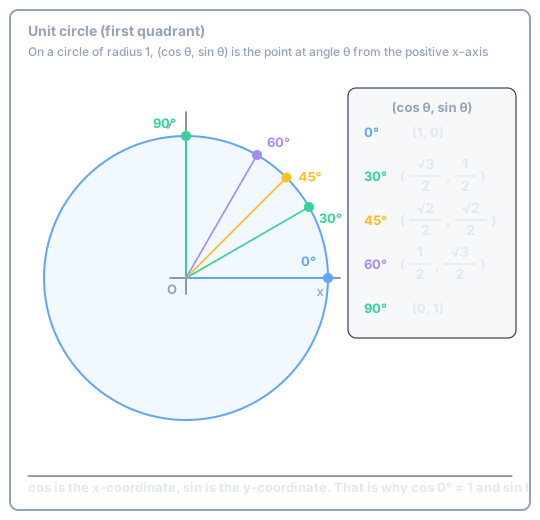
Unit circle (first quadrant)
On a circle of radius \(1\), the point at angle \(\theta\) from the positive \(x\)-axis is \((\cos\theta,\;\sin\theta)\). That is why \(\cos 0^\circ = 1\) and \(\sin 90^\circ = 1\).
Paper 2 (non-calculator)
Leave answers as surds or fractions. \(\sin 45^\circ = 0.707\) is a calculator rounding, not an exact value. The same applies to \(\frac{\sqrt{3}}{2} \approx 0.866\).
Try this
Without a calculator, find the exact value of \(2\sin 30^\circ + \tan 45^\circ\).
Show answer
-
Substitute the exact values
\[ 2\left(\tfrac{1}{2}\right) + 1 = 1 + 1 \] -
Simplify
\[ = 2 \]
0/10